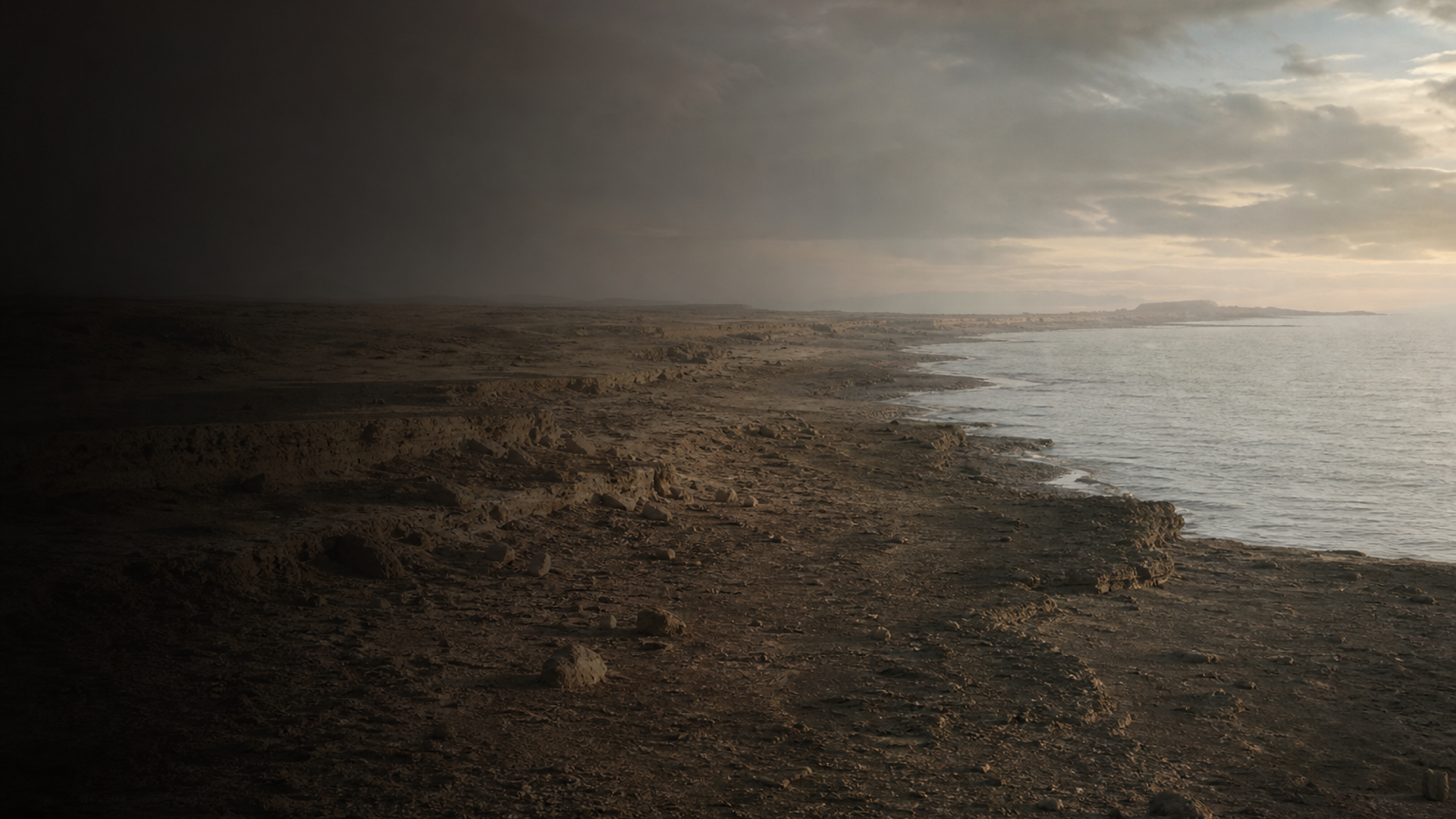
Tylos Shoreline, Abu Saiba

下载的 PDF 是图像副本。如需可选中文本及更好的辅助技术支持,请使用打印功能。

Tylos Shoreline, Abu Saiba

揭开一个失落的文明

正在加载考古记录……

正在收集古代记录

跳转到主内容
Tylos Shoreline, Abu Saiba
文明焦点

Tylos Shoreline, Abu Saiba

A single genome from Bahrain illuminates Hellenistic–Mesopotamian maritime ties

200 BCE - 300 CE
Bahrain (Abu Saiba, Northern Governorate)
滚动开始
Chapter I

剧情

了解 Tylos Shoreline, Abu Saiba 文化

Archaeological and genetic evidence from Abu Saiba (Bahrain) links the Early Tylos (Seleucid–Characene) era to wider Persian Gulf trade networks. A lone mtDNA J sample suggests Near Eastern maternal ancestry, but conclusions are preliminary (n=1).

Time Period

200 BCE - 300 CE

Region

Bahrain (Abu Saiba, Northern Governorate)

Common Y-DNA

Not reported (sample size 1)

Common mtDNA

J (1 sample)

Chapter II

时间线

这种文化历史上的关键时刻

200 BCE

Onset of Seleucid–Characene influence

Material culture at Abu Saiba dates to the Early Tylos period, aligning with Hellenistic and Mesopotamian regional interactions.

100 BCE

Intensified Gulf trade

Archaeological indicators across the Gulf suggest rising maritime commerce connecting Bahrain with Mesopotamia and the wider Mediterranean.

300 CE

Transitional late antiquity phase

By the third century CE regional political and economic shifts reshape Gulf networks; local traditions persist amid changing ties.

Chapter III

Origins & Emergence

The Early Tylos period in Bahrain (commonly framed by scholars as the Seleucid–Characene interval) is a time when the island landscape of the Persian Gulf was woven into long-distance networks. Abu Saiba, in the Northern Governorate of Bahrain, yields material traces dated to roughly 200 BCE–300 CE that archaeologists interpret as part of a marine-oriented, outward-looking society. Archaeological data indicates imports and stylistic influences consistent with contacts across the Gulf and into the eastern Mediterranean — a pattern compatible with historical records naming Bahrain as Tylos in Greek sources.

Limited evidence suggests that political influence in the region oscillated between Hellenistic-era polities and emergent Mesopotamian states such as Characene; local elites appear to have capitalized on seafaring commerce. The picture from Abu Saiba is fragmentary: excavated contexts are modest and stratigraphic sequences can be complex, so any reconstruction of origins must be cautious. Radiocarbon and associated finds place the primary occupational window within the provided date range, but finer chronological resolution awaits further excavation and multidisciplinary dating.

  • Local emergence during the Seleucid–Characene interval (200 BCE–300 CE)
  • Archaeological indicators of long-distance trade and maritime exchange
  • Interpretations are provisional given limited site data
Chapter IV

Daily Life & Society

Life in Tylos-era Abu Saiba can be imagined as a choreography between land and sea: fishermen, sailors, craftsmen, and merchants moving along tidal creeks and across open water. Archaeological contexts from Tylos sites in the Gulf point to economies built on fishing, shell-working (including pearls in later historical periods), and the export of local products in exchange for ceramics, metalwork, and other imported goods. Domestic architecture in comparable sites often shows simple, functional structures adapted to a coastal environment.

Social life likely revolved around porto-commercial hubs rather than large urban cores; elites may have mediated exchange with visiting traders. Funerary evidence from the Tylos horizon elsewhere in the region reveals varying burial treatments, suggesting social differentiation, but at Abu Saiba the mortuary record is sparse. Material culture — pottery fragments, beads, and metal objects found in regional surveys — paints a picture of cultural blending: local traditions articulated alongside foreign forms and technologies. Yet archaeological interpretation must remain tentative: Abu Saiba provides a concise snapshot rather than a comprehensive portrait.

  • Economy oriented to the sea: fishing, craft, and exchange
  • Evidence suggests social stratification but site data remain limited
Chapter V

Genetic Profile

The genetic record for Abu Saiba in this dataset is extremely limited: a single ancient individual dated to the Tylos period yielded mitochondrial haplogroup J. Haplogroup J is broadly distributed across the Near East, the Levant, Anatolia and parts of the Mediterranean and is frequently interpreted as a maternal lineage with deep regional roots. The presence of mtDNA J at Abu Saiba suggests maternal connections to wider Near Eastern gene pools, consistent with Bahrain's position as a crossroads of maritime exchange.

Crucially, no Y-chromosome data are reported for this individual, and autosomal results (if any) are not part of this summary. With sample count = 1, any population-level inference would be premature. Single-sample findings can reflect individual mobility, marriage networks, or the ancestry of one maternal line rather than the genetic makeup of the broader community. Archaeogenetic interpretation therefore emphasizes possibilities rather than certainties: the mtDNA J signal supports hypotheses of Near Eastern maternal input during the Seleucid–Characene era, but broader sampling across multiple burials and sites is required to test whether this pattern is typical, exceptional, or part of a mosaic of ancestries in ancient Bahrain.

  • mtDNA J detected — suggests Near Eastern maternal ancestry
  • Absence of Y-DNA and n=1 mean conclusions are preliminary
Chapter VI

Legacy & Modern Connections

The cultural and genetic legacies of Tylos-era Bahrain are woven into the island's long history of exchange. Archaeological continuities in settlement loci and maritime practices, coupled with historical accounts, hint at durable connections between ancient residents and later coastal communities. From a genetic perspective, a single mtDNA J lineage at Abu Saiba aligns with the broader pattern of Near Eastern maternal haplogroups persisting in the region, but it does not by itself demonstrate direct continuity to modern Bahraini populations.

Understanding legacy requires more data: expanded ancient DNA sampling, comparative analyses with contemporaneous sites across the Persian Gulf and Mesopotamia, and integration with archaeological finds. When combined, those lines of evidence can reveal how trade, migration, and local resilience shaped the genetic mosaic of the Gulf through late antiquity and into the modern era.

  • Archaeology and genetics hint at Near Eastern links but are not conclusive
  • Broader sampling needed to trace direct connections to modern populations
AI 电源

AI 助手

就 Tylos Shoreline, Abu Saiba 文化提问

AI 助手 由DNAGENICS公司制作

解锁此特性
Ask questions about the Tylos Shoreline, Abu Saiba culture. Our AI assistant can explain genetic findings, historical context, archaeological evidence, and modern connections.
AI 样本分析

Tylos Shoreline, Abu Saiba 文化是人类历史中值得了解的一章……

遗传分析揭示了与早期种群的联系,同时显示了独特的适应和文化创新的证据。 古代DNA样本提供了对迁徙模式、社会结构以及古代种群之间的生物关系的深刻见解。

这是人工智能分析的预览。 解锁全AI 助手, 以探索关于:

  • 遗传组成和祖先
  • 移徙模式和起源
  • 日常生活和文化习俗
  • 现代遗传遗产

探索更古老的文化

揭开古代世界文明的故事

使用优惠码 可减免 35% • 11月12日 到期