Menu
Store
Blog
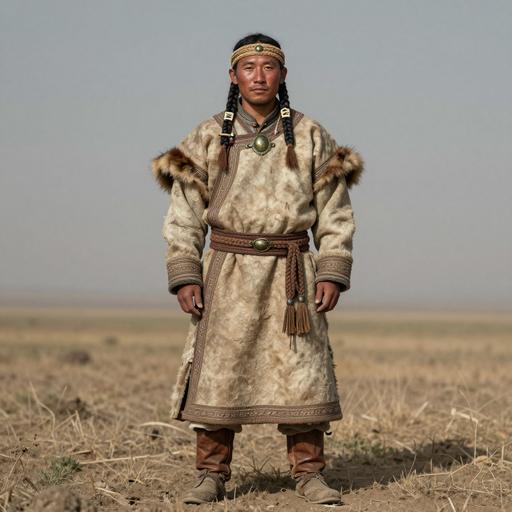
Portrait reconstruction of I12973
Ancient Individual

A man buried in Mongolia in the Middle Late Bronze Age era

I12973
1388 BCE - 1133 BCE
Male
Bronze Age 1 Mongolia
Mongolia
Scroll to begin
Chapter I

Identity

The biological and cultural markers that define this ancient individual

Sample ID

I12973

Date Range

1388 BCE - 1133 BCE

Biological Sex

Male

mtDNA Haplogroup

D4j

Y-DNA Haplogroup

Q1b1a3-L334

Cultural Period

Bronze Age 1 Mongolia

Chapter II

Place

Where this individual was discovered

Country Mongolia
Locality Bulgan. Khutag undur sum. Marzyn Khutul tomb 1
Chapter III

Time

When this individual lived in the broader context of human history

I12973 1388 BCE - 1133 BCE
Chapter IV

Story

The narrative of this ancient life

The Bronze Age in Mongolia, particularly the period denoted as Bronze Age 1, is an era that marks significant developments in the lifestyles, technologies, and cultural practices of the nomadic steppe cultures. This period, roughly spanning from 2200 to 1500 BCE, is critical in understanding the transformation of societies in the Eurasian steppes, an area that covers vast plains and plateaus known for its harsh climate and arid conditions.

Geographic and Environmental Context

Bronze Age 1 Mongolia was predominantly influenced by its geography, occupying a pivotal area within the great steppes of Central Asia. This landscape, characterized by its expansive grasslands, rugged mountains, and desert regions like the Gobi, presented both opportunities and challenges. The climate, marked by cold winters and moderate summers, shaped the nomadic lifestyles that these cultures developed.

Social Structure and Nomadism

The societies of Bronze Age Mongolia were primarily nomadic, driven by the need to move seasonally in search of pastures for their herds. This nomadic pastoralism became a cornerstone of their livelihood, with sheep, goats, cattle, and horses playing vital roles. The social structure was typically clan-based, with extended families living together in portable dwellings such as yurts (ger), which allowed them to efficiently move across the landscape.

Leadership within these clans likely revolved around a form of tribal organization, where chiefs or elders, chosen for their wisdom and valor, played critical roles in decision-making and mediating disputes. Kinship ties were essential, fostering networks of alliances and facilitating trade and communication across vast distances.

Technological and Material Culture

The transition to the Bronze Age brought about remarkable changes in technology. The introduction of metallurgy, specifically bronze, marked a significant leap forward. This era witnessed the crafting of bronze tools, weapons, and ornaments, a practice that likely emerged from a synthesis of local innovation and external influences via trade and intercultural exchanges with neighboring regions in China and Siberia.

The enhancement of horse domestication during this time also transformed these societies. Horses provided greater mobility, significantly impacting the military and economic capabilities of the nomads, and facilitating long-distance trade. They became central to nomadic culture, symbolizing status and power.

Economy and Trade

While pastoralism was the bedrock of their economy, trade routes that crisscrossed Mongolia during the Bronze Age facilitated exchanges with distant cultures. These trade networks were crucial in the diffusion of metallurgical knowledge, goods, and ideas between East and West. Mongolian societies, in turn, exported essential commodities such as livestock, hides, and possibly bronze artifacts.

Spiritual Beliefs and Practices

The spiritual and religious beliefs of Bronze Age Mongolian cultures are less documented, but archaeological evidence hints at a rich tapestry of spiritual practices. Burial mounds, known as khirigsuurs, have been found across Mongolia, indicating complex funerary rites and a belief in an afterlife. These structures often contain human remains, animal bones, and artifacts, suggesting ritualistic animal sacrifices and ancestor worship.

Petroglyphs and stone monuments, often depicting animals, humans, and chariots, offer further insights into the symbolic and ritualistic world of these cultures. The reverence for certain animals, especially the horse and deer, perhaps reflected shamanistic or animistic practices, where the spirits of animals played integral roles in spiritual beliefs.

Art and Communication

Art and symbolic communication during this era were largely expressed through petroglyphs and carving on stones and metal artifacts. Stylized representations of humans and animals are prevalent, possibly serving as both decorative art and communicative symbols that conveyed social and spiritual narratives.

Conclusion

The Bronze Age 1 period in Mongolia is emblematic of a critical evolutionary stage in nomadic culture. It is characterized by the enhanced mobility brought forth by horse domestication, the adoption of metallurgy, and the complex interplay of local practices with broader Eurasian cultural currents. This era laid much of the groundwork for the subsequent developments that would lead to the rise of more complex social structures and influential nomadic empires in the later Iron Age and early historical periods.

Chapter V

Genetics

The genetic ancestry of this ancient individual

Ancient Genetic Admixture

This analysis compares the DNA profile of I12973 with ancient reference populations, showing the genetic composition in terms of prehistoric ancestral groups.

Ancient Asians 84.2%
Western Steppe Pastoralists 12.2%
Ancient Native Americans 3.6%

Modern Genetic Admixture

This analysis compares the DNA profile with present-day reference populations, showing what percentage of genetic makeup resembles modern populations from different regions.

Asia 90.9%
Northern Asian 60.8%
Siberian 40.1%
Mongolian 20.7%
Central Asian, Northern Indian & Pakistani 18.9%
Central Asian 18.9%
Japanese & Korean 6.7%
Japanese 6.7%
Chinese & Southeast Asian 4.5%
Tibetan 4.5%
America 8.6%
America 8.6%
Native American 8.6%

Closest Modern Populations

These are the modern populations showing the closest statistical alignment to A man buried in Mongolia in the Middle Late Bronze Age era, ranked by genetic distance. Lower distance values indicate closer statistical similarity.

1
Khakass Kachins
6.3191
2
Teleut O
7.1513
3
Khakass
7.2397
4
Altaian
7.2555
5
Altaian Kizhi
7.4459
6
Teleut
7.5386
7
Mogush
8.1899
8
Buryat O
8.6365
9
Kirghiz
8.8223
10
Kazakh China
8.8863
Chapter VI

Context

Other ancient individuals connected to this sample

Sources

References

Scientific publications and genetic data

Scientific Publication

Genomic insights into the formation of human populations in East Asia

Authors Wang CC, Yeh HY, Popov AN
Abstract

The deep population history of East Asia remains poorly understood owing to a lack of ancient DNA data and sparse sampling of present-day people1,2. Here we report genome-wide data from 166 East Asian individuals dating to between 6000 BC and AD 1000 and 46 present-day groups. Hunter-gatherers from Japan, the Amur River Basin, and people of Neolithic and Iron Age Taiwan and the Tibetan Plateau are linked by a deeply splitting lineage that probably reflects a coastal migration during the Late Pleistocene epoch. We also follow expansions during the subsequent Holocene epoch from four regions. First, hunter-gatherers from Mongolia and the Amur River Basin have ancestry shared by individuals who speak Mongolic and Tungusic languages, but do not carry ancestry characteristic of farmers from the West Liao River region (around 3000 BC), which contradicts theories that the expansion of these farmers spread the Mongolic and Tungusic proto-languages. Second, farmers from the Yellow River Basin (around 3000 BC) probably spread Sino-Tibetan languages, as their ancestry dispersed both to Tibet-where it forms approximately 84% of the gene pool in some groups-and to the Central Plain, where it has contributed around 59-84% to modern Han Chinese groups. Third, people from Taiwan from around 1300 BC to AD 800 derived approximately 75% of their ancestry from a lineage that is widespread in modern individuals who speak Austronesian, Tai-Kadai and Austroasiatic languages, and that we hypothesize derives from farmers of the Yangtze River Valley. Ancient people from Taiwan also derived about 25% of their ancestry from a northern lineage that is related to, but different from, farmers of the Yellow River Basin, which suggests an additional north-to-south expansion. Fourth, ancestry from Yamnaya Steppe pastoralists arrived in western Mongolia after around 3000 BC but was displaced by previously established lineages even while it persisted in western China, as would be expected if this ancestry was associated with the spread of proto-Tocharian Indo-European languages. Two later gene flows affected western Mongolia: migrants after around 2000 BC with Yamnaya and European farmer ancestry, and episodic influences of later groups with ancestry from Turan.

G25 Coordinates

The G25 coordinates for sample I12973 can be used for detailed admixture analysis in our G25 Studio tool.

I12973,0.05948976,-0.28072988,0.07926864,0.01951504,-0.0647062,-0.02592392,0.00145592,0.00672976,0.0095892,0.00132294,0.01778232,-0.00351212,0.0056388,-0.02123916,-0.01590592,-0.01318058,-0.00590976,0.006663,0.01452474,0.00697406,0.01051522,-0.00968928,0.01163518,0.00416876,0.00723622
Analyze in G25 Studio
Use code for 40% off Expires Feb 27