Menu
Store
Blog
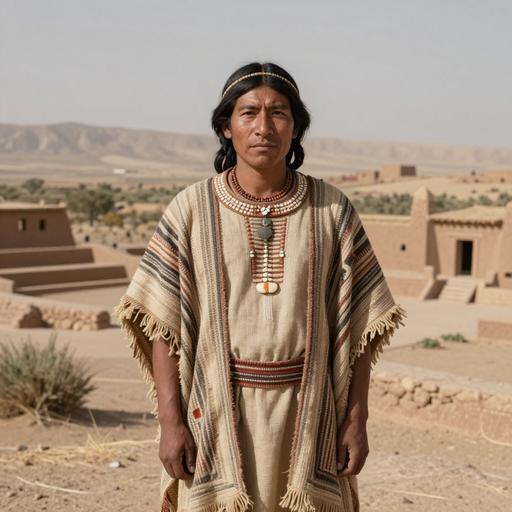
Portrait reconstruction of I2558
Ancient Individual

A man buried in Peru in the Pre-Columbian South America era

I2558
585 CE - 675 CE
Male
Early Intermediate Period Ullujaya, Peru 1,350 Years Ago
Peru
Scroll to begin
Chapter I

Identity

The biological and cultural markers that define this ancient individual

Sample ID

I2558

Date Range

585 CE - 675 CE

Biological Sex

Male

mtDNA Haplogroup

B2

Y-DNA Haplogroup

Q-B48

Cultural Period

Early Intermediate Period Ullujaya, Peru 1,350 Years Ago

Chapter II

Place

Where this individual was discovered

Country Peru
Locality Ica Valley
Chapter III

Time

When this individual lived in the broader context of human history

I2558 585 CE - 675 CE
Chapter IV

Story

The narrative of this ancient life

The Early Intermediate Period (EIP) in the Andean region, which occurred approximately 1,350 years ago (around 650 AD), was a dynamic phase in pre-Columbian history. This period was marked by significant social, political, and cultural developments across various Andean civilizations. The Ullujaya culture, located in the southern coastal and highland regions of what is now Peru, played a vital role during this time.

Geographic Setting

The Ullujaya culture was situated in the arid coastal plains and the Andean highlands of Peru. This region is characterized by diverse landscapes, including fertile valleys, desert coastlines, and rugged mountain ranges. The Ullujaya people harnessed these geographical features to support agricultural and trade activities, which were vital for their sustenance and economic expansion.

Social and Political Structure

During the EIP, Andean societies experienced significant social stratification and political centralization. The Ullujaya culture, like many of its contemporaries, would have had a hierarchical social organization, with an elite class likely consisting of religious and political leaders. These leaders wielded power over the community, mediating between the people and the gods, and were responsible for coordinating large-scale agricultural and construction projects.

Political organization was likely based on a chiefdom model, with control over smaller villages and hamlets. The Ullujaya elites probably managed alliances and conflicts with neighboring groups, ensuring the stability and growth of their culture.

Economy and Trade

The economy of the Ullujaya was largely agrarian, with agriculture forming the backbone of their subsistence strategies. They cultivated crops like maize, beans, squash, and cotton, adapting to the region’s varied environments through sophisticated irrigation practices. The Ullujaya also engaged in animal husbandry, raising llamas and alpacas, which were important for both transportation and textile production.

Trade played a crucial role in Ullujaya society. Located strategically near coastal and highland routes, the Ullujaya engaged in exchange with other Andean cultures, such as the Nazca and the Wari. They traded goods like textiles, ceramics, and metal artifacts, helping to disseminate a shared material culture throughout the region.

Art and Architecture

The Ullujaya culture is known for its distinctive artistic expression, which includes ceramics, textiles, and metalwork. Ullujaya pottery often features intricate geometric patterns and is typically characterized by its fine quality and decorative motifs, which may have had religious or ceremonial significance.

Textiles were another prominent form of artistic expression, where the Ullujaya showcased their skills in weaving with vibrant colors and complex designs. Clothing and textiles not only served practical purposes but also denoted social status and identity.

Architecturally, the Ullujaya constructed monumental structures that served as ceremonial centers, administrative hubs, and burial sites. They utilized locally available materials, such as adobe, stones, and wood, to build these structures, which often featured plazas, terraces, and pyramidal platforms.

Religion and Beliefs

Religion played a central role in the Ullujaya culture, influencing nearly every aspect of their daily life. Their belief system likely incorporated animistic and shamanistic elements, emphasizing the sacred nature of both natural elements and celestial bodies. Rituals and ceremonies would have been conducted to appease deities, ensure agricultural fertility, and maintain cosmic balance.

Significant effort was put into the construction of ceremonial centers, which served as focal points for religious activities. These centers would have hosted rites of passage, seasonal festivals, and ancestor worship, underscoring the importance of spiritual connectivity in Ullujaya life.

Legacy

The Ullujaya culture, like many EIP societies, laid the groundwork for subsequent developments in Andean civilization. Their advancements in agriculture, trade, and social organization influenced later cultures, contributing to the region’s rich historical tapestry. Understanding the Ullujaya’s contributions provides insight into the complexities and innovations of pre-Columbian Andean societies, preserving their legacy within the broader narrative of human history.

Chapter V

Genetics

The genetic ancestry of this ancient individual

Ancient Genetic Admixture

This analysis compares the DNA profile of I2558 with ancient reference populations, showing the genetic composition in terms of prehistoric ancestral groups.

Ancient Native Americans 81.8%
Ancient Asians 18.2%

Modern Genetic Admixture

This analysis compares the DNA profile with present-day reference populations, showing what percentage of genetic makeup resembles modern populations from different regions.

America 93.5%
America 93.5%
Native American 93.5%
Asia 6.3%
Chinese & Southeast Asian 4.1%
Chinese 4.1%
Central Asian, Northern Indian & Pakistani 1.1%
Indian 1.1%
Northern Asian 0.8%
Mongolian 0.8%

Closest Modern Populations

These are the modern populations showing the closest statistical alignment to A man buried in Peru in the Pre-Columbian South America era, ranked by genetic distance. Lower distance values indicate closer statistical similarity.

1
Piapoco
1.7648
2
Wichi
1.9848
3
Aymara
2.2839
4
Yukpa
2.3839
5
Karitiana
2.7121
6
Bolivian Lapaz
3.5260
7
Surui
3.7651
8
Colla
3.9646
9
Cachi
4.6243
10
Mixe
4.9940
Chapter VI

Context

Other ancient individuals connected to this sample

Sources

References

Scientific publications and genetic data

Scientific Publication

A Paleogenomic Reconstruction of the Deep Population History of the Andes

Authors Nakatsuka N, Lazaridis I, Barbieri C
Abstract

There are many unanswered questions about the population history of the Central and South Central Andes, particularly regarding the impact of large-scale societies, such as the Moche, Wari, Tiwanaku, and Inca. We assembled genome-wide data on 89 individuals dating from ∼9,000-500 years ago (BP), with a particular focus on the period of the rise and fall of state societies. Today's genetic structure began to develop by 5,800 BP, followed by bi-directional gene flow between the North and South Highlands, and between the Highlands and Coast. We detect minimal admixture among neighboring groups between ∼2,000-500 BP, although we do detect cosmopolitanism (people of diverse ancestries living side-by-side) in the heartlands of the Tiwanaku and Inca polities. We also highlight cases of long-range mobility connecting the Andes to Argentina and the Northwest Andes to the Amazon Basin. VIDEO ABSTRACT.

G25 Coordinates

The G25 coordinates for sample I2558 can be used for detailed admixture analysis in our G25 Studio tool.

I2558,0.0567512,-0.31640334,0.1120011,0.10204278,-0.1158898,-0.00992062,-0.30959492,-0.3640786,-0.0157887,-0.0175249,0.00089068,-0.00093694,-0.00125362,0.02588676,-0.00567034,-0.00047998,0.00635824,0.002931,0.00042902,-0.00186606,-0.00118062,0.00828016,-0.00255806,-0.0054902,-0.00613141
Analyze in G25 Studio
Use code for 40% off Expires Feb 27