Menu
Store
Blog
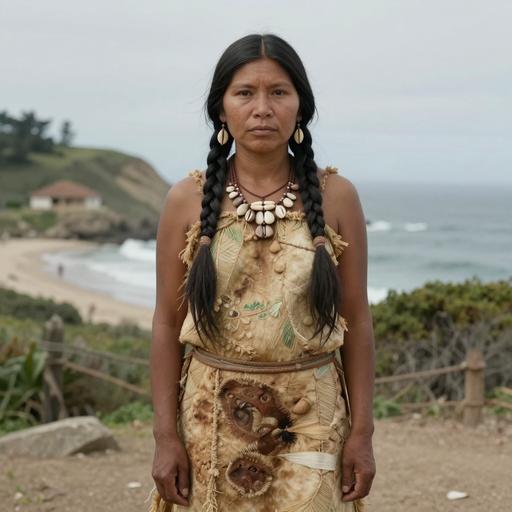
Portrait reconstruction of I2709
Ancient Individual

A woman buried in USA in the Native American era

I2709
3621 BCE - 3366 BCE
Female
Santa Rosa Island Native American Culture
USA
Scroll to begin
Chapter I

Identity

The biological and cultural markers that define this ancient individual

Sample ID

I2709

Date Range

3621 BCE - 3366 BCE

Biological Sex

Female

mtDNA Haplogroup

R

Cultural Period

Santa Rosa Island Native American Culture

Chapter II

Place

Where this individual was discovered

Country USA
Locality CA-SRI-3 (California, Santa Rosa Island, Tecolote Point)
Chapter III

Time

When this individual lived in the broader context of human history

I2709 3621 BCE - 3366 BCE
Chapter IV

Story

The narrative of this ancient life

Santa Rosa Island, part of California's Channel Islands, is known for its rich history and the cultural significance of the Native American inhabitants, particularly the Chumash people. The Chumash are an indigenous people who have lived along the central and southern coastal regions of California and the Northern Channel Islands. Their presence on Santa Rosa Island and the surrounding Channel Islands dates back thousands of years, and their culture is characterized by a deep connection to the land, sea, and natural resources of the area.

Historical Context and Geography

Santa Rosa Island is the second largest of the Channel Islands, with diverse landscapes that include rolling hills, coastal terraces, and sandy beaches. This geographic variety provided the Chumash with a wealth of resources, allowing them to establish a complex and enduring culture. Archaeological evidence suggests that the Chumash arrived on the Channel Islands more than 13,000 years ago, making them one of the earliest known coastal populations in North America.

Social Structure and Settlements

The Chumash society was organized into complex chiefdoms, which were centralized in large villages along the mainland coast and on the islands. Each chiefdom was led by a chief, or \wot," who held significant political and spiritual power. On Santa Rosa Island, the Chumash established several villages, although due to the transient nature of island life, these settlements were relatively small compared to those on the mainland.

The social structure of the Chumash included a stratified class system, with roles ranging from chiefs and shamans to hunters, gatherers, and craftsmen. Shamans held important roles, acting as spiritual leaders and healers. The Chumash culture was rich with ceremonies and rituals, often conducted to honor natural cycles, secure successful hunts, or ensure communal harmony.

Economic Life and Resources

The Chumash economy was primarily based on the abundant marine resources surrounding Santa Rosa Island. They were skilled fishermen and seafarers, utilizing canoes known as "tomols" for fishing, trade, and communication between islands. The tomol, a plank-built boat, was a significant achievement in maritime technology and highlighted the Chumash's advanced woodworking skills.

The island's waters provided fish, shellfish, and marine mammals, while the terrestrial environment offered game, seeds, plants, and nuts. The Chumash were adept at harvesting these resources sustainably, and their diet was supplemented by traded goods brought in from other islands and the mainland.

Material Culture

The material culture of the Chumash was sophisticated and specialized. They were known for their craftsmanship, producing intricately woven baskets, tools made from stone and bone, and shell bead currency, which was highly valued and widely used in trade networks across the region. The Chumash are especially noted for their rock art, including petroglyphs and pictographs, found in caves and on rock faces throughout the Channel Islands and mainland.

Spiritual Beliefs and Art

The Chumash cosmology was deeply tied to the natural world. Their spiritual beliefs included a pantheon of deities associated with elements of nature, such as the sun, moon, Earth, and ocean. Chumash mythology often highlighted moral lessons and explanations for natural phenomena, preserving cultural values and community norms.

Artistic expression played a crucial role in Chumash spiritual life. Their rock art, characterized by geometric patterns, animal motifs, and anthropomorphic figures, is believed to have religious and ceremonial significance, potentially used during rituals or as part of storytelling traditions.

European Contact and Impact

The arrival of European explorers, notably the Spanish in the 16th century, marked a significant turning point for the Chumash culture. Spanish colonization efforts, including the establishment of missions, dramatically altered their way of life. Many Chumash were forcibly relocated to missions, which disrupted traditional social structures, practices, and their relationship with the land.

Despite these challenges, Chumash descendants continue to preserve and revitalize their culture, language, and traditions. Modern Chumash communities actively engage in cultural preservation, public education, and political advocacy to reclaim and celebrate their heritage.

In summary, the Santa Rosa Island Native American Culture of the Chumash reflects a rich tapestry of social complexity, technological innovation, and spiritual depth. The Chumash's ability to adapt to and thrive in their environment for thousands of years stands as a testament to their resilience and ingenuity. Their legacy continues to influence the cultural landscape of California today."

Chapter V

Context

Other ancient individuals connected to this sample

Sources

References

Scientific publications and genetic data

Scientific Publication

Genetic continuity and change among the Indigenous peoples of California

Authors Nakatsuka N, Holguin B, Sedig J
Abstract

Before the colonial period, California harboured more language variation than all of Europe, and linguistic and archaeological analyses have led to many hypotheses to explain this diversity1. We report genome-wide data from 79 ancient individuals from California and 40 ancient individuals from Northern Mexico dating to 7,400-200 years before present (BP). Our analyses document long-term genetic continuity between people living on the Northern Channel Islands of California and the adjacent Santa Barbara mainland coast from 7,400 years BP to modern Chumash groups represented by individuals who lived around 200 years BP. The distinctive genetic lineages that characterize present-day and ancient people from Northwest Mexico increased in frequency in Southern and Central California by 5,200 years BP, providing evidence for northward migrations that are candidates for spreading Uto-Aztecan languages before the dispersal of maize agriculture from Mexico2-4. Individuals from Baja California share more alleles with the earliest individual from Central California in the dataset than with later individuals from Central California, potentially reflecting an earlier linguistic substrate, whose impact on local ancestry was diluted by later migrations from inland regions1,5. After 1,600 years BP, ancient individuals from the Channel Islands lived in communities with effective sizes similar to those in pre-agricultural Caribbean and Patagonia, and smaller than those on the California mainland and in sampled regions of Mexico.

Use code for 40% off Expires Feb 27