Menu
Store
Blog
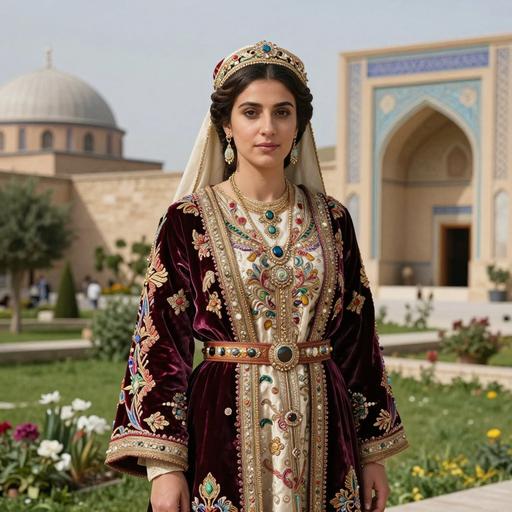
Portrait reconstruction of MA2195
Ancient Individual

A woman buried in Turkey in the Middle Ages era

MA2195
1400 CE - 1600 CE
Female
Ottoman Turkey
Turkey
Scroll to begin
Chapter I

Identity

The biological and cultural markers that define this ancient individual

Sample ID

MA2195

Date Range

1400 CE - 1600 CE

Biological Sex

Female

mtDNA Haplogroup

C4a1a4a

Cultural Period

Ottoman Turkey

Chapter II

Place

Where this individual was discovered

Country Turkey
Locality Kalehöyük
Coordinates 39.3458, 33.7881
Chapter III

Time

When this individual lived in the broader context of human history

MA2195 1400 CE - 1600 CE
Chapter IV

Story

The narrative of this ancient life

The Ottoman Empire, which spanned from 1299 to 1922, is often considered a successor to the Islamic Golden Age rather than a part of it. The Islamic Golden Age typically refers to the flourishing of science, culture, and knowledge under various Islamic caliphates, particularly during the Abbasid Caliphate between the 8th and 13th centuries. However, when we speak of Ottoman Turkey in the context of a historical and cultural peak, we usually refer to periods such as the reign of Sultan Suleiman the Magnificent (1520–1566).

Historical Context

The Ottoman Empire originated in the late 13th century under the leadership of Osman I in northwestern Anatolia. It quickly expanded under subsequent rulers, becoming a significant political, military, and economic power by the 16th and 17th centuries. The empire, at its zenith, controlled a vast region that included most of Southeast Europe, Western Asia, the Caucasus, North Africa, and the Horn of Africa.

Governance and Society

The Ottoman Empire was a highly centralized state with the Sultan at its apex, who wielded absolute political and spiritual authority. The Sultan was supported by a sophisticated bureaucratic system that included the Grand Vizier and various councils and offices. The administration was notable for its codification of laws, known as the Kanun, complementing Sharia law.

The Ottoman society was a multi-ethnic and multi-religious mosaic. It was organized according to a system called \millet," which ensured a degree of autonomy for various religious communities, such as Christians and Jews, allowing them to govern themselves in matters of personal law. This facilitated a relatively harmonious coexistence among different groups.

Culture and Arts

Culturally, the Ottoman period was marked by a profound synthesis of Central Asian, Middle Eastern, and European influences. Architecture flourished, with the construction of iconic structures such as the Suleymaniye Mosque, designed by the renowned architect Mimar Sinan. The Ottomans were instrumental in advancing the art of calligraphy, miniature painting, textiles, and ceramics. The Topkapi Palace in Istanbul became a focal point of imperial culture and a repository of significant artistic and cultural artifacts.

Ottoman literature diversified to include works in the Turkish language, written in Arabic script, while also fostering a rich tradition of oral storytelling, poetry, and prose. The court patronized poets and writers who contributed to an expansive literary canon.

Science and Technology

The Ottomans, benefiting from earlier Islamic scientific discoveries, made advancements in several fields. They continued the tradition of studying astronomy, medicine, and geography, though their achievements did not reach the earlier heights of the Islamic Golden Age. Imperial institutions, such as the Palace School Enderun, were critical in educating the empire’s elite in various subjects, including science and administration.

Economy and Trade

The Ottoman Empire played a crucial role in connecting the East and West through the Silk Road and various sea routes, acting as a bridge between different cultures and economies. Trade brought wealth and an influx of new ideas, goods, and technologies. The empire's economy was diverse, based on agriculture, trade, and craftsmanship, heavily utilizing the resources and specialties of its different regions.

Decline and Legacy

Following the zenith of its power in the late 16th century, the Ottoman Empire faced numerous challenges, including military defeats, economic difficulties, and administrative inefficiencies, leading to its gradual decline. Despite these challenges, the cultural and architectural legacies of the Ottomans remain deeply influential in modern Turkey and across former Ottoman territories.

In conclusion, the Ottoman era, particularly during its peak, represents a fascinating period of cultural fusion, artistic patronage, and complex governance. While distinct from the Islamic Golden Age, it played a pivotal role in the continuation and adaptation of its intellectual and cultural traditions."

Chapter V

Context

Other ancient individuals connected to this sample

Sources

References

Scientific publications and genetic data

Scientific Publication

The first horse herders and the impact of early Bronze Age steppe expansions into Asia

Authors de Barros Damgaard P, Martiniano R, Kamm J
Abstract

The Yamnaya expansions from the western steppe into Europe and Asia during the Early Bronze Age (~3000 BCE) are believed to have brought with them Indo-European languages and possibly horse husbandry. We analyzed 74 ancient whole-genome sequences from across Inner Asia and Anatolia and show that the Botai people associated with the earliest horse husbandry derived from a hunter-gatherer population deeply diverged from the Yamnaya. Our results also suggest distinct migrations bringing West Eurasian ancestry into South Asia before and after, but not at the time of, Yamnaya culture. We find no evidence of steppe ancestry in Bronze Age Anatolia from when Indo-European languages are attested there. Thus, in contrast to Europe, Early Bronze Age Yamnaya-related migrations had limited direct genetic impact in Asia.

Use code for 40% off Expires Feb 27