انتقل إلى المحتوى الرئيسي
ملفات الحمض النووي

Nile Currents: Modern Egypt in DNA and Archaeology

A portrait of modern Egyptian identities woven from urban archaeology and 2000 CE genetic samples

2000 CE
Egypt (Nile Delta & Cairo)

القصة

Archaeological and genetic data from 22 modern Egyptian samples (collected in 2000 CE across Cairo, Alexandria/Iskandaria, Mansoura, Tanta, Kafar Sheikh and migrants in Kuwait) reveal a living tapestry shaped by Nile corridors, Mediterranean links, and recent migration. Results are preliminary but evocative.

Time Period

2000 CE (modern)

Region

Egypt (Nile Delta & Cairo)

Common Y-DNA

Not reported in dataset

Common mtDNA

Not reported in dataset

الموضوعات

الخط الزمني

1922 CE

Unilateral Declaration of Egyptian Independence

The United Kingdom recognizes Egypt as an independent kingdom in 1922, beginning a new modern political era and shaping 20th-century demographics.

1952 CE

Egyptian Revolution and End of Monarchy

A military-led revolution overthrows the monarchy in 1952, initiating land reforms, social shifts, and internal migration that affected population structure.

2011 CE

Arab Spring Protests and Political Upheaval

Mass protests in 2011 lead to rapid political change, influencing migration, urban dynamics, and demographic trends in contemporary Egypt.

Origins & Emergence

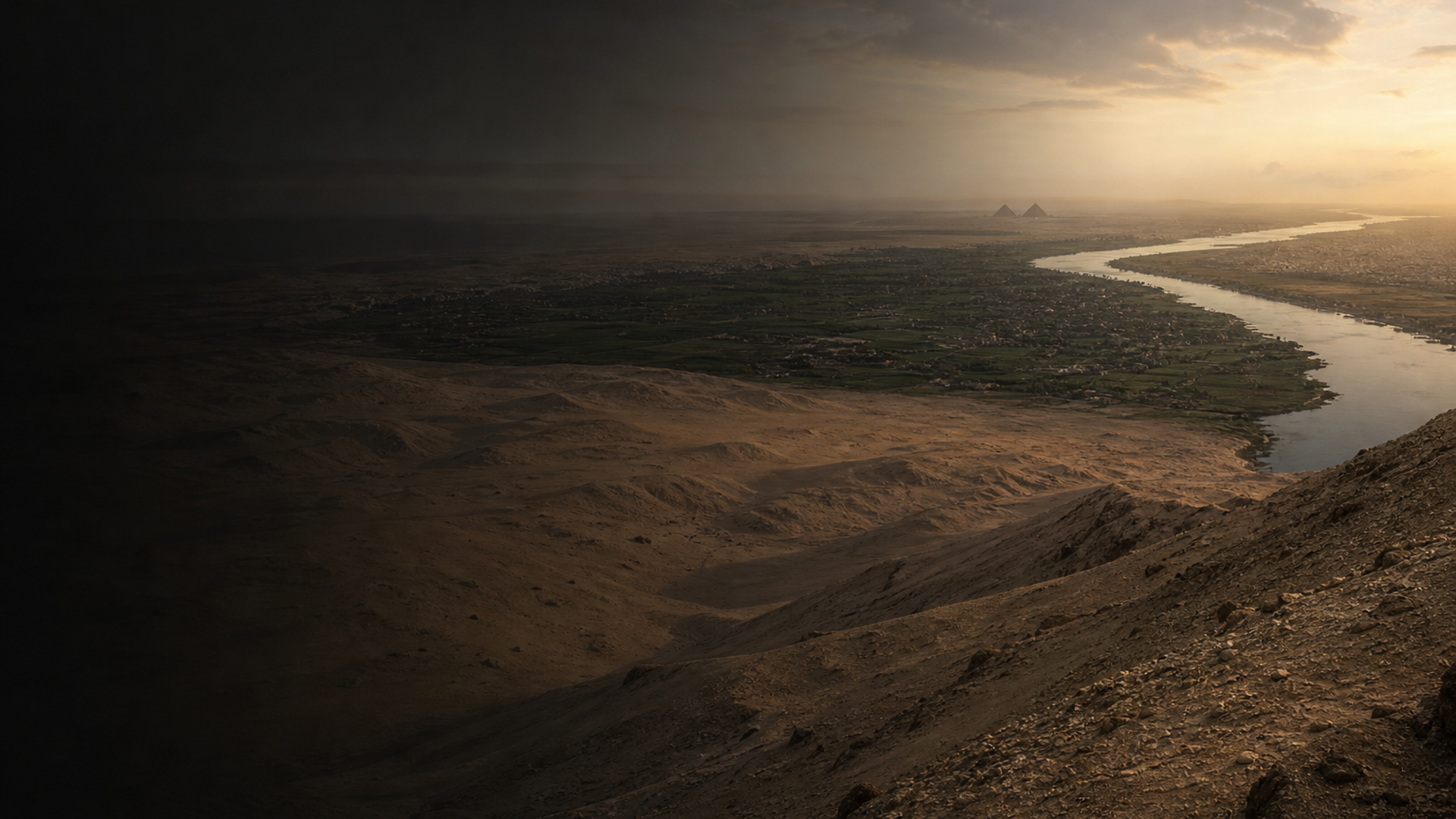
Modern Egypt is a palimpsest: millennia of Nile-borne civilizations layered beneath bustling 21st-century streets. Archaeological landscapes — from Coptic monasteries and Ottoman quarters in Cairo to Greco-Roman remains in Iskandaria (Alexandria) and rural Delta settlements near Mansoura and Tanta — document continuous human occupation and repeated cultural reworking. Material culture in urban cores preserves traces of Pharaonic infrastructure reinterpreted through Byzantine, Islamic, Ottoman, and colonial urbanism.

The genetic samples in this dataset were collected in 2000 CE from 22 individuals connected to Egypt (sites include Cairo, Iskandaria, Mansoura, Tanta, Kafar Sheikh) and migrants sampled in Kuwait. Archaeological data indicates intense long-distance connectivity — Mediterranean trade, Red Sea routes, and trans-Saharan exchanges — that create the historical backdrop for modern genetic diversity. Limited evidence from this sample set can suggest patterns of local continuity and recent mobility but cannot alone reconstruct the deep formative phases of Egyptian population history.

Interpreting present-day identities requires integrating stratified archaeological contexts with modern genetic signals: the Nile corridor’s role as a conduit of people and ideas explains why archaeological horizons often align with zones of genetic admixture. Where the material record is dense (urban centers, ports), we should expect more layered ancestry; where it is sparse (some rural Delta sectors), genetic signals may reflect localized continuity.

  • Modern Egyptian landscapes reflect continuous occupation along the Nile corridor
  • Samples (22 individuals, 2000 CE) drawn from Cairo, Iskandaria, Mansoura, Tanta, Kafar Sheikh and migrants in Kuwait
  • Archaeological networks (Mediterranean, Red Sea, Sahara) frame expected genetic diversity

Daily Life & Society

Daily life in modern Egyptian urban and Delta contexts is an ongoing choreography between river, market, and mosque. Archaeological remains — street plans, wells, ceramic assemblages, and domestic architecture — reveal continuity of Nile-dependent livelihoods: irrigation, seasonal cropping, and riverine trade. In cities like Cairo and Iskandaria, layers of urbanism preserve marketplaces, ports, and crafts that have drawn artisans, merchants, and migrants for centuries.

Material culture complements genetic sampling in highlighting mobility. Migrant workers and diasporic networks — exemplified here by migrants sampled in Kuwait — are part of a living archaeological record: modern housing patterns, remittance-driven building, and reused older masonry speak to social ties across borders. Oral histories and contemporary ethnography, when combined with archaeological survey, show how recent movements reshape household composition and marriage networks, which in turn influence genetic structure over decades.

Archaeological indicators of continuity (burial customs, local ceramic types) suggest persistent cultural threads, while urban stratigraphy records sudden changes: waves of construction, new religious institutions, or colonial-era infrastructure projects. These events create demographic pulses that align with expectations of recent gene flow and admixture in the genetic data.

  • Nile-dependent livelihoods persist in material record (irrigation, markets, crafts)
  • Contemporary migration (e.g., workers in Kuwait) leaves both archaeological and genetic traces

Genetic Profile

This dataset comprises 22 modern samples, all dated to 2000 CE, collected in Egypt (Cairo, Iskandaria, Mansoura, Tanta, Kafar Sheikh) and among migrants in Kuwait. The dataset as provided does not report specific Y-DNA or mtDNA haplogroups; therefore haplogroup-level claims cannot be made from these records alone. Where direct haplogroup data are missing, analyses that combine autosomal markers, uniparental markers, and comparative regional datasets become essential to contextualize ancestry.

Broadly, archaeological and regional genetic research suggests that populations in the Nile Valley reflect a complex history of local continuity and external inputs from the Near East, the Mediterranean, sub-Saharan Africa, and later Eurasian movements. Because these 22 samples are modern and include migrants, observed genetic variation likely captures both long-term admixture processes and very recent mobility (labor migration to Gulf states, urban in-migration). The inclusion of migrants sampled in Kuwait further increases the heterogeneity of the set and may introduce non-local ancestry components.

Given the moderate sample size (n = 22) and lack of reported uniparental markers, conclusions must remain cautious. Additional sampling across rural and urban strata, direct haplogroup reporting, and integration with larger comparative panels are needed to resolve fine-scale patterns of continuity, recent admixture, and sex-biased gene flow in modern Egyptian populations.

  • Dataset: 22 modern samples from Egyptian cities and migrants in Kuwait (2000 CE)
  • Uniparental haplogroups not reported in this set; autosomal context suggests mixed Nile Valley ancestry but requires broader comparison

Legacy & Modern Connections

Modern Egyptian identity is shaped by the deep imprint of the Nile and by centuries of contact and movement. Archaeology preserves the physical traces of this legacy — urban cores, religious monuments, rural irrigation systems — while genetic data record the human movements that animate those stones. Together they tell a cinematic story of continuity and change: people rooted in local landscapes, yet continually remade by trade, empire, and migration.

For DNA ancestry platforms, the combination of well-documented archaeological contexts and responsibly interpreted genetic data offers a powerful means to communicate past–present connections. Users should understand that small, modern sample sets (like this 22-person collection) provide valuable snapshots but do not replace larger, stratified datasets required to infer population history robustly. Where archaeological evidence is dense, genetic signals tend to be more interpretable; where it is sparse, genetic inferences should be framed as provisional. Ultimately, the legacy of modern Egypt is one of a living landscape: the Nile still carries people, stories, and genes between worlds.

  • Archaeology and genetics together illuminate continuity and mobility along the Nile
  • Small, modern samples offer snapshots; broader, contextualized datasets needed for robust ancestry claims

مساعد الذكاء الاصطناعي

مساعد الذكاء الاصطناعي من DNA Genics

فتح هذه الميزة
اطرح أسئلة عن ثقافة Nile Currents: Modern Egypt in DNA and Archaeology. يمكن للمساعد شرح النتائج الجينية والسياق التاريخي والأدلة الأثرية والصلات بالعصر الحديث.
مثال على تحليل بالذكاء الاصطناعي

لمحة عن ثقافة Nile Currents: Modern Egypt in DNA and Archaeology

تساعد عينات الحمض النووي القديم الباحثين على دراسة أنماط الهجرة والعلاقات الجينية بين المجموعات السكانية القديمة.

هذه معاينة للتحليل. يتيح المساعد الكامل استكشاف الموضوعات التالية:

  • التركيب الجيني والأصول
  • أنماط الهجرة والأصول
  • الحياة اليومية والممارسات الثقافية
  • الإرث الجيني المعاصر