انتقل إلى المحتوى الرئيسي
ملفات الحمض النووي

Otrar's Late Iron Age Echoes

Small burial assemblage (100–500 CE) from Konyrtobe mound 1 reveals mixed Eurasian ancestries

100 CE - 500 CE
South Kazakhstan (Otrar, Konyrtobe mound 1)

القصة

Konyrtobe mound 1 (Otrar, South Kazakhstan) dates to 100–500 CE. Five individuals show diverse Y and mtDNA lineages, hinting at wide-ranging connections across Eurasia during the Late Iron Age. Limited sample size makes conclusions preliminary.

Time Period

100–500 CE

Region

South Kazakhstan (Otrar, Konyrtobe mound 1)

Common Y-DNA

E, J, D, L (each in 1/5)

Common mtDNA

I, T, W, HV, U (each in 1/5)

الخط الزمني

100 CE

Earliest burials at Konyrtobe mound 1 (approx.)

Initial interments at mound 1 near Otrar date to around 100 CE; stratigraphy and artefacts align with Late Iron Age chronologies.

Origins & Emergence

Archaeological data indicates the Konyrtobe burial complex near Otrar in South Kazakhstan belongs to the Late Iron Age horizon commonly dated between 100 and 500 CE. The mound (mound 1) sits on the crossroads of steppe corridors and ancient caravan routes; its soils preserve the echoes of transregional movement. Limited evidence suggests this locality participated in a mosaic of mobile pastoralism, local settlement, and episodic long-distance exchange that characterized much of Central Asia in the first half of the first millennium CE.

From an archaeological perspective, funerary architecture and grave contexts at Konyrtobe are fragmentarily preserved; artifacts recorded during excavation hint at everyday objects and personal adornment rather than monumental elite assemblages. This pattern aligns with many Late Iron Age sites in southern Kazakhstan where communities maintained regional traditions while absorbing material influences from neighboring zones.

Genetically, the assemblage’s diversity points to multiple ancestral strands converging in the Otrar region: the combination of maternal and paternal lineages is consistent with a frontier landscape where eastern, western, and southern Eurasian gene flows intersected. Because only five individuals have been sampled, any reconstruction of population formation must remain provisional. Future sampling across neighboring mounds and settlements will be essential to test whether Konyrtobe represents a broader demographic pattern or a small, heterogenous burial group.

  • Konyrtobe mound 1 dated ~100–500 CE, Otrar, South Kazakhstan
  • Site sits on steppe corridors linking Central Asia with West and South Asia
  • Limited sample (n=5) means origin hypotheses are preliminary

Daily Life & Society

Archaeological impressions from Konyrtobe point to a community shaped by mobility and regional trade. Ethnographic parallels and regional surveys indicate mixed pastoral economies—sheep, goat and horse herding—were common across Late Iron Age southern Kazakhstan, supplemented by seasonal cultivation in river oases. At Otrar, watercourses and fertile strips would have concentrated settlements and provided staging points for exchange.

Burial contexts at mound 1 appear modest rather than ostentatious. Artefactual traces suggest personal items, possibly simple metalwork or bead forms, but preservation is uneven; therefore, interpretations of social ranking remain cautious. The funerary choices recorded—grave orientation, body treatment, associated objects—reflect community identities that combined local customs with outward influences imported through trade or marriage ties.

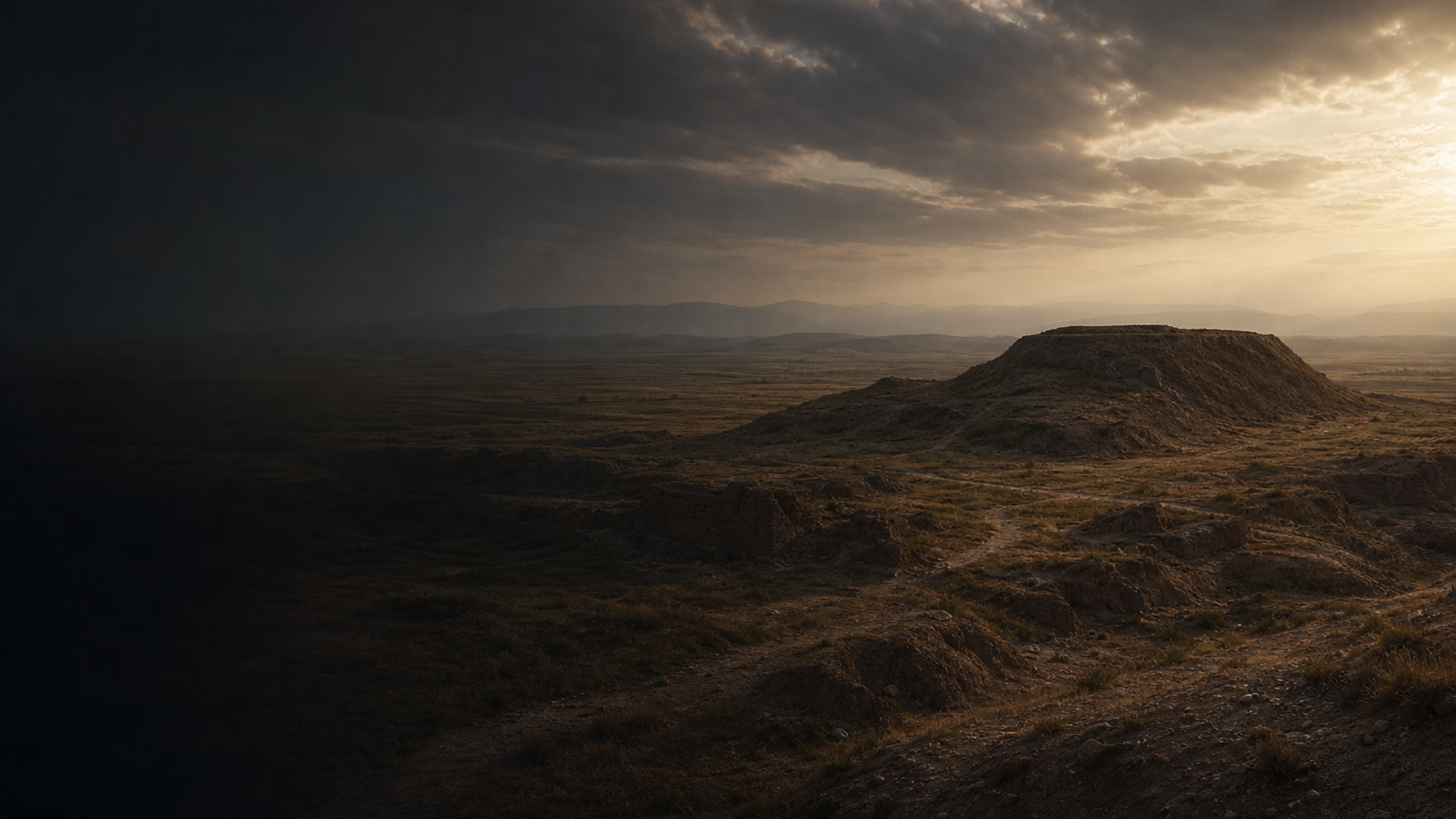
Cinematically, imagine low mounds dotting the steppe at dusk, a caravan’s glint on the horizon, and households weaving seasonal patterns between summer pastures and irrigated fields. Archaeological data suggests these were not isolated hamlets but nodes in networks where ideas, goods, and people flowed. Still, the small number of sampled burials constrains confident reconstructions of household structure, craft specialization, or long-term settlement hierarchy.

  • Economy likely mixed pastoralism with oasis cultivation
  • Grave assemblages modest; social stratification unclear

Genetic Profile

Five genome samples from Konyrtobe mound 1 reveal a strikingly heterogeneous genetic picture for a single burial locus. On the paternal side, Y-chromosome markers include haplogroups E, J, D and L (one individual each). These lineages today have distinct geographic associations—E and J are common in parts of West Asia and the Near East, D has deep ties to East and South Asian groups, and L is most often seen in South Asia—but in the first half of the first millennium CE they may reflect past mobility and complex contact zones rather than simple provenance statements.

Mitochondrial diversity is equally broad: I, T, W, HV and U are each represented. These maternal haplogroups span West Eurasian and broader Eurasian distributions and suggest that women buried at Konyrtobe had diverse maternal ancestries. The combination of diverse maternal and paternal lineages is consistent with a frontier environment of interregional marriage, adoption of outsiders, or episodic migration.

Importantly, with only five samples conclusions must remain provisional. The absence of common steppe-associated high-frequency markers in this small set—such as R1a or Q—does not prove they were absent in the living population. Instead, the data point to complex ancestry and regional connectivity, and they underline the value of expanding sampling across Otrar and neighboring Late Iron Age cemeteries to better resolve demographic processes.

  • High paternal diversity (E, J, D, L) suggests multi-directional gene flow
  • Maternal lineages (I, T, W, HV, U) indicate mixed West–Eurasian ancestries

Legacy & Modern Connections

Archaeological and genetic signals from Konyrtobe paint a portrait of Late Iron Age Otrar as a crossroads of people and ideas. Limited but evocative ancient DNA evidence shows links that span west to the Near East, east toward Inner Asia, and south toward the Indian subcontinent. Modern populations of Kazakhstan and neighboring regions carry a tapestry of these ancestral threads, but direct continuity cannot be assumed from five individuals alone.

For contemporary descendants and researchers, Konyrtobe offers a narrative of mobility: families and lineages moved, intermarried, and left mixed genetic legacies across the steppe. Ongoing sampling and comparative studies will help clarify how these local patterns contributed to broader population histories across Central Asia.

  • Konyrtobe reflects long-term steppe connectivity across Eurasia
  • Small sample size means links to modern populations remain tentative

مساعد الذكاء الاصطناعي

مساعد الذكاء الاصطناعي من DNA Genics

فتح هذه الميزة
اطرح أسئلة عن ثقافة Otrar's Late Iron Age Echoes. يمكن للمساعد شرح النتائج الجينية والسياق التاريخي والأدلة الأثرية والصلات بالعصر الحديث.
مثال على تحليل بالذكاء الاصطناعي

لمحة عن ثقافة Otrar's Late Iron Age Echoes

تساعد عينات الحمض النووي القديم الباحثين على دراسة أنماط الهجرة والعلاقات الجينية بين المجموعات السكانية القديمة.

هذه معاينة للتحليل. يتيح المساعد الكامل استكشاف الموضوعات التالية:

  • التركيب الجيني والأصول
  • أنماط الهجرة والأصول
  • الحياة اليومية والممارسات الثقافية
  • الإرث الجيني المعاصر