Altai Echoes: Mongolia Late Bronze Burials

Download PDF creates a visual, rasterized copy. Use Print for selectable text and better assistive-technology support.

Bericht wird vorbereitet

Verfügbare Informationen und Referenzen werden geladen

Verbindung mit dem archäologischen Quellenbestand...

Alte Quellen werden zusammengestellt

Zum Hauptinhalt springen
Altai Echoes: Mongolia Late Bronze Burials
Zivilisations-Spotlight

Altai Echoes: Mongolia Late Bronze Burials

Three kurgan burials in Khovd and Bayan-Ölgii illuminate landscape, lifeways, and early East Asian ancestry.

1259 CE - 917 BCE
Mongolia (Khovd, Bayan-Ölgii)
Scrollen zum Start
Kapitel I

Die Geschichte

Die Altai Echoes: Mongolia Late Bronze Burials-Kultur verstehen

Late Bronze Age burials (1259–917 BCE) from Khovd and Bayan-Ölgii show funerary kurgans and predominantly East Asian maternal lineages (mtDNA D, C). With only three samples the genetic picture is preliminary but points to regional continuity within the Altai steppe.

Time Period

1259–917 BCE

Region

Mongolia (Khovd, Bayan-Ölgii)

Common Y-DNA

O (1)

Common mtDNA

D (2), C (1)

Kapitel II

Zeitleiste

Zentrale Momente in der Geschichte dieser Kultur

1259 BCE

Earliest dated burial in the dataset

Radiocarbon evidence places a Khudzhirtyn gol burial at 1259 BCE, marking the earliest of the three sampled interments.

Kapitel III

Origins & Emergence

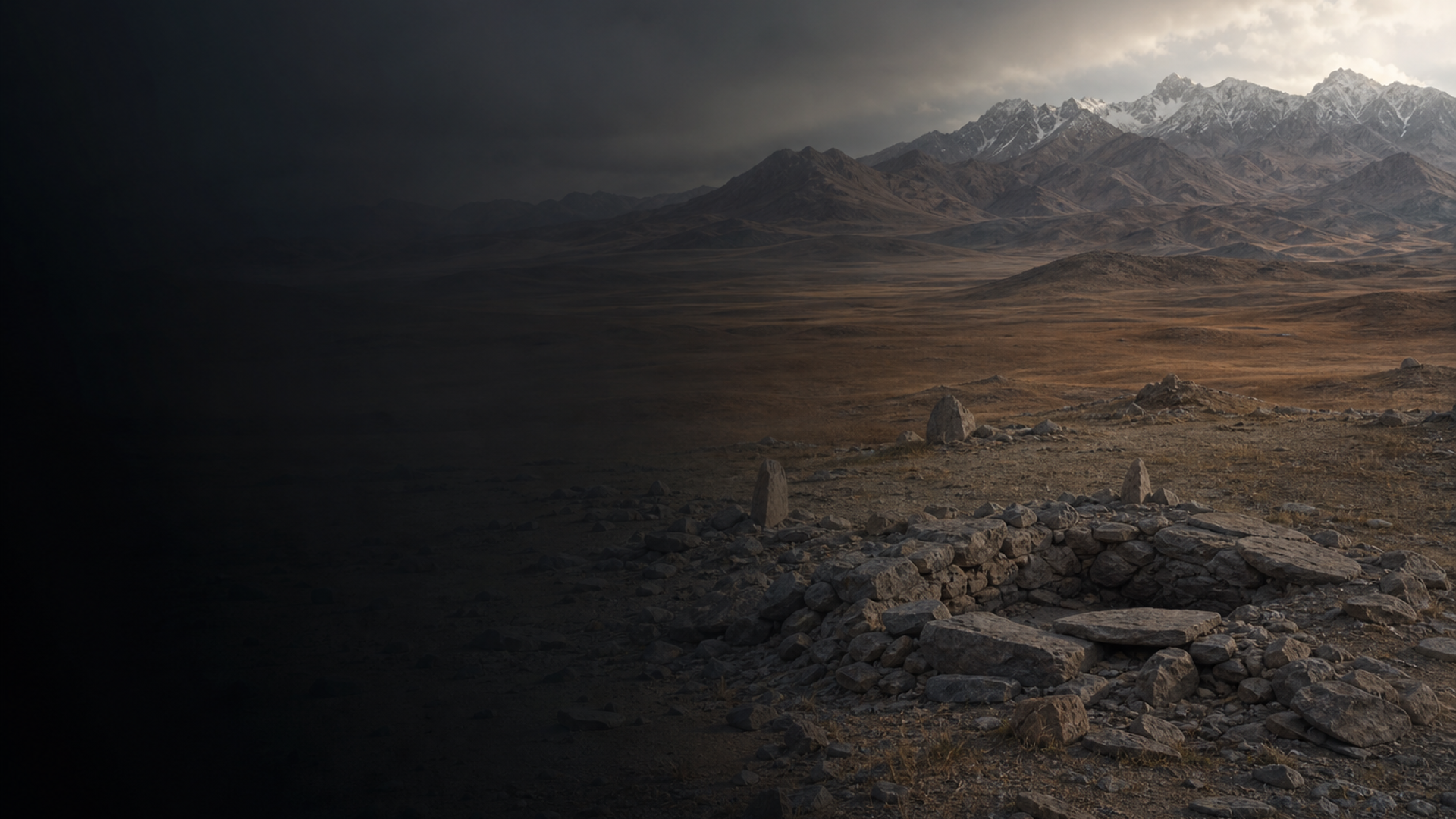
Across the stony shoulders of the Altai, the Late Bronze Age Center West horizon takes shape in the archaeological record as a pattern of raised earthworks and clustered barrows. The three dated burials associated with this dataset—Khudzhirtyn gol I kurgan 2 (Khovd), Biluut 2 barrow 3 (Tsengel, Bayan-Ölgii), and Khudzhirtyn-gol-1 (Üyench District)—fall between 1259 and 917 BCE. Archaeological data indicates these interments were part of a landscape of seasonal movement and territorial markers: low-profile kurgans and isolated barrows often sited on valley margins and river terraces.

Material culture evidence from the broader region suggests continuity of pastoral lifeways in the Late Bronze Age Center West sphere, but explicit artifact links for these specific graves are limited. Radiocarbon dates place these individuals firmly in the later second and early first millennium BCE, a period when highland and valley networks connected the Mongolian Altai with neighboring steppe zones. Limited evidence suggests social display through burial architecture, yet the small sample size and uneven excavation records mean that larger regional patterns remain tentative.

  • Three burials dated 1259–917 BCE from Khovd and Bayan-Ölgii
  • Interments are kurgans/barrows on valley and river terraces
  • Evidence suggests pastoral seasonal mobility; social signals are tentative
Kapitel IV

Daily Life & Society

The visual of family herds against bleak mountain passes is supported by archaeological inference rather than abundant grave inventory for these specific sites. Across the Mongolian Altai, faunal assemblages and toolkits in comparable Late Bronze Age contexts point to sheep, goats and horses as economic staples; pollen and sediment studies from nearby valleys record grazing landscapes and seasonal occupation zones. For the individuals from Khudzhirtyn gol and Biluut, burial in low mounds implies a society where mobile pastoral groups used funerary monuments as anchors in a shifting world.

Archaeological data indicates a society organized around kin-based herding units with fluctuating camp sites and community focal points at river crossings or sheltered basins. Craft specialization and long-distance exchange are visible in the wider region, but the direct evidence from these three graves is limited, so models of hierarchy or political organization must be cautious. Burial treatment may reflect both family identity and territorial claims along pastoral routes that threaded the Altai ranges.

  • Pastoral economy inferred from regional archaeological patterns
  • Kurgan tombs function as durable landmarks for mobile groups
Kapitel V

Genetic Profile

The genetic dataset for Mongolia_LBA_CenterWest_5 comprises three individuals—an extremely small sample that requires conservative interpretation. Mitochondrial haplogroups are dominated by East Asian lineages (D in two individuals, C in one), while the single male Y-chromosome is assigned to haplogroup O. These lineages are common across modern and ancient East Asian and Siberian populations, and their presence here suggests maternal continuity with regional East Asian maternal gene pools during the Late Bronze Age.

Notably, the absence of clearly West Eurasian paternal or maternal markers among these three samples contrasts with contemporaneous mixed ancestries documented in other steppe pockets; however, with n = 3 this could reflect sampling bias. Archaeogenetic patterns in Mongolia are complex: other Late Bronze Age and Iron Age contexts show varying degrees of east–west admixture. For this Center West cluster, the preliminary signal points toward predominant East Asian ancestry in both maternal and paternal lines, but further sampling is required to test hypotheses about population continuity, migration, or localized admixture dynamics.

  • mtDNA: D (2) and C (1) — East Asian/Siberian maternal lineages
  • Y-DNA: O (1) — single male sample; evidence is preliminary
Kapitel VI

Legacy & Modern Connections

These burials offer a whisper of continuity across millennia. The predominance of mtDNA D and C and the presence of Y haplogroup O echo the genetic profile seen widely across modern Mongolic and neighboring Siberian groups, suggesting at least partial maternal continuity in the Altai highlands. Culturally, the use of kurgans and barrows as territorial anchors resonates with later steppe funerary traditions that persisted into the Iron Age and beyond.

Archaeological data indicates that mobility, pastoral economies, and local landmarking strategies were long-standing features of life on these high pastures. Still, with only three samples the genetic connections to present-day populations are suggestive rather than conclusive; continued sampling, especially from contemporaneous cemeteries and settlement sites, is vital to transform these whispers into a robust narrative of ancestral continuity and change.

  • Maternal lineages (D, C) align with broad East Asian/Siberian affinities
  • Kurgan traditions anticipate persistent steppe funerary and territorial practices
KI-gestützt

KI-Assistent

Stellen Sie Fragen zur Altai Echoes: Mongolia Late Bronze Burials-Kultur

KI-Assistent von DNAGENICS

Funktion freischalten
Stellen Sie Fragen zur Kultur Altai Echoes: Mongolia Late Bronze Burials. Unser KI-Assistent kann genetische Befunde, historischen Kontext, archäologische Belege und moderne Verbindungen erläutern.
Beispiel einer KI-Analyse

Die Altai Echoes: Mongolia Late Bronze Burials-Kultur ist ein faszinierendes Kapitel der Menschheitsgeschichte...

Genetische Analysen zeigen Übereinstimmungen mit früheren Populationen und Hinweise auf besondere Anpassungen und kulturelle Innovationen. Alte DNA-Proben liefern Einblicke in Migrationsmuster, soziale Strukturen und genetische Verbindungen zwischen Populationen.

Dies ist eine Vorschau der KI-Analyse. Schalten Sie den vollständigen KI-Assistenten frei, um detaillierte Einblicke zu erkunden:

  • Genetische Zusammensetzung und genetische Ähnlichkeit
  • Migrationsmuster und Ursprünge
  • Alltag und kulturelle Praktiken
  • Genetischer Bezug zu heutigen Populationen

Weitere antike Kulturen erkunden

Geschichten von Zivilisationen aus der antiken Welt entdecken

Use code for 35% off • Expires Nov 09




