A preparar o relatório

A carregar as informações e as referências disponíveis

Consultando el registro arqueológico...

Recopilando registros antiguos

Saltar para o conteúdo principal
Altai Echoes: Mongolia Late Bronze Burials
Cultura de destaque

Altai Echoes: Mongolia Late Bronze Burials

Three kurgan burials in Khovd and Bayan-Ölgii illuminate landscape, lifeways, and early East Asian ancestry.

1259 CE - 917 BCE
Mongolia (Khovd, Bayan-Ölgii)
Desplázate para começar
Capítulo I

A História

Comprender la cultura Altai Echoes: Mongolia Late Bronze Burials

Late Bronze Age burials (1259–917 BCE) from Khovd and Bayan-Ölgii show funerary kurgans and predominantly East Asian maternal lineages (mtDNA D, C). With only three samples the genetic picture is preliminary but points to regional continuity within the Altai steppe.

Time Period

1259–917 BCE

Region

Mongolia (Khovd, Bayan-Ölgii)

Common Y-DNA

O (1)

Common mtDNA

D (2), C (1)

Capítulo II

Cronologia

Momentos-chave da história desta cultura

1259 BCE

Earliest dated burial in the dataset

Radiocarbon evidence places a Khudzhirtyn gol burial at 1259 BCE, marking the earliest of the three sampled interments.

Capítulo III

Origins & Emergence

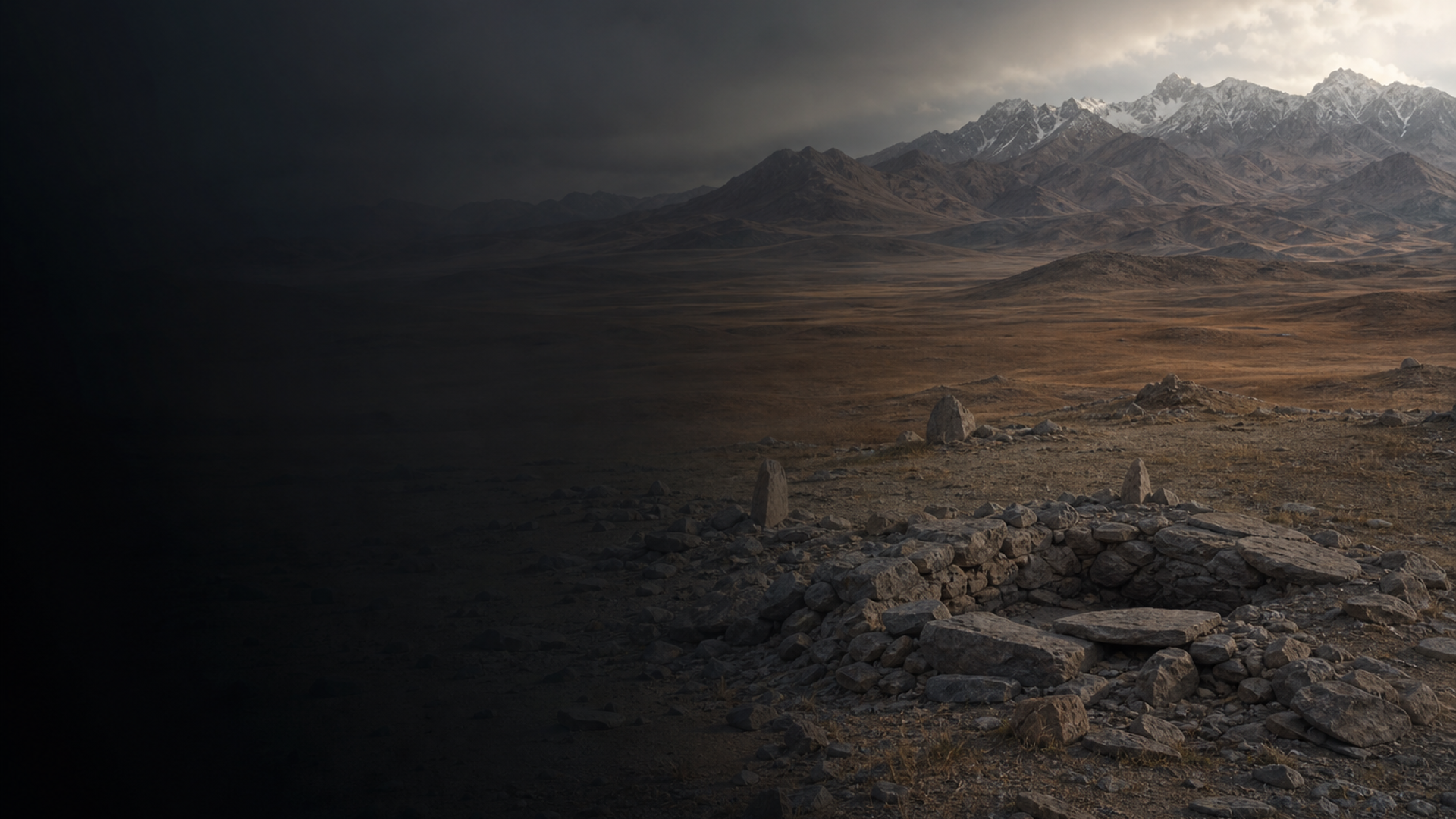
Across the stony shoulders of the Altai, the Late Bronze Age Center West horizon takes shape in the archaeological record as a pattern of raised earthworks and clustered barrows. The three dated burials associated with this dataset—Khudzhirtyn gol I kurgan 2 (Khovd), Biluut 2 barrow 3 (Tsengel, Bayan-Ölgii), and Khudzhirtyn-gol-1 (Üyench District)—fall between 1259 and 917 BCE. Archaeological data indicates these interments were part of a landscape of seasonal movement and territorial markers: low-profile kurgans and isolated barrows often sited on valley margins and river terraces.

Material culture evidence from the broader region suggests continuity of pastoral lifeways in the Late Bronze Age Center West sphere, but explicit artifact links for these specific graves are limited. Radiocarbon dates place these individuals firmly in the later second and early first millennium BCE, a period when highland and valley networks connected the Mongolian Altai with neighboring steppe zones. Limited evidence suggests social display through burial architecture, yet the small sample size and uneven excavation records mean that larger regional patterns remain tentative.

  • Three burials dated 1259–917 BCE from Khovd and Bayan-Ölgii
  • Interments are kurgans/barrows on valley and river terraces
  • Evidence suggests pastoral seasonal mobility; social signals are tentative
Capítulo IV

Daily Life & Society

The visual of family herds against bleak mountain passes is supported by archaeological inference rather than abundant grave inventory for these specific sites. Across the Mongolian Altai, faunal assemblages and toolkits in comparable Late Bronze Age contexts point to sheep, goats and horses as economic staples; pollen and sediment studies from nearby valleys record grazing landscapes and seasonal occupation zones. For the individuals from Khudzhirtyn gol and Biluut, burial in low mounds implies a society where mobile pastoral groups used funerary monuments as anchors in a shifting world.

Archaeological data indicates a society organized around kin-based herding units with fluctuating camp sites and community focal points at river crossings or sheltered basins. Craft specialization and long-distance exchange are visible in the wider region, but the direct evidence from these three graves is limited, so models of hierarchy or political organization must be cautious. Burial treatment may reflect both family identity and territorial claims along pastoral routes that threaded the Altai ranges.

  • Pastoral economy inferred from regional archaeological patterns
  • Kurgan tombs function as durable landmarks for mobile groups
Capítulo V

Genetic Profile

The genetic dataset for Mongolia_LBA_CenterWest_5 comprises three individuals—an extremely small sample that requires conservative interpretation. Mitochondrial haplogroups are dominated by East Asian lineages (D in two individuals, C in one), while the single male Y-chromosome is assigned to haplogroup O. These lineages are common across modern and ancient East Asian and Siberian populations, and their presence here suggests maternal continuity with regional East Asian maternal gene pools during the Late Bronze Age.

Notably, the absence of clearly West Eurasian paternal or maternal markers among these three samples contrasts with contemporaneous mixed ancestries documented in other steppe pockets; however, with n = 3 this could reflect sampling bias. Archaeogenetic patterns in Mongolia are complex: other Late Bronze Age and Iron Age contexts show varying degrees of east–west admixture. For this Center West cluster, the preliminary signal points toward predominant East Asian ancestry in both maternal and paternal lines, but further sampling is required to test hypotheses about population continuity, migration, or localized admixture dynamics.

  • mtDNA: D (2) and C (1) — East Asian/Siberian maternal lineages
  • Y-DNA: O (1) — single male sample; evidence is preliminary
Capítulo VI

Legacy & Modern Connections

These burials offer a whisper of continuity across millennia. The predominance of mtDNA D and C and the presence of Y haplogroup O echo the genetic profile seen widely across modern Mongolic and neighboring Siberian groups, suggesting at least partial maternal continuity in the Altai highlands. Culturally, the use of kurgans and barrows as territorial anchors resonates with later steppe funerary traditions that persisted into the Iron Age and beyond.

Archaeological data indicates that mobility, pastoral economies, and local landmarking strategies were long-standing features of life on these high pastures. Still, with only three samples the genetic connections to present-day populations are suggestive rather than conclusive; continued sampling, especially from contemporaneous cemeteries and settlement sites, is vital to transform these whispers into a robust narrative of ancestral continuity and change.

  • Maternal lineages (D, C) align with broad East Asian/Siberian affinities
  • Kurgan traditions anticipate persistent steppe funerary and territorial practices
Com IA

Assistente de IA

Haz preguntas sobre la cultura Altai Echoes: Mongolia Late Bronze Burials

Assistente de IA por DNAGENICS

Desbloquear esta função
Pregunta sobre la cultura Altai Echoes: Mongolia Late Bronze Burials. El asistente con IA puede explicar hallazgos genéticos, contexto histórico, pruebas arqueológicas y conexiones modernas, con sus límites de interpretación.
Exemplo de análise com IA

La cultura Altai Echoes: Mongolia Late Bronze Burials representa un capítulo de la historia humana...

A análise genética permite estudar semelhanças com populações anteriores e possíveis adaptações. As amostras de DNA antigo fornecem informações para investigar padrões migratórios e relações entre populações, com limites que dependem do estudo e do contexto arqueológico.

Esta é uma antevisão da análise com IA. Aceder ao assistente completo para explorar informações sobre:

  • Composição e similaridade genética
  • Padrões migratórios e origens
  • Vida cotidiana e práticas culturais
  • Contexto genético moderno

Explore mais culturas antigas

Descubra a história de civilizações de diferentes partes do mundo antigo