Beli Breyag: Early Bronze Age Echoes

Download PDF creates a visual, rasterized copy. Use Print for selectable text and better assistive-technology support.

Zum Hauptinhalt springen
Zivilisations-Spotlight

Beli Breyag: Early Bronze Age Echoes

Two voices from Nova Zagora connect archaeology and ancient DNA in Bulgaria

3400 CE - 1600 BCE
Nova Zagora, Beli Breyag (Bulgaria)

Die Geschichte

Early Bronze Age human remains from Beli Breyag (Nova Zagora, Bulgaria; 3400–1600 BCE) show Y-DNA haplogroup I in both sampled males. Archaeological context and limited genetic data suggest local Balkan continuity with emerging Bronze Age social and metalworking networks. Conclusions remain preliminary.

Time Period

3400–1600 BCE

Region

Nova Zagora, Beli Breyag (Bulgaria)

Common Y-DNA

I (2 samples)

Common mtDNA

Not reported / insufficient data

Zeitleiste

2500 BCE

Early Bronze Age occupation at Beli Breyag

Archaeological contexts and human remains at Beli Breyag date to the Early Bronze Age, illustrating local participation in regional Bronze Age networks.

Origins & Emergence

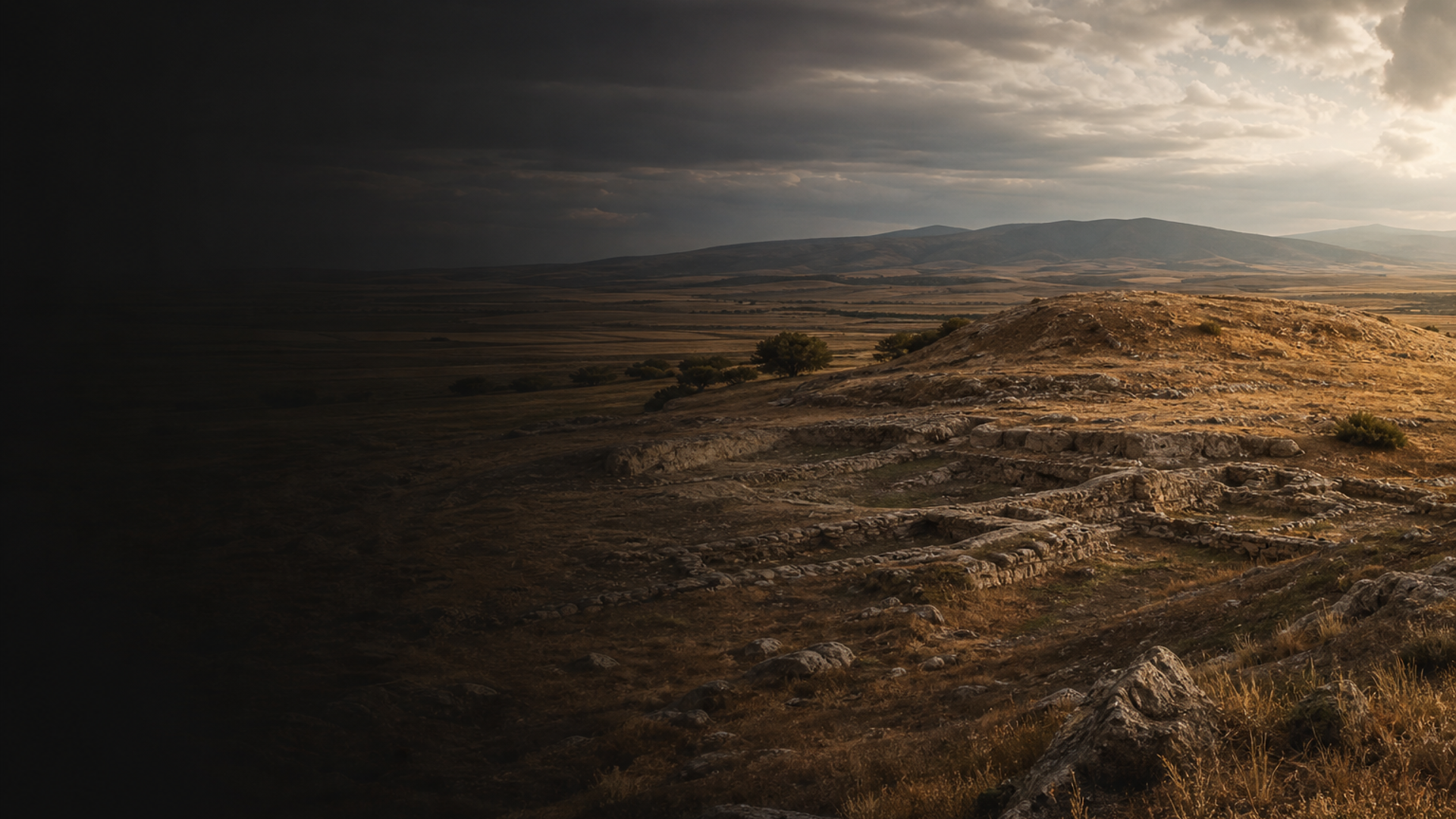
The remains attributed to Bulgaria_BeliBreyag_EBA come from the vicinity of Nova Zagora (Beli Breyag) and sit within the broad Early Bronze Age span of 3400–1600 BCE. Archaeological data indicates this part of the eastern Balkans was a crossroads where local Neolithic traditions intersected with emerging Bronze Age technologies and exchange networks. Landscapes of rolling plains and river valleys funneled people, goods and ideas between the Aegean, Thrace and the Danubian world.

Limited evidence from the site itself means reconstruction is cautious: funerary deposits and settlement traces suggest continuity of local lifeways alongside innovations in metallurgy and mobility. The genetic signal recovered so far — both male individuals carrying Y-haplogroup I — aligns with lineages known in Mesolithic and Neolithic Balkan populations, hinting at regional continuity of male lines into the Early Bronze Age. However, with only two samples available, claims about migration, demographic turnover, or social structure remain provisional. Further excavation and DNA sampling across contemporary sites are needed to resolve whether Beli Breyag reflects a persistent local population, incoming groups, or a mixture of both.

  • Site: Nova Zagora, Beli Breyag, Bulgaria (Early Bronze Age contexts)
  • Regional crossroads linking Aegean, Thracian, and Danubian zones
  • Both male samples carry Y-haplogroup I, suggesting local lineage continuity

Daily Life & Society

Archaeological evidence for daily life in Early Bronze Age Beli Breyag is fragmentary but evocative. Material traces from contemporary eastern Balkan sites show communities engaged in mixed farming, pastoralism, and increasingly sophisticated metallurgy — bronze production and exchange networks were transforming economies and social hierarchies. At Nova Zagora, settlement remains and burial contexts suggest households organized around family compounds, with craft specializations emerging in some locales.

Excavations regionally indicate long-distance contacts: exotic raw materials and stylistic parallels point to mobility and trade. Social life likely revolved around seasonal cycles, animal husbandry, cereal cultivation and communal rituals that anchored identity. Burial variability in nearby sites hints at emerging social differentiation, but archaeological data from Beli Breyag itself remain limited; inferences about household organization, craft production or status differentiation must therefore be described as tentative.

  • Economy likely based on mixed farming, herding, and early metallurgy
  • Exchange networks linked the eastern Balkans with wider Bronze Age communities

Genetic Profile

Genetic sampling at Beli Breyag is extremely limited: two individuals have been reported, and both are males carrying Y-chromosome haplogroup I. This haplogroup has deep roots in Europe and is commonly detected in Mesolithic and Neolithic Balkan contexts, so its presence here is compatible with continuity of local paternal lineages into the Early Bronze Age. No mitochondrial haplogroups are reported for these samples, and absence of mtDNA data prevents assessment of maternal ancestry or sex-biased demographic processes.

Because the sample count is so small (<10), any population-level conclusions are preliminary. The lack of steppe-associated Y-haplogroups (for example R1a/R1b) in these two samples does not mean they were absent in the region; broader surveys across Bulgaria and neighboring regions show complex admixture patterns during the 4th–2nd millennia BCE. Limited evidence suggests a scenario in which local Balkan ancestry persisted alongside incoming influences, but confirming admixture proportions, migration timing, and social dynamics will require many more genomes from Beli Breyag and comparative sites.

  • Both analyzed individuals (n=2) are Y-DNA haplogroup I — suggests local paternal continuity
  • No mtDNA reported; conclusions about maternal ancestry and sex-biased processes are tentative

Legacy & Modern Connections

The voices from Beli Breyag are a faint but meaningful chord in the deep genetic symphony of the Balkans. Haplogroup I persists in modern populations across southeastern Europe, so these Early Bronze Age males may represent ancestral strands that contribute to present-day genetic diversity in Bulgaria. Yet modern Bulgarians are the result of many waves of movement — Bronze Age mobility, later Iron Age and historic migrations — so direct lineal claims should be avoided.

Archaeologically, Beli Breyag sits within a narrative of local resilience and far-reaching connections: the site demonstrates how small communities participated in broader Bronze Age transformations. Genetically, the current dataset is a starting point. Together, archaeology and DNA invite a cinematic yet careful reconstruction: individual lives caught between continuity and change, awaiting fuller illumination from future research.
  • Haplogroup I continuity suggests ties to longstanding Balkan paternal lineages
  • Modern genetic landscapes reflect millennia of additional migrations; direct links are complex

KI-Assistent

KI-Assistent von DNAGENICS

Funktion freischalten
Stellen Sie Fragen zur Kultur Beli Breyag: Early Bronze Age Echoes. Unser KI-Assistent kann genetische Befunde, historischen Kontext, archäologische Belege und moderne Verbindungen erläutern.

Beispiel einer KI-Analyse

Die Beli Breyag: Early Bronze Age Echoes-Kultur ist ein faszinierendes Kapitel der Menschheitsgeschichte...

Genetische Analysen zeigen Übereinstimmungen mit früheren Populationen und Hinweise auf besondere Anpassungen und kulturelle Innovationen. Alte DNA-Proben liefern Einblicke in Migrationsmuster, soziale Strukturen und genetische Verbindungen zwischen Populationen.

Dies ist eine Vorschau der KI-Analyse. Schalten Sie den vollständigen KI-Assistenten frei, um detaillierte Einblicke zu erkunden:

  • Genetische Zusammensetzung und genetische Ähnlichkeit
  • Migrationsmuster und Ursprünge
  • Alltag und kulturelle Praktiken
  • Genetischer Bezug zu heutigen Populationen
Use code for 30% off • Expires Nov 15




