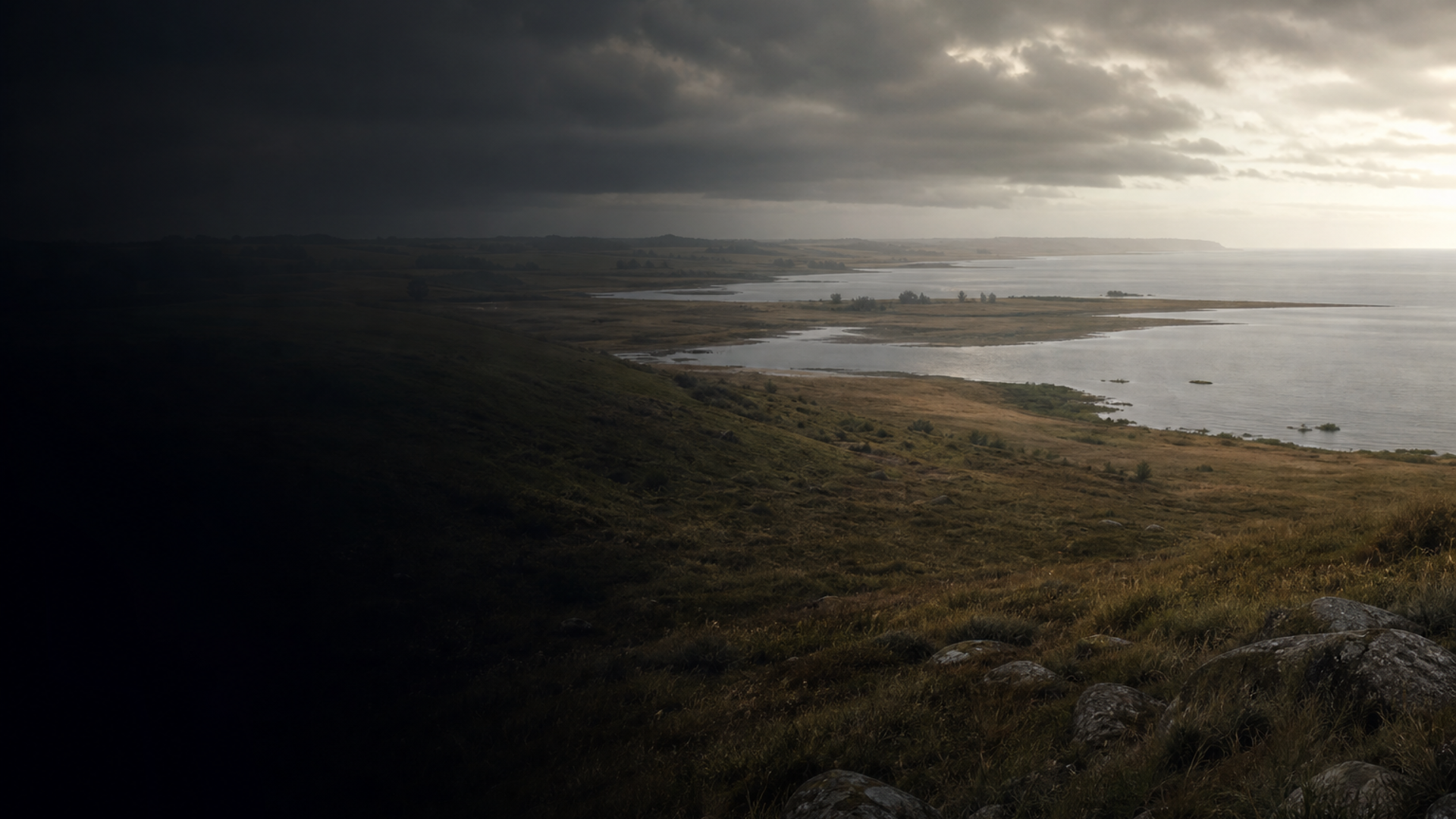
The Kongemose horizon in Denmark unfolds along a drowned shoreline: a weave of sandbanks, lagoons and rich fishing grounds that shaped Mesolithic lifeways from roughly 6500 to 5000 BCE. Archaeological data indicates a continuity of hunter‑gatherer economies following the earlier Maglemosian traditions, with new emphasis on marine resources and specialized microlithic toolkits. Sites sampled here—Orehoved Sejlrende (Falster), Korsør Nor (Zealand), Vedbæk Boldbaner (Zealand), Tybrind Vig (Funen), Tudse Hage (Zealand) and Rønsten (Jutland)—preserve flint scatters, shell middens and, at some localities, burials or inhumation traces.
The coastal setting is cinematic: low, forested skerries giving way to tidal flats where seals, fish and migratory birds concentrated. Sea‑level rise and local submergence mean many evidence-rich contexts lie offshore; underwater archaeology (e.g., Tybrind Vig) has revealed well‑preserved organic remains at waterlogged sites. Limited evidence suggests regional networks of raw material exchange and shared tool traditions across the Danish archipelago, but variability between sites shows local adaptations to shoreline microenvironments.
Because the genetic sample set is small, interpretations about population continuity and mobility remain provisional. Archaeological data indicates the Kongemose phenomenon is best understood as a mosaic of coastal foraging lifeways rather than a single uniform culture.