Menu
Store
Blog
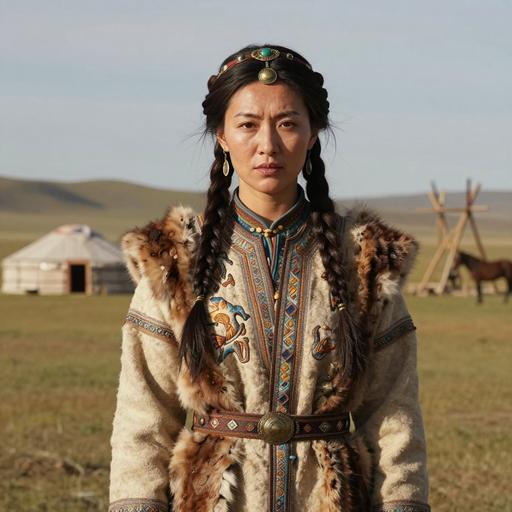
Portrait reconstruction of GD1-1
Ancient Individual

A woman buried in Mongolia in the Imperial era

GD1-1
541 CE - 634 CE
Female
First Turkic Khaganate of Mongolia
Mongolia
Scroll to begin
Chapter I

Identity

The biological and cultural markers that define this ancient individual

Sample ID

GD1-1

Date Range

541 CE - 634 CE

Biological Sex

Female

mtDNA Haplogroup

G2a2a

Cultural Period

First Turkic Khaganate of Mongolia

Chapter II

Place

Where this individual was discovered

Country Mongolia
Locality Gurvan Dov
Chapter III

Time

When this individual lived in the broader context of human history

GD1-1 541 CE - 634 CE
Chapter IV

Story

The narrative of this ancient life

The First Turkic Khaganate, also known as the Göktürk Khaganate, was a pivotal political and cultural entity in the history of Central Asia, existing from 552 to 742 CE. Emerging from the steppes of Mongolia and the Altai Mountains, the Göktürks were the first Turkic-speaking people to form a political entity of this scale and influence, marking the beginning of the historic Turkic empires. This khaganate played a crucial role in fostering cultural exchanges, managing trade routes, and influencing the political landscape of Central Eurasia during the early medieval period.

Formation and Geography

The Göktürk Khaganate was founded by Bumin Khagan in 552 CE after he revolted against the Rouran Khaganate, a dominant power in the region. Bumin declared himself the ruler, effectively establishing the Göktürk Khaganate with its capital at Ötüken, in modern-day Mongolia. Geographically, the khaganate stretched from the eastern part of Mongolia across the steppes to the western regions near the Caspian Sea, encompassing major trade routes, including parts of the Silk Road.

Governance and Political Structure

The Göktürk Khaganate was governed by a khagan, a supreme ruler who claimed divinely sanctioned authority. The political structure was a loose confederation of tribes, each led by its own local chieftains who owed allegiance to the central authority of the khagan. The decentralized nature of the governance allowed for relative autonomy among the tribes while still maintaining the unity necessary to conduct large-scale military campaigns and manage vast territories.

Economy and Trade

The economy of the Göktürk Khaganate was diverse, primarily based on pastoral nomadism. The Göktürks were skilled horsemen and relied heavily on cattle, sheep, and horses for sustenance and trade. Their strategic control of the Silk Road trade routes allowed them to facilitate commerce between the East and West, dealing in goods such as silk, spices, textiles, and precious metals. This not only brought wealth but also cultural exchanges that enriched the khaganate.

Military Prowess

The Göktürk military was formidable, known for its cavalry which was both swift and highly mobile. The cavalry was crucial in their ability to conduct quick raids and engage in effective open-field battles. Göktürk warriors were reputed for their skill in archery, especially while mounted, making them a significant military force of the era. Their military campaigns expanded their influence into Central Asia, at times clashing with the Chinese dynasties to the east and Persian empires to the west.

Culture and Religion

The Göktürks contributed significantly to the spread of Turkic culture across Central Asia. They were among the earliest adopters of a script to represent their language, known as the Old Turkic script, found on the Orkhon inscriptions, which are crucial historical sources today. Their religious beliefs were primarily rooted in Tengrism, a shamanistic and animistic faith centering on the worship of Tengri, the sky god, which influenced their social and political ideologies.

Decline and Legacy

The decline of the Göktürk Khaganate began in the late 7th century, due to internal strife, succession disputes, and external pressures from neighboring powers like the Tang Dynasty of China and the emergence of other Turkic tribes. By 742 CE, internal rebellions and pressure from the Uyghurs and Basmyls led to the fragmentation and eventual dissolution of the Göktürk Khaganate.

Despite their decline, the legacy of the Göktürks persisted. Their sophisticated administration, military tactics, and cultural achievements laid the groundwork for subsequent Turkic empires and influenced the socio-political and cultural landscapes of Central Asia. The concept of a unified Turkic identity and consciousness can be traced back to the Göktürks, who established a model of governance and culture that resonated through the ages, shaping the history of the Eurasian steppes for centuries to come.

Chapter V

Context

Other ancient individuals connected to this sample

Use code for 40% off Expires Feb 26