Menu
Store
Blog
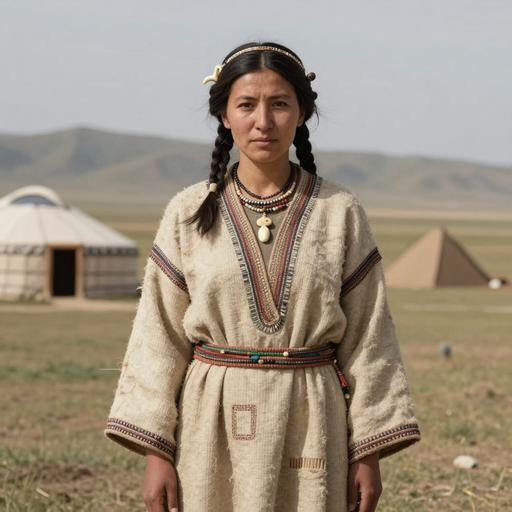
Portrait reconstruction of I11501
Ancient Individual

A woman buried in Kazakhstan in the Early Bronze Age era

I11501
3345 BCE - 3096 BCE
Female
Early Bronze Kumsay
Kazakhstan
Scroll to begin
Chapter I

Identity

The biological and cultural markers that define this ancient individual

Sample ID

I11501

Date Range

3345 BCE - 3096 BCE

Biological Sex

Female

mtDNA Haplogroup

C5c-a

Cultural Period

Early Bronze Kumsay

Chapter II

Place

Where this individual was discovered

Country Kazakhstan
Locality Kumsay. Kyirik Oba
Coordinates 49.4900, 58.5100
Chapter III

Time

When this individual lived in the broader context of human history

I11501 3345 BCE - 3096 BCE
Chapter IV

Story

The narrative of this ancient life

The Kumsay culture, part of the Early Bronze Age cultures within the Eurasian Steppe, represents a significant era in the prehistoric development of the region now known as Kazakhstan. This culture is often studied as part of the broader Andronovo cultural horizon, which spanned a vast territory across the steppe regions of Central Asia.

Geography and Environment

The Kumsay culture emerged in what is now the western regions of Kazakhstan, characterized by expansive steppe landscapes. This environment fostered a semi-nomadic lifestyle centered around pastoralism. The region's climate during the Early Bronze Age was likely similar to today, with cold winters and hot, arid summers, influencing the economic and social structures of the Kumsay people.

Society and Lifestyle

The Kumsay culture was primarily pastoral, with evidence suggesting a heavy reliance on animal husbandry. Livestock such as cattle, sheep, and horses were crucial to their economy, providing food, clothing, and materials for tools and trade. This nomadic lifestyle required the Kumsay people to develop sophisticated herding and breeding techniques, with seasonal migrations as a strategy to ensure fresh pastures for grazing.

Settlements and Architecture

Unlike sedentary societies that left behind large, permanent architectural structures, the Kumsay people’s settlements were transient, often consisting of lightweight, portable structures like yurts. However, archaeological evidence does indicate the existence of temporary camps with more robust semi-permanent structures made of materials like wood and animal hides.

Material Culture

The Kumsay culture is notable for its pottery, metallurgy, and craftsmanship. Pottery from this period includes simple forms with minimal decoration, primarily utilitarian wares used for cooking and storage. Metalworking was a prominent activity, with a focus on bronze, reflecting technological advancements in the production of weapons, tools, and ornaments. The metallurgy of the Kumsay culture was sophisticated, involving alloying techniques that improved the hardness and durability of bronze products.

Religion and Spirituality

Though specific details about the spiritual beliefs of the Kumsay people are sparse, it is likely they followed animistic or shamanistic traditions. This assumption is based on their connection with nature and reliance on animals, typical of steppe cultures during the Bronze Age. Burials from this era often include grave goods such as pottery, weapons, and ornaments, indicating beliefs in an afterlife where such items might be needed.

Trade and Interaction

The vastness of the Eurasian Steppe provided opportunities for the Kumsay culture to engage in long-distance trade and cultural exchanges. They were part of extensive networks that facilitated the movement of goods such as metals, textiles, and precious stones. These interactions likely played a role in the diffusion of technologies and ideas across regions, contributing to the development of other cultures and influencing social structures and economies.

Archaeological Significance

The archaeological study of the Kumsay culture provides valuable insights into early Bronze Age societies of Central Asia. Excavations have uncovered artifacts that illustrate the material culture, economy, and social organization of the Kumsay people. These findings help scholars piece together the history and evolution of human societies in the steppe regions, highlighting the complexity and adaptability of nomadic cultures.

In summary, the Early Bronze Age Kumsay culture of the Central Eurasian Steppe offers an enriching glimpse into the lives of prehistoric nomadic societies. Their innovations in metallurgy, adaptation to harsh environments through pastoralism, and interactions with neighboring cultures have left an enduring legacy that continues to be explored by archaeologists and historians today.

Chapter V

Genetics

The genetic ancestry of this ancient individual

Ancient Genetic Admixture

This analysis compares the DNA profile of I11501 with ancient reference populations, showing the genetic composition in terms of prehistoric ancestral groups.

Western Steppe Pastoralists 45.5%
Ancient Asians 19.4%
Neolithic Farmers 17.1%
European Hunter-Gatherers 11.4%
Ancient Native Americans 6.7%

Modern Genetic Admixture

This analysis compares the DNA profile with present-day reference populations, showing what percentage of genetic makeup resembles modern populations from different regions.

Europe 55.1%
Eastern European 55.1%
America 44.9%
America 44.9%
Native American 44.9%

Closest Modern Populations

These are the modern populations showing the closest statistical alignment to A woman buried in Kazakhstan in the Early Bronze Age era, ranked by genetic distance. Lower distance values indicate closer statistical similarity.

1
Besermyan
6.5606
2
Udmurt
7.1727
3
Tatar Kazan
7.5774
4
Tatar Lipka
8.5198
5
Chuvash
8.6620
6
Pamiri Sarikoli
9.3493
7
Tajik Tajikistan Hisor
9.4834
8
Tajik Tajikistan Ayni
9.8511
9
Tatar Mishar
9.9142
10
Komi A
9.9638
Chapter VI

Context

Other ancient individuals connected to this sample

Sources

References

Scientific publications and genetic data

Scientific Publication

The formation of human populations in South and Central Asia

Authors Narasimhan VM, Patterson N, Moorjani P
Abstract

By sequencing 523 ancient humans, we show that the primary source of ancestry in modern South Asians is a prehistoric genetic gradient between people related to early hunter-gatherers of Iran and Southeast Asia. After the Indus Valley Civilization's decline, its people mixed with individuals in the southeast to form one of the two main ancestral populations of South Asia, whose direct descendants live in southern India. Simultaneously, they mixed with descendants of Steppe pastoralists who, starting around 4000 years ago, spread via Central Asia to form the other main ancestral population. The Steppe ancestry in South Asia has the same profile as that in Bronze Age Eastern Europe, tracking a movement of people that affected both regions and that likely spread the distinctive features shared between Indo-Iranian and Balto-Slavic languages.

G25 Coordinates

The G25 coordinates for sample I11501 can be used for detailed admixture analysis in our G25 Studio tool.

I11501,0.09843544,-0.01502508,0.03045636,0.06741132,-0.0412544,0.01556416,-0.01464956,-0.01863412,-0.01516304,-0.03221768,0.00806156,-0.00738904,0.01145576,-0.0098092,-0.009413,-0.01053016,-0.01191976,-0.00407588,-0.01236984,-0.01516012,-0.00453936,0.00504824,-0.01619932,0.0010754,-0.00709609
Analyze in G25 Studio
Use code for 40% off Expires Feb 26