Menu
Store
Blog
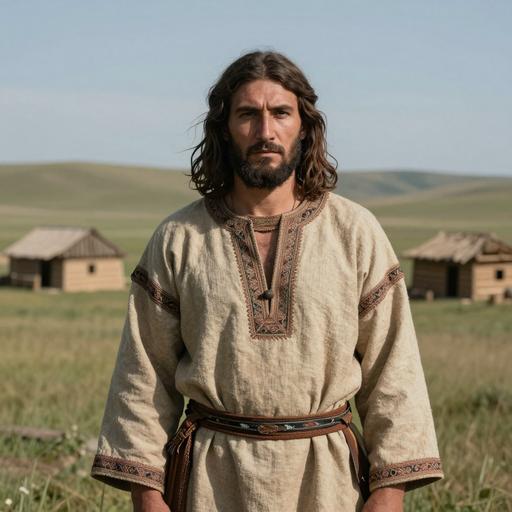
Portrait reconstruction of I11540
Ancient Individual

A man buried in Kazakhstan in the Late Iron Age era

I11540
131 CE - 318 CE
Male
Late Iron Georgievsky
Kazakhstan
Scroll to begin
Chapter I

Identity

The biological and cultural markers that define this ancient individual

Sample ID

I11540

Date Range

131 CE - 318 CE

Biological Sex

Male

mtDNA Haplogroup

A1a

Y-DNA Haplogroup

R-BY30764

Cultural Period

Late Iron Georgievsky

Chapter II

Place

Where this individual was discovered

Country Kazakhstan
Locality Georgievsky Bugor
Coordinates 50.4501, 57.0401
Chapter III

Time

When this individual lived in the broader context of human history

I11540 131 CE - 318 CE
Chapter IV

Story

The narrative of this ancient life

The Late Iron Age, particularly focused on the Georgievsky culture of the nomadic steppe cultures in Kazakhstan, is a fascinating period that highlights the dynamic interactions between sedentary civilizations and nomadic groups. The Georgievsky culture, nested within the broader scope of Central Asian history, represents a time when the steppes were vibrant with cultural exchanges, technological advancements, and strategic movements across vast landscapes.

Historical Context:

The Late Iron Age in Kazakhstan, spanning approximately from the 4th century BCE to the 2nd century CE, was a period characterized by the integration and influence of various cultural and technological shifts across the Eurasian steppes. The nomadic groups of this time, including the Georgievsky culture, were adept at horse-riding and had developed complex pastoral nomadic economies that relied on vast expanses of grazing land for their herds of cattle, sheep, and horses.

Geography and Environment:

The region inhabited by the Georgievsky culture was primarily the steppes of Kazakhstan, a vast grassland area that offered rich pastures for livestock but required a nomadic lifestyle due to its challenging climate and seasonal variations. The nomads were skilled at navigating this environment, moving along established migratory routes to take advantage of seasonal grazing and water resources.

Societal Structure:

The Georgievsky culture was likely organized into tribal confederations or clans, each led by chieftains or khans. Social structures were typically hierarchical but also flexible, allowing dynamic shifts in leadership based on merit, wisdom, or martial prowess. This flexibility was essential for survival, as it enabled groups to adapt quickly to changing conditions and threats from other nomadic tribes or sedentary civilizations.

Economy and Lifestyle:

Economically, the Georgievsky culture was primarily based on transhumant pastoralism, with a heavy reliance on animal husbandry. They domesticated horses, which were central not only for transportation and herding but also as a symbol of status and power. The cultivation of certain cereals might have been supplementary, conducted in oasis areas or through trade with sedentary neighbors.

Technological Advancements:

One of the significant contributions of the Late Iron Age nomadic cultures, including the Georgievsky, was in metallurgy, particularly in the production of iron tools and weapons. Their skill in metalworking allowed them to produce superior weapons like swords, spears, and arrowheads, which were crucial for defense and conquest, enhancing both their hunting abilities and military prowess.

Art and Material Culture:

Artifacts from this era suggest that the Georgievsky culture produced intricate metalwork, textiles, and possibly leather goods. Artistic motifs often featured animal forms, which held great symbolic significance, tying into shamanistic and religious beliefs regarding the spiritual world. Burial sites reveal that they engaged in complex rituals, with grave goods indicating a belief in the afterlife.

Cultural Exchanges and Influence:

The Georgievsky culture, like many other steppe cultures, served as a crucial link between East and West, facilitating the exchange of goods, ideas, and technologies along the proto-Silk Roads. They interacted with neighboring civilizations such as the Sarmatians, Persians, and, later on, the Huns and Turkic groups, absorbing and influencing cultural and technological attributes.

Conclusion:

The Late Iron Georgievsky culture of the nomadic steppe cultures in Kazakhstan is a testament to the enduring adaptability and resilience of nomadic societies. They mastered the art of survival in a challenging environment and played a pivotal role in the cultural and economic exchanges across Eurasia. Their legacy is reflected in the technological innovations, artistic expressions, and complex socio-political structures that influenced successive cultures and civilizations in the region.

Chapter V

Genetics

The genetic ancestry of this ancient individual

Ancient Genetic Admixture

This analysis compares the DNA profile of I11540 with ancient reference populations, showing the genetic composition in terms of prehistoric ancestral groups.

Western Steppe Pastoralists 36.8%
European Hunter-Gatherers 29.2%
Neolithic Farmers 20.1%
Ancient Asians 13.9%

Modern Genetic Admixture

This analysis compares the DNA profile with present-day reference populations, showing what percentage of genetic makeup resembles modern populations from different regions.

Europe 52.1%
Eastern European 28.0%
Northwestern European 24.1%
Scandinavian 18.1%
English 5.9%
Asia 45.3%
Northern West Asian 27.2%
Caucasian 27.2%
Central Asian, Northern Indian & Pakistani 17.5%
Pakistan 11.6%
Indian 5.9%
Northern Asian 0.6%
Siberian 0.6%
America 2.5%
America 2.5%
Native American 2.5%

Closest Modern Populations

These are the modern populations showing the closest statistical alignment to A man buried in Kazakhstan in the Late Iron Age era, ranked by genetic distance. Lower distance values indicate closer statistical similarity.

1
Pamiri Rushan
6.5989
2
Tatar Mishar
6.6822
3
Tajik Yaghnobi
6.9165
4
Tatar Kazan
7.3112
5
Pamiri Shugnan
7.3746
6
Turkish Deliorman
7.8265
7
Turkish Rumeli
8.1590
8
Tajik Tajikistan Kulob
8.2342
9
Lezgin
8.3108
10
Pamiri Badakhshan
8.4305
Chapter VI

Context

Other ancient individuals connected to this sample

Sources

References

Scientific publications and genetic data

Scientific Publication

The formation of human populations in South and Central Asia

Authors Narasimhan VM, Patterson N, Moorjani P
Abstract

By sequencing 523 ancient humans, we show that the primary source of ancestry in modern South Asians is a prehistoric genetic gradient between people related to early hunter-gatherers of Iran and Southeast Asia. After the Indus Valley Civilization's decline, its people mixed with individuals in the southeast to form one of the two main ancestral populations of South Asia, whose direct descendants live in southern India. Simultaneously, they mixed with descendants of Steppe pastoralists who, starting around 4000 years ago, spread via Central Asia to form the other main ancestral population. The Steppe ancestry in South Asia has the same profile as that in Bronze Age Eastern Europe, tracking a movement of people that affected both regions and that likely spread the distinctive features shared between Indo-Iranian and Balto-Slavic languages.

G25 Coordinates

The G25 coordinates for sample I11540 can be used for detailed admixture analysis in our G25 Studio tool.

I11540,0.1118129,0.06151786,0.01928412,0.04237956,-0.01628024,0.01618712,0.00464366,-0.00024124,-0.02128238,-0.02599994,0.00091914,0.00043324,0.00307586,-0.00856642,0.0024724,-0.00339172,-0.0086302,-0.0006444,-0.00581584,-0.00775336,-0.00021078,0.00382098,-0.00426394,0.00712418,-0.00322991
Analyze in G25 Studio
Use code for 40% off Expires Feb 26