Menu
Store
Blog
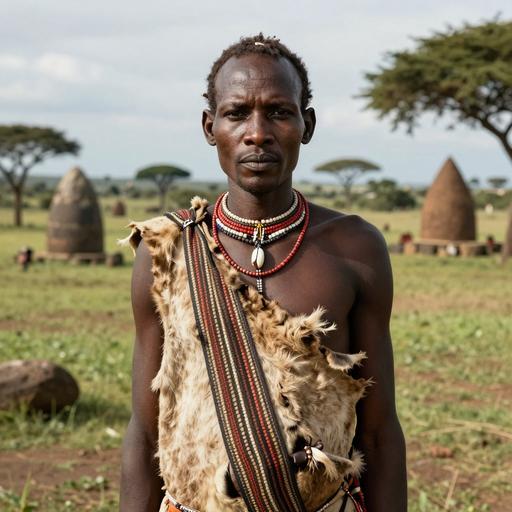
Portrait reconstruction of I12379
Ancient Individual

A man buried in Kenya in the Modern era

I12379
1527 CE - 1662 CE
Male
Historic Era 2 in Kenya
Kenya
Scroll to begin
Chapter I

Identity

The biological and cultural markers that define this ancient individual

Sample ID

I12379

Date Range

1527 CE - 1662 CE

Biological Sex

Male

mtDNA Haplogroup

L3h1a2a1

Y-DNA Haplogroup

E1b1b1b2b2a1

Cultural Period

Historic Era 2 in Kenya

Chapter II

Place

Where this individual was discovered

Country Kenya
Locality Emurula Ole Polos Cairns. GvJh 122
Coordinates -1.3960, 35.9830
Chapter III

Time

When this individual lived in the broader context of human history

I12379 1527 CE - 1662 CE
Chapter IV

Story

The narrative of this ancient life

The Nilotic period in Kenya refers to the era when Nilotic communities, such as the Luo, Maasai, and Turkana, among others, migrated and settled in the region. This period is marked by significant cultural, social, and economic developments characterized by dynamic pastoral and agricultural practices. Here's an extensive description of the Nilotic historical era in Kenya:

Historical Background

The arrival of Nilotic peoples in Kenya occurred over several centuries, with migrations beginning around 1000-1500 AD. These groups are believed to have originated from regions of the Nile Valley in present-day South Sudan and Ethiopia. The Nilotic migration was part of larger ethnolinguistic movements in East Africa, which also involved Bantu and Cushitic groups.

Cultural Characteristics

Nilotic cultures in Kenya have distinct social structures, languages, and customs. They are primarily speakers of Nilo-Saharan languages and are known for being pastoralists, although some groups like the Luo adopted agriculture and fishing due to their settlement in areas near rivers and lakes.

1. Social Structure and Clan Systems

  • Pastoral Communities: The Maasai and Turkana are famously known for their nomadic pastoralist lifestyle. They rely heavily on cattle, which are central to their economy, social status, and culture.
  • Clan Systems: Nilotic societies are organized into clan-based systems, where kinship and lineage play crucial roles in social organization. Elders hold significant authority, guiding community decisions and religious rites.

2. Economy and Livelihood

  • Pastoralism and Livestock: Livestock, particularly cattle, goats, and sheep, are vital for sustenance and trade. The Maasai, for example, are known for their deep connection with cattle, which are a source of food, dowry, and wealth.
  • Agriculture: Among the Luo, agriculture became prevalent with a focus on crops like millet, sorghum, and later, maize. Fishing also plays a significant role among communities residing near Lake Victoria.

3. Religion and Beliefs

  • Spiritual Practices: The Nilotic peoples have rich spiritual traditions. They practice animism and have a strong belief in ancestral spirits. The Maasai, for instance, worship a deity called Enkai.
  • Rituals and Ceremonies: Initiation rituals, circumcision, and age-set ceremonies are significant. These rituals mark transitions in societal roles and responsibilities.

Artistic and Cultural Expressions

1. Oral Traditions and Folklore

  • The Nilotic communities possess rich oral traditions, with folklore, proverbs, songs, and stories passed down through generations. These oral narratives play a crucial role in preserving history and cultural values.

2. Traditional Clothing and Adornments

  • The Maasai are world-renowned for their vibrant clothing and beadwork. They wear shukas (red blankets), and elaborate beadwork is used to signify social status and various life stages.

3. Music and Dance

  • Music and dance are vital aspects of Nilotic cultural expression. They are utilized in rituals, entertainment, and as a means of social commentary. Traditional instruments like the nyatiti for the Luo and the kudu horn for the Maasai accompany these expressions.

Interaction with Other Communities

The Nilotic groups, through trade, intermarriage, and occasional conflict, interacted with neighboring Bantu, Cushitic, and later European communities. These interactions led to cultural exchanges, hybrid practices, and sometimes tension.

Colonial and Post-Colonial Impact

The arrival of European colonialists in the late 19th century disrupted traditional lifestyles, impacting Nilotic societies through the division of land, introduction of new religions, and imposition of colonial governance structures.

Post-independence, Nilotic groups in Kenya have navigated the challenges of modernity while striving to maintain cultural traditions. Organizations and cultural festivals have been established to celebrate and preserve Nilotic heritage amid the pressures of globalization and national integration.

In summary, the Nilotic historical era in Kenya is a tapestry of vibrant cultures and rich traditions centered around pastoralism, community, and resilience. The enduring legacy of Nilotic societies continues to shape the cultural landscape of Kenya, contributing to its diverse and multifaceted identity.

Chapter V

Genetics

The genetic ancestry of this ancient individual

Ancient Genetic Admixture

This analysis compares the DNA profile of I12379 with ancient reference populations, showing the genetic composition in terms of prehistoric ancestral groups.

Ancient Africans 67.1%
Neolithic Farmers 30.1%
Ancient Asians 2.9%

Modern Genetic Admixture

This analysis compares the DNA profile with present-day reference populations, showing what percentage of genetic makeup resembles modern populations from different regions.

Africa 97.2%
Northern East African 68.0%
Ethiopian 39.8%
Eastern African 28.2%
Congolese & Southern East African 14.7%
South East African 14.7%
North African 6.5%
North African 5.0%
Egyptian 1.5%
West African 4.6%
Senegambian & Guinean 4.6%
African Hunter-Gatherer 3.5%
Europe 1.9%
Northwestern European 1.9%
Finnish 1.9%
Asia 0.8%
Arab, Egyptian & Levantine 0.8%
Arabian 0.8%

Closest Modern Populations

These are the modern populations showing the closest statistical alignment to A man buried in Kenya in the Modern era, ranked by genetic distance. Lower distance values indicate closer statistical similarity.

1
Elmolo
2.0986
2
Datog
2.8255
3
Ogiek
3.5493
4
Masai
4.2388
5
Ethiopian Ari Cultivator
4.4604
6
Ethiopian Ari Blacksmith
4.8279
7
Baggara Arab Sudan
5.2908
8
Ethiopian Ari
5.3309
Chapter VI

Context

Other ancient individuals connected to this sample

Sources

References

Scientific publications and genetic data

Scientific Publication

Ancient DNA reveals a multistep spread of the first herders into sub-Saharan Africa

Authors Prendergast ME, Lipson M, Sawchuk EA
Abstract

How food production first entered eastern Africa ~5000 years ago and the extent to which people moved with livestock is unclear. We present genome-wide data from 41 individuals associated with Later Stone Age, Pastoral Neolithic (PN), and Iron Age contexts in what are now Kenya and Tanzania to examine the genetic impacts of the spreads of herding and farming. Our results support a multiphase model in which admixture between northeastern African-related peoples and eastern African foragers formed multiple pastoralist groups, including a genetically homogeneous PN cluster. Additional admixture with northeastern and western African-related groups occurred by the Iron Age. These findings support several movements of food producers while rejecting models of minimal admixture with foragers and of genetic differentiation between makers of distinct PN artifacts.

G25 Coordinates

The G25 coordinates for sample I12379 can be used for detailed admixture analysis in our G25 Studio tool.

I12379,-0.40736942,0.07826518,-0.01743514,-0.040831,-0.00235612,-0.01807808,-0.0030263,-0.00603888,0.0997064,-0.08080914,-0.01495192,0.00228928,-0.01296728,0.0015952,0.01768414,-0.016096,0.01497206,0.00080208,0.01136798,-0.00952978,0.00210122,0.00168694,-0.00310338,-0.00167348,0.00215993
Analyze in G25 Studio
Use code for 40% off Expires Feb 27