Menu
Store
Blog
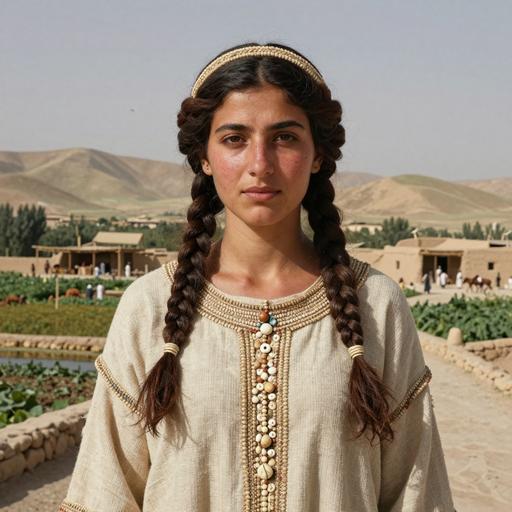
Portrait reconstruction of I4351
Ancient Individual

A woman buried in Iran in the Copper Age era

I4351
6065 BCE - 5889 BCE
Female
Chalcolithic Hajji Firuz
Iran
Scroll to begin
Chapter I

Identity

The biological and cultural markers that define this ancient individual

Sample ID

I4351

Date Range

6065 BCE - 5889 BCE

Biological Sex

Female

mtDNA Haplogroup

HV

Cultural Period

Chalcolithic Hajji Firuz

Chapter II

Place

Where this individual was discovered

Country Iran
Locality Hajji Firuz
Coordinates 36.9944, 45.4744
Chapter III

Time

When this individual lived in the broader context of human history

I4351 6065 BCE - 5889 BCE
Chapter IV

Story

The narrative of this ancient life

The Chalcolithic era, also known as the Copper Age, represents a significant period in human history marked by the first use of metal alongside stone tools. Hajji Firuz Tepe, located in the northwestern region of modern-day Iran, is an important archaeological site that provides insight into the Chalcolithic culture and the early stages of ancient Near Eastern civilization.

Geographic and Environmental Context

Situated in the Zagros Mountain region, Hajji Firuz Tepe is part of a series of settlements scattered across what is now northwestern Iran. The region features a combination of fertile valleys and rugged terrain, creating a diverse environment conducive to early agricultural and pastoral activities. Access to natural resources such as water, timber, and metal ores likely facilitated early human settlement and technological advancements.

Chronology

The Hajji Firuz culture dates approximately to the late 6th and early 5th millennia BCE, a transitional period between the Neolithic and the more urbanized societies of the Bronze Age. This era is characterized by the advent of metallurgy in which copper tools began to supplement existing stone tool technologies.

Material Culture

  1. Pottery: The Chalcolithic inhabitants of Hajji Firuz Tepe are renowned for their distinctive pottery. Characterized by simple handcrafted forms, the pottery is often painted with geometric designs in shades of red and black against a buff background. These ceramics are crucial in understanding the technological and cultural dynamics of the era.

  2. Metallurgy: The introduction of copper tools signifies technological progression. Though still rudimentary, these tools reflect experimentation with metalwork, a precursor to advancements in metallurgy that would define subsequent cultures.

  3. Stone Tools: Stone tools remained prevalent and were skillfully crafted. Flint and obsidian were commonly used, suggesting a continuation of traditional Neolithic skills alongside emerging metal technologies.

Settlement and Architecture

Hajji Firuz Tepe settlements during the Chalcolithic period were relatively small and organized, with circular or rectangular mud-brick dwellings. Excavations reveal evidence of communal structures, indicating an organized society with some degree of social cohesion and collective effort.

Economy and Subsistence

  1. Agriculture: The economy of the Chalcolithic Hajji Firuz culture was predominantly agrarian. They cultivated a variety of crops such as barley and wheat, pointing towards established farming practices.

  2. Animal Husbandry: The domestication of sheep, goats, and cattle was common, providing meat, milk, wool, and other resources. This indicates a mixed subsistence strategy combining agriculture and pastoralism.

  3. Trade: Evidence of trade is seen through non-local materials such as obsidian and cowrie shells found at the site, suggesting exchange networks that extended beyond immediate geographical boundaries.

Social Structure and Organization

The societal organization of the Chalcolithic Hajji Firuz culture remains partially speculative but likely involved small, kin-based communities. The absence of grandiose architecture or elaborate burials suggests an egalitarian society with limited social stratification during this period.

Religion and Ritual

While specific religious practices of Hajji Firuz inhabitants are not extensively documented, the presence of figurines and evidence of ritualistic activity suggests spiritual or religious beliefs and practices. These likely involved nature reverence, fertility rites, or ancestor worship, common in early agrarian societies.

Contributions to Later Civilizations

The Chalcolithic Hajji Firuz culture represents an important transitional phase that laid foundational elements for the complex societies that followed in the ancient Near East. Its advancements in metallurgy, agricultural techniques, and societal organization influenced the development of later civilizations in the region, such as those in Mesopotamia and Elam.

In summary, the Chalcolithic Hajji Firuz culture provides a fascinating glimpse into the early adaptive strategies and innovations that heralded the shift from simple agrarian villages to more complex urban societies. Its archaeological findings contribute significantly to our understanding of prehistoric human development in the Near East.

Chapter V

Genetics

The genetic ancestry of this ancient individual

Ancient Genetic Admixture

This analysis compares the DNA profile of I4351 with ancient reference populations, showing the genetic composition in terms of prehistoric ancestral groups.

Neolithic Farmers 78.5%
European Hunter-Gatherers 13.4%
Western Steppe Pastoralists 3.1%
Ancient Asians 2.5%
Ancient Africans 2.5%

Modern Genetic Admixture

This analysis compares the DNA profile with present-day reference populations, showing what percentage of genetic makeup resembles modern populations from different regions.

Asia 98.5%
Northern West Asian 52.8%
Mesopotamian 27.0%
Caucasian 14.9%
Cypriot 8.1%
Anatolian 2.9%
Arab, Egyptian & Levantine 35.1%
Levantine 29.1%
Arabian 6.0%
Central Asian, Northern Indian & Pakistani 10.6%
Indian 7.1%
Pakistan 3.5%
Europe 1.4%
Southern European 1.4%
Italian 1.0%

Closest Modern Populations

These are the modern populations showing the closest statistical alignment to A woman buried in Iran in the Copper Age era, ranked by genetic distance. Lower distance values indicate closer statistical similarity.

1
Armenian Ararat
1.9114
2
Armenian Gesaria
2.0588
3
Armenian Erzurum
2.0818
4
Armenian Syunik
2.1255
5
Georgian Jew
2.2138
6
Turkish Erzurum
2.2311
7
Assyrian
2.2649
8
Armenian Urfa
2.4656
9
Armenian Parspatunik
2.5733
10
Armenian Aintab
2.5786
Chapter VI

Context

Other ancient individuals connected to this sample

Sources

References

Scientific publications and genetic data

Scientific Publication

The formation of human populations in South and Central Asia

Authors Narasimhan VM, Patterson N, Moorjani P
Abstract

By sequencing 523 ancient humans, we show that the primary source of ancestry in modern South Asians is a prehistoric genetic gradient between people related to early hunter-gatherers of Iran and Southeast Asia. After the Indus Valley Civilization's decline, its people mixed with individuals in the southeast to form one of the two main ancestral populations of South Asia, whose direct descendants live in southern India. Simultaneously, they mixed with descendants of Steppe pastoralists who, starting around 4000 years ago, spread via Central Asia to form the other main ancestral population. The Steppe ancestry in South Asia has the same profile as that in Bronze Age Eastern Europe, tracking a movement of people that affected both regions and that likely spread the distinctive features shared between Indo-Iranian and Balto-Slavic languages.

G25 Coordinates

The G25 coordinates for sample I4351 can be used for detailed admixture analysis in our G25 Studio tool.

I4351,0.09587052,0.12870906,-0.05966676,-0.0591874,-0.0340005,-0.01428816,0.00452114,-0.00356624,-0.0275014,-0.007535,0.00551698,0.00208052,-0.00117162,0.00175264,-0.0074217,-0.00555116,-0.00075302,-0.00038446,-0.00157436,0.00112908,0.0040006,0.00302546,-0.0012886,-0.0066259,-0.00311273
Analyze in G25 Studio
Use code for 40% off Expires Feb 26