Menu
Store
Blog
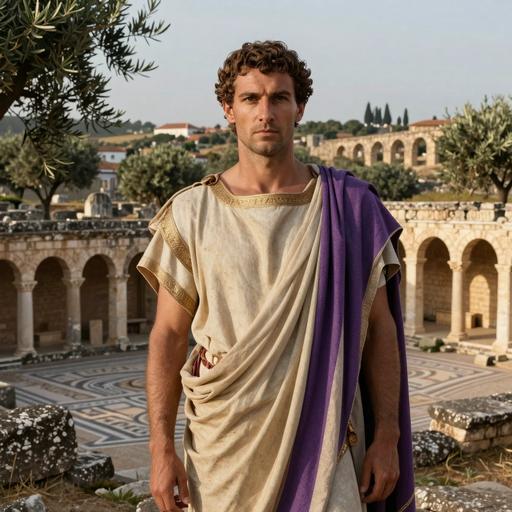
Portrait reconstruction of R10488
Ancient Individual

A man buried in Portugal in the Middle Ages era

R10488
250 CE - 450 CE
Male
Roman Conimbriga
Portugal
Scroll to begin
Chapter I

Identity

The biological and cultural markers that define this ancient individual

Sample ID

R10488

Date Range

250 CE - 450 CE

Biological Sex

Male

mtDNA Haplogroup

Not available

Y-DNA Haplogroup

Not available

Cultural Period

Roman Conimbriga

Chapter II

Place

Where this individual was discovered

Country Portugal
Locality Coimbra. Condeixa-à-Velha. Conimbriga
Coordinates 40.0994, -8.4906
Chapter III

Time

When this individual lived in the broader context of human history

R10488 250 CE - 450 CE
Chapter IV

Story

The narrative of this ancient life

Conímbriga, located in present-day Portugal, represents one of the most significant Roman archaeological sites on the Iberian Peninsula. It provides valuable insights into the social, economic, and architectural aspects of life during the Roman Empire. Conímbriga was originally a Celtic settlement, but it was transformed into a flourishing Roman town from the 1st century BCE through the 4th century CE.

Historical Background

Pre-Roman and Roman Conquest

Conímbriga's history dates back to the Iron Age when it was settled by indigenous Celtic tribes. The Romans first arrived in the region in the 2nd century BCE, during the conquest of the Iberian Peninsula. Conímbriga was formally integrated into the Roman Empire after the campaigns led by General Decimus Junius Brutus in 139 BCE. The strategic location of Conímbriga, situated along important trade routes, contributed to its development as a thriving Roman settlement.

Roman Development

Under Roman rule, Conímbriga developed significantly. By the 1st century CE, it became a municipium, a self-governing city under Roman law. Roman engineers constructed an extensive infrastructure, including roads, aqueducts, and public buildings, which were characteristic of Roman urban planning and contributed to the economic prosperity and quality of life in the city.

Urban Structure and Architecture

The urban layout of Conímbriga was typical of Roman towns, reflecting advanced planning and architectural prowess. The city was fortified with substantial walls, some of which remain today. Inside these walls, residential areas, public baths, markets, and entertainment venues reflected the Roman way of life.

Public Buildings

  • Forum: The social and political center of the city, the forum was a large open space surrounded by public buildings and temples. It served as the hub of civic life.
  • Baths: The public baths of Conímbriga were integral to daily life, serving as sites for socialization and leisure as well as hygiene. They featured elaborate heating systems (hypocausts) and different rooms for cold, warm, and hot baths.
  • Houses (Domus): Wealthy residents lived in elaborate houses or domus, adorned with intricate mosaics that depicted mythological themes and daily life. The House of the Fountains is particularly notable, showcasing elaborate water features and a peristyle garden.

Infrastructure

  • Aqueducts and Water Management: Conímbriga had a sophisticated water management system, which included aqueducts to bring fresh water into the city, distribution systems, and sewage management. This facilitated the functioning of baths and fountains.
  • Roads: The city was connected by a network of roads that facilitated trade and movement of people. The presence of these roads underscored Conímbriga’s role as a trade hub.

Society and Economy

Social Structure

The social structure of Conímbriga, similar to other Roman cities, was hierarchical. At the top were Roman citizens, often occupying administrative and political positions, followed by freedmen and slaves. The integration of local Celtic elites into the Roman administrative system reflects the process of Romanization, whereby local identities were subsumed under Roman practices.

Economy

Conímbriga's economy was diverse, relying on agriculture, mining, and trade. The city benefitted from its location on trade routes, importing luxury goods such as wine and oil from across the empire while exporting local produce and crafts. Markets in the city were centers for exchange, contributing to the city's prosperity.

Cultural and Religious Life

Religion

Religion in Conímbriga was a syncretic blend of Roman and local practices. Temples and shrines within the city honored Roman deities such as Jupiter, Mars, and Venus, and Roman religious occasions were marked by festivals and public ceremonies. Evidence of local religious practices suggests a degree of cultural integration and the persistence of indigenous traditions.

Art and Education

Art in Conímbriga was expressed through mosaics, sculptures, and architecture, revealing the aesthetic sensibilities of its residents. The mosaics, in particular, demonstrate the artistic sophistication and wealth of the city's residents. Education was primarily the privilege of the elite, with a curriculum based on Roman traditions focusing on rhetoric, grammar, and philosophy.

Decline and Legacy

Conímbriga faced decline in the 3rd and 4th centuries CE due to various factors, including economic difficulties, political instability within the empire, and invasions by barbarian tribes. While it lost political significance, many of its structures were preserved beneath later debris and renovations. The archaeological site today, with its extensive ruins, provides vital insights into urban life during the Roman Empire.

Modern archaeological efforts have transformed Conímbriga into an open-air museum, attracting scholars and tourists keen to explore Roman culture and history. Its well-preserved ruins remain a testament to Roman engineering, urban planning, and the cultural fusion of Roman and local traditions.

Chapter V

Genetics

The genetic ancestry of this ancient individual

Ancient Genetic Admixture

This analysis compares the DNA profile of R10488 with ancient reference populations, showing the genetic composition in terms of prehistoric ancestral groups.

Neolithic Farmers 34.1%
European Hunter-Gatherers 33.5%
Western Steppe Pastoralists 29.2%
Ancient Africans 3.3%

Modern Genetic Admixture

This analysis compares the DNA profile with present-day reference populations, showing what percentage of genetic makeup resembles modern populations from different regions.

Europe 94.7%
Southern European 69.3%
Iberian 57.4%
Sardinian 9.5%
Balkan 2.4%
Northwestern European 25.4%
Scandinavian 25.4%
Africa 5.3%
North African 5.3%
North African 5.3%

Closest Modern Populations

These are the modern populations showing the closest statistical alignment to A man buried in Portugal in the Middle Ages era, ranked by genetic distance. Lower distance values indicate closer statistical similarity.

1
Spanish Biscay
1.9172
2
Spanish Barcelones
2.1575
3
Spanish Cantabria
2.3398
4
Spanish Burgos
2.3457
5
Spanish Cataluna
2.4399
6
Spanish Navarra
2.4606
7
French South
2.4919
8
Spanish Aragon
2.4966
9
French Bearn
2.5026
10
Spanish Valencia
2.5249
Chapter VI

Context

Other ancient individuals connected to this sample

Sources

References

Scientific publications and genetic data

G25 Coordinates

The G25 coordinates for sample R10488 can be used for detailed admixture analysis in our G25 Studio tool.

R10488,0.11034924,0.1483112,0.04955474,0.00924774,0.0497465,0.00155544,-0.00083856,0.00391082,0.02642942,0.0299356,-0.00890178,0.0119282,-0.0204446,-0.00907588,0.0131211,-0.00345134,-0.01428084,-0.00183324,-0.0006567,-0.00181076,0.00667274,0.004884,-0.0103139,-0.0059371,0.00077742
Analyze in G25 Studio
Use code for 40% off Expires Feb 26