Menu
Store
Blog
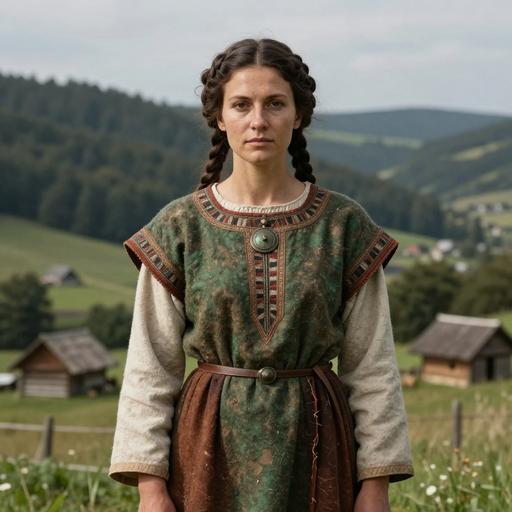
Portrait reconstruction of R2201
Ancient Individual

A woman buried in Slovakia in the Iron Age era

R2201
100 BCE - 60 CE
Female
La Tène to Roman Period Púchov Culture, Bytča-Hrabové, Slovakia
Slovakia
Scroll to begin
Chapter I

Identity

The biological and cultural markers that define this ancient individual

Sample ID

R2201

Date Range

100 BCE - 60 CE

Biological Sex

Female

mtDNA Haplogroup

Not available

Cultural Period

La Tène to Roman Period Púchov Culture, Bytča-Hrabové, Slovakia

Chapter II

Place

Where this individual was discovered

Country Slovakia
Locality Bytča district. Bytča-Hrabové
Coordinates 49.2056, 18.5662
Chapter III

Time

When this individual lived in the broader context of human history

R2201 100 BCE - 60 CE
Chapter IV

Story

The narrative of this ancient life

The La Tène to Roman Period Púchov Culture, specifically centered around Bytča-Hrabové in Slovakia, represents a fascinating transition and integration of cultural and societal influences during the late Iron Age and early Roman period in Central Europe. This era, approximately spanning from the 2nd century BCE to the 1st century CE, was characterized by the interaction and gradual assimilation of Celtic cultures with Roman influences, as well as indigenous developments unique to the Púchov culture.

La Tène Culture Background

The La Tène culture, named after an archaeological site in Switzerland, represents the latter part of the European Iron Age. Known for its art, metalwork, and complex social structures, this culture spread across much of Europe. In the Carpathian Basin and the area now known as Slovakia, La Tène influence was pronounced, marked by distinct styles in pottery, jewelry, weapons, and settlements.

Púchov Culture - Characteristics

The Púchov Culture, primarily located in present-day Slovakia, including the region of Bytča-Hrabové, is believed to have emerged as a local adaptation and evolution of the La Tène culture. This culture maintained many Celtic traditions while also integrating influences from neighboring tribes and eventually the Roman Empire.

1. Settlement Patterns:

Púchov settlements were often strategically located on elevated and fortified positions. These hill-forts provided defense and controlled trade routes. Bytča-Hrabové, for instance, would have been suitably located near the Váh River, serving as both a defensive site and a trade hub.

2. Economic Activities:

The inhabitants of the Púchov Culture were engaged in agriculture, livestock farming, and metallurgy. Evidence of advanced ironworking skills is notable, with tools, weapons, and decorative metal objects reflecting both functionality and aesthetic finesse.

3. Art and Crafts:

The artistic expressions of the Púchov Culture show continuity from the La Tène tradition, with intricate designs found on pottery, metalworks, and personal ornaments. These artifacts often feature geometric patterns and stylized natural motifs, indicative of Celtic artistic sensibilities.

4. Burial Practices:

Funerary practices during this transition period reveal a mix of Celtic traditions with emergent Roman influences. Both cremation and inhumation were practiced, and grave goods often included weapons, fibulae, and ceramics, which provide insights into social stratification and cultural affiliations.

Roman Influence

The Roman conquest and subsequent incorporation of parts of Central Europe into the Roman Empire brought about significant changes. Though the region of modern Slovakia was never fully integrated into the Roman Empire, its proximity to Roman provinces like Pannonia facilitated cross-cultural exchanges.

1. Trade and Economy:

The Púchov Culture, by virtue of its position, became a participant in the extensive Roman trade networks. Roman goods such as amphorae, glass, and luxurious items have been uncovered at archaeological sites, suggesting the adoption of some aspects of Roman lifestyle and amenities.

2. Military and Political Structures:

The Roman influence is likely to have introduced new military strategies and organizational frameworks to the Púchov communities. The presence of Roman coins and artifacts underlines the political and economic interactions between these cultures.

3. Cultural Synthesis:

The fusion of La Tène and Roman elements in the Púchov Culture is evident in their art, architecture, and societal roles. This synthesis created a unique cultural identity that persisted even under Roman dominion.

Conclusion

The transition from the La Tène to Roman Period marks an era of profound transformation for the Púchov Culture of Bytča-Hrabové. It encapsulates the dynamic interactions between indigenous Celtic traditions and the encroaching influence of the Roman Empire. This period is not only a testament to cultural resilience and adaptation but also to the complexities of ancient identity formation in the face of changing political and social landscapes. The archaeological remains from this era provide invaluable insights into the cultural syncretism that defined much of Central Europe during this time.

Chapter V

Genetics

The genetic ancestry of this ancient individual

Ancient Genetic Admixture

This analysis compares the DNA profile of R2201 with ancient reference populations, showing the genetic composition in terms of prehistoric ancestral groups.

European Hunter-Gatherers 40.9%
Western Steppe Pastoralists 30.5%
Neolithic Farmers 28.6%

Modern Genetic Admixture

This analysis compares the DNA profile with present-day reference populations, showing what percentage of genetic makeup resembles modern populations from different regions.

Europe 100.0%
Northwestern European 48.0%
Northwestern European 19.8%
English 17.7%
Scandinavian 5.9%
Finnish 4.7%
Southern European 42.2%
Iberian 22.4%
Balkan 18.3%
Sardinian 1.5%
Eastern European 9.8%

Closest Modern Populations

These are the modern populations showing the closest statistical alignment to A woman buried in Slovakia in the Iron Age era, ranked by genetic distance. Lower distance values indicate closer statistical similarity.

1
French Nord
1.6603
2
French Alsace
1.7680
3
Belgianb
1.7931
4
German
1.8112
5
Belgiana
1.8370
6
French Pas De Calais
1.8833
7
Belgianc
1.8937
8
German Erlangen
2.0861
9
French Paris
2.1564
10
French Brittany
2.1773
Chapter VI

Context

Other ancient individuals connected to this sample

Sources

References

Scientific publications and genetic data

G25 Coordinates

The G25 coordinates for sample R2201 can be used for detailed admixture analysis in our G25 Studio tool.

R2201,0.129644,0.13605448,0.05691176,0.03247104,0.04403264,0.01161384,0.00242752,0.00665098,0.01213666,0.01129386,-0.00523598,0.00473272,-0.0070176,-0.00505828,0.00781024,0.00373544,-0.002342,0.00188162,-0.00026918,-0.00039108,0.00344546,0.00177806,-0.00072418,0.00118086,0.00207314
Analyze in G25 Studio
Use code for 40% off Expires Feb 26