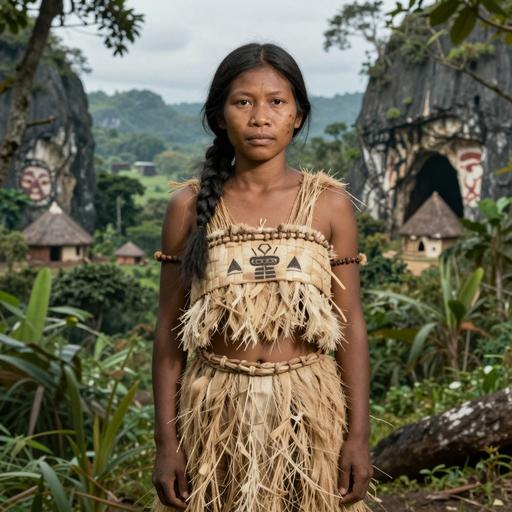
The ancient hunter-gatherers of Indonesia, particularly in regions like Sulawesi, represent a fascinating chapter of human prehistory, revealing insights into early human migration, adaptation, and cultural development. These early inhabitants of Indonesia are often associated with the broader Austronesian migration patterns, although hunter-gatherer cultures existed long before the widespread distribution of Austronesian-speaking peoples.
Geographical Context
Sulawesi is one of the largest islands in Indonesia with a diverse and rugged landscape featuring mountains, tropical forests, and coastlines. This varied geography provided numerous ecological niches, which likely influenced the lifestyle and subsistence strategies of its ancient inhabitants. The island's position in the Indo-Pacific region also made it a pivotal location for human migration and cultural exchanges.
Archaeological Evidence
The earliest evidence of human habitation in Sulawesi dates back over 40,000 years. This is based on archaeological findings, including stone tools and cave art, most notably the hand stencils and animal depictions in the Maros-Pangkep karst region, which are among the oldest known artworks in the world.
Lifestyle and Subsistence
The ancient hunter-gatherers of Sulawesi led a nomadic or semi-nomadic lifestyle, relying on the rich biodiversity around them. Their subsistence likely included:
Hunting: They hunted a variety of animals including small to medium-sized mammals and birds, making use of tools like stone blades and possibly early projectile points.
Fishing and Gathering: Proximity to coastal and riverine environments would have made fish and other aquatic resources a significant part of their diet. This would also include shellfish gathering along the coasts.
Plant Foraging: Collection of fruits, nuts, roots, and tubers from the diverse plant life in tropical forests would have been essential for sustenance.
Cultural and Social Organization
These communities were likely organized into small, kin-based groups, typical of hunter-gatherer societies. Social structures would have been egalitarian, with shared responsibilities in hunting, gathering, and childcare. Cultural aspects such as art, religion, and tool-making indicate a complex and rich societal fabric.
- Art and Symbolism: The cave paintings in Sulawesi are a testament to their artistic capabilities and suggest ritualistic or symbolic functions, possibly related to shamanistic practices or social storytelling.
Austronesian Connections
While the ancient hunter-gatherers of Sulawesi predate the Austronesian migrations, these later waves of Austronesian-speaking people, who began expanding out of Taiwan around 5,000 years ago, eventually reached Indonesia. As these Austronesian groups migrated, they introduced new technologies, agricultural practices, and languages, assimilating and interacting with existing populations.
Environmental and Cultural Adaptations
The adaptability of these ancient hunter-gatherers is evident in their successful occupation of various environmental niches. They developed a deep understanding of their surroundings, leading to refined hunting techniques and resource management.
Conclusion
The ancient hunter-gatherers of Sulawesi and broader Indonesia laid foundational cultural and genetic contributions that would persist in the region's subsequent Austronesian societies. Their adaptability and creativity are reflected in archaeological findings that continue to shed light on their complex interactions with the environment and each other. As such, they represent a crucial link in understanding human evolution and cultural development in Southeast Asia.