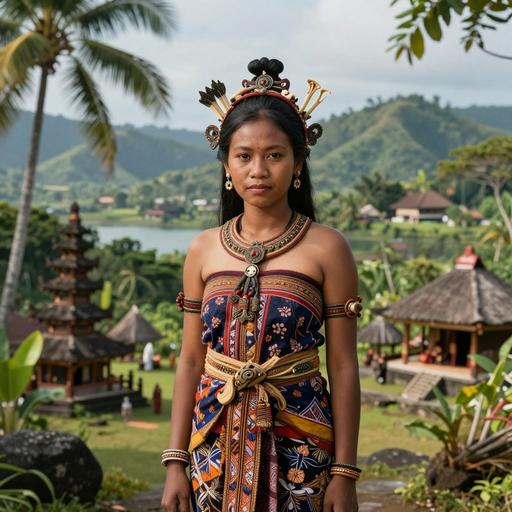
Pre-colonial Indonesia, particularly the Austronesian period, was a vibrant and dynamic era that significantly shaped the cultural, political, and social landscapes of the region. This period spans from the early migrations of Austronesian peoples to the emergence of prominent kingdoms such as Majapahit prior to European colonization.
Austronesian Migrations
The Austronesian era in Indonesia began with the migrations of Austronesian-speaking peoples, who are believed to have originated from Taiwan around 3000 to 1500 BCE. These maritime people spread across Southeast Asia, reaching as far as Madagascar and Easter Island. In Indonesia, they arrived on the archipelago and began to establish agricultural societies. They brought with them advanced knowledge of seafaring, agriculture, and technology which played a crucial role in the development of early Indonesian communities.
Socio-Cultural Developments
Linguistics and Society
The Austronesian languages formed the linguistic foundation for many of the languages spoken in Indonesia today. The social structure of these early communities was typically hierarchical, with leadership often vested in local chieftains or tribal leaders. The communities were primarily agrarian but complemented by fishing, hunting, and gathering due to the archipelagic geography.
Art and Architecture
Austronesian people are known for their distinctive art and architecture. This period saw the construction of impressive megalithic structures and the development of indigenous spiritual practices featuring animism and ancestor worship. Traditional crafts such as weaving, pottery, and metalworks flourished, influenced by natural motifs and spiritual significance.
Political Entities
Kingdom of Pantar and Jareng Bori
Pantar and Jareng Bori, though less documented compared to major kingdoms, reflected the diversity of Indonesia's political landscape. These communities contributed to the rich tapestry of pre-colonial political entities that thrived through complex trade networks and mutual relations with neighboring regions.
The Majapahit Empire
The Majapahit Empire (circa 1293–1527 CE) represents the zenith of pre-colonial Indonesian power and influence. It succeeded the Singhasari kingdom and became a significant political and cultural entity. Majapahit established a vast thalassocracy that extended its influence over much of Southeast Asia. It was renowned for its sophisticated governance, wealth, and as a center for religion and intellectual developments.
Economy and Trade
Trade was a significant aspect of pre-colonial Indonesian life, with the region's strategic geographical position fostering robust trade networks. Spices, particularly cloves, nutmeg, and mace, were highly sought after by traders from China, India, and later the Middle East, leading to Indonesia's prominence in early global trade routes. The economy was not only reliant on spice but also on other commodities like timber, metals, rice, and textiles, which were exchanged through extensive maritime trade networks.
Religion and Belief Systems
The Austronesian pre-colonial era was characterized by indigenous belief systems prominently featuring animism, ancestor worship, and a reverence for nature. With increased trade and cultural exchanges, Hinduism and Buddhism gradually spread to the region, profoundly influencing the religious and cultural practices. This was evident in the art, literature, and architecture, with the construction of monumental structures like Borobudur and Prambanan.
Conclusion
The Austronesian period in pre-colonial Indonesia laid the foundation for the region's cultural and political identity, influencing its social structures, trade networks, and belief systems. The subsequent Kingdoms, such as Majapahit, built on this foundation, creating a legacy that continues to resonate today. This era is a testament to the ingenuity and adaptability of the Indonesian peoples, who harnessed their maritime prowess and rich cultural heritage to thrive in a diverse and ever-changing landscape.