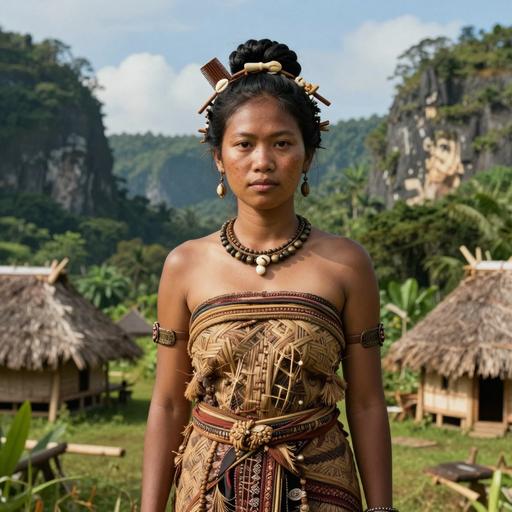
The Late Iron Age period in Indonesia, particularly in regions such as Flores and sites like Liang Toge, represents a fascinating chapter in the Austronesian cultural tapestry. This era is characterized by the increased sophistication in metallurgy, complex social structures, and elaborate artistic expressions that reflect broader regional interactions across the Austronesian world.
Geographical and Environmental Context:
Flores, an island in eastern Indonesia, is part of the Lesser Sunda Islands. Its diverse topography, ranging from coastal areas to rugged highlands, significantly impacted the settlement patterns and lifestyle of its inhabitants during the Late Iron Age. The island's varying climate, marked by wet and dry seasons, influenced agricultural practices, contributing to societal resilience and economic stability.
Cultural and Societal Structure:
The Late Iron Age on Flores is marked by the presence of Austronesian-speaking communities who had established themselves across the archipelago. These communities were part of the broader Austronesian expansion, which saw the spread of peoples and cultures across the Pacific and Indian Oceans.
Society in this era was typically organized into hierarchical chiefdoms. These chiefdoms were likely ruled by chieftains or local kings who held both political and religious authority. Social stratification was evident, with an elite class emerging due to control over resources such as metals and wealth acquired through trade. Artisan classes, skilled in metallurgy and other crafts, played a crucial role in the socioeconomic dynamics of the time.
Metallurgy and Technology:
The Late Iron Age was marked by significant advancements in metalworking technology, especially iron and bronze. The production of iron tools and weapons not only enhanced agricultural productivity but also played a critical role in local warfare and defense strategies. The ability to work metals such as bronze allowed for the creation of intricate ceremonial objects, jewelry, and tools, which were often used as status symbols and in trade.
These technological advancements were facilitated by widespread trade networks that connected Flores with other parts of Indonesia and beyond. The exchange of goods, ideas, and technology with neighboring islands and distant lands enriched the cultural and technological landscape of Flores during this period.
Artistic and Religious Expressions:
Art and religion were deeply intertwined during the Late Iron Age in Indonesia. Artistic expression found its way into every aspect of life, from daily utensils to ceremonial artifacts. Shells, beads, and metals were frequently used to create ornate jewelry and ceremonial items. Motifs often depicted in art and carvings include animals, geometric patterns, and mythological figures, reflecting both local beliefs and broader Austronesian cosmology.
The religious life of Late Iron Age communities in Flores was likely centered around ancestor worship and animistic beliefs, which emphasized the spiritual connection with the natural world. Megalithic structures and burial sites discovered in various parts of Flores indicate rituals and practices aimed at honoring ancestors and appeasing spirits.
Trade and External Influences:
The communities in Flores were active participants in the extensive maritime trade networks of Southeast Asia. These trade routes connected them with other Austronesian societies, as well as with traders from India, China, and beyond. Through these interactions, Flores experienced cultural exchanges that influenced its art, technology, and sociopolitical structures.
The presence of foreign goods, such as Chinese ceramics and Indian textiles, in archaeological sites suggests Flores' integration into the larger economic and cultural systems of the region. These interactions facilitated the flow of ideas and technologies, enhancing local innovation and cultural development.
Conclusion:
The Late Iron Age on Flores, represented by sites like Liang Toge, was a period of significant cultural evolution and technological advancement. The Austronesian inhabitants of Flores developed a complex society characterized by ironworking, elaborate artistic traditions, and robust trade networks. Their legacy is etched into the cultural and historical landscape of Indonesia, offering valuable insights into the social dynamics and technological prowess of pre-colonial Austronesian societies.