انتقل إلى المحتوى الرئيسي
ملفات الحمض النووي

Orkney Dawn

Neolithic communities of northern Scotland where stone, sea and genes meet

4000 CE - 2348 BCE
Scotland (Orkney & mainland)

القصة

Scotland_N (4000–2348 BCE) captures Neolithic communities across Orkney and mainland Scotland. Archaeology of chambered tombs and farmsteads aligns with ancient DNA showing strong Y-haplogroup I signal and diverse maternal lineages (K, U, J, H, T). Regional sampling (45) reveals farmer–hunter-gatherer mixtures with local persistence.

Time Period

4000–2348 BCE

Region

Scotland (Orkney & mainland)

Common Y-DNA

I (27 of 45)

Common mtDNA

K (12), U (7), J (5), H (5), T (3)

الخط الزمني

3000 BCE

Active use of chambered tombs in Orkney

Regional cairns and chambered tombs in Orkney are actively constructed and reused, anchoring communal ritual and burial practices.

Origins & Emergence

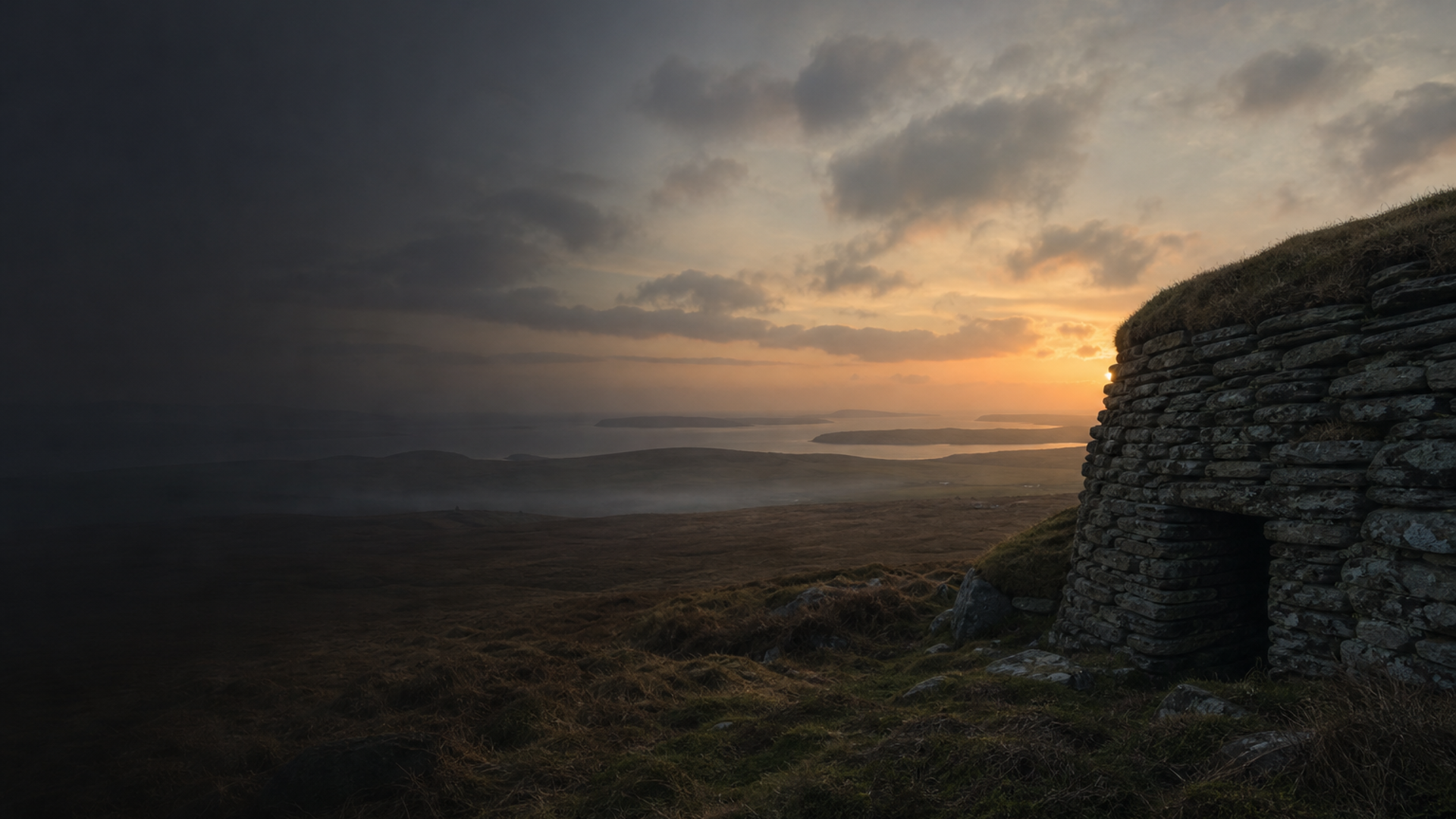
The Scotland_N assemblage spans the heart of the Scottish Neolithic — from island tombs in Orkney to caves and lowland sites on the mainland — between roughly 4000 and 2348 BCE. Archaeological landmarks in this dataset include Unstan Chamber Tomb (Orkney), Holm of Papa Westray North, Isbister and Quoyness on mainland Orkney, as well as Tulach an t'Sionnach and Raschoille Cave on the west coast. These sites evoke a landscape of stone-built ritual and settlement: circular tombs, domestic aisles, and coastal farmsteads.

Archaeological data indicates that farming and new material culture arrived in northern Britain with people carrying ancestry derived largely from early European farmers, who mixed with indigenous hunter-gatherers. The material record — Unstan ware pottery, carved stone assemblages and chambered cairns — shows both shared Neolithic traditions and distinctive northern adaptations. Maritime routes across the North Sea and Irish Sea likely funneled people, ideas and livestock into Orkney and western Scotland, creating a patchwork of communities adapted to rugged coasts and fertile machair.

Limited evidence suggests regional diversity: Orkney tomb architecture and ritual practices are particularly prominent in the dataset, implying local developments of pan‑Neolithic themes. The 45 sampled individuals provide enough power to recognize broad demographic patterns, though finer chronological and social details remain provisional until denser chronometric and geographic sampling are available.

  • Sites: Unstan, Holm of Papa Westray North, Isbister, Quoyness, Raschoille Cave
  • Period: Neolithic expansion and local adaptation (4000–2348 BCE)
  • Evidence: chambered tombs, Unstan ware pottery, coastal farmsteads

Daily Life & Society

Archaeological remains paint a cinematic picture of everyday life under a cool northern sky. Large stone tombs mark communal memory while nearby houses and middens record routine labor: herding cereals and cattle, hunting sea birds, crafting pottery, and working bone and stone. In Orkney, clustered settlements and hulking cairns suggest communities organized around long-term occupation and shared ritual landscapes; on the mainland, caves such as Distillery Cave and Raschoille preserve episodic use and special activities.

Material culture indicates mixed subsistence strategies. Stable isotope studies elsewhere in Britain show diets blending terrestrial farming with marine resources — a plausible model here given coastal site locations like Point of Cott and Holm of Papa Westray. Pottery styles (including Unstan ware) and lithic technology demonstrate both regional craft traditions and links with broader Neolithic networks. Social life likely combined household-level production with communal ritual: construction and repeated use of chambered tombs imply collective investment in ancestry and landscape.

Archaeological interpretations are enhanced by DNA data that tie individuals to broader population movements, but social specifics — status differences, kinship practices, or rites — remain interpretative. Fieldwork and targeted dating will sharpen our view of how these communities lived, worked and remembered their dead.

  • Economy: mixed farming, marine foraging, localized craft traditions
  • Social life: household production plus communal ritual at chambered tombs

Genetic Profile

The genetic profile from 45 individuals associated with Scotland_N provides a regional snapshot of Neolithic northern Britain. Paternally, haplogroup I is common (27 of 45), a signal consistent with other northwest European and British Neolithic datasets where I (often I2 sublineages) appears as a frequent male lineage. Maternally, diversity is notable: mtDNA haplogroups K (12), U (7), J (5), H (5) and T (3) are represented, reflecting a mixture of lineages commonly found in early farming communities and local hunter-gatherer populations.

Population-genomic patterns indicate predominant ancestry related to Early European Farmers (Aegean/Anatolian-derived) combined with variable Western Hunter‑Gatherer (WHG) admixture. Archaeological clustering in Orkney suggests some regional demographic continuity: the high incidence of Y-haplogroup I may reflect local male-line persistence or founder effects in island communities, while maternal haplogroup K — frequently associated with Neolithic farmer groups — points to incoming female-mediated gene flow or founder diversity.

Interpretive cautions: although 45 samples give moderate statistical power to detect major ancestry components, geographic clustering (many samples from Orkney) can bias inferences about mainland Scotland. Substructure, kinship within tombs, and temporal changes across the 4000–2348 BCE range require denser sampling and direct radiocarbon linkage. Overall, the dataset supports a story of farmer–hunter-gatherer admixture, local demographic trajectories, and the entanglement of genes and stones in northern Neolithic lifeways.

  • High Y-DNA I frequency (27/45) — possible local paternal continuity or founder effect
  • mtDNA diversity (K, U, J, H, T) consistent with farmer and local hunter-gatherer ancestry

Legacy & Modern Connections

The echoes of Scotland_N resonate in landscape and genome. Monumental cairns and settlement remains shaped later place memory, while some genetic lineages detected here persist at low to moderate levels in modern populations of the British Isles. The combination of Neolithic farmer ancestry and surviving hunter‑gatherer components contributes to the deep ancestry of northern Scotland and Orkney today.

For modern communities and visitors, sites such as Unstan and the broader Orkney chambered complex are tangible links to lives eight millennia old. Genomic data do not map neatly onto modern identities, but they illuminate migration, mixture and resilience: a past in which maritime mobility, local adaptation and shared ritual produced the cultural landscapes we still explore. Continued sampling and refined chronology will further clarify how these Neolithic threads connect to later Bronze Age and historic populations.

  • Material legacy: enduring tombs and settlement patterns that shape modern landscapes
  • Genetic legacy: components of farmer and hunter‑gatherer ancestry contribute to regional modern diversity

مساعد الذكاء الاصطناعي

مساعد الذكاء الاصطناعي من DNA Genics

فتح هذه الميزة
اطرح أسئلة عن ثقافة Orkney Dawn. يمكن للمساعد شرح النتائج الجينية والسياق التاريخي والأدلة الأثرية والصلات بالعصر الحديث.
مثال على تحليل بالذكاء الاصطناعي

لمحة عن ثقافة Orkney Dawn

تساعد عينات الحمض النووي القديم الباحثين على دراسة أنماط الهجرة والعلاقات الجينية بين المجموعات السكانية القديمة.

هذه معاينة للتحليل. يتيح المساعد الكامل استكشاف الموضوعات التالية:

  • التركيب الجيني والأصول
  • أنماط الهجرة والأصول
  • الحياة اليومية والممارسات الثقافية
  • الإرث الجيني المعاصر