Menu
Store
Blog
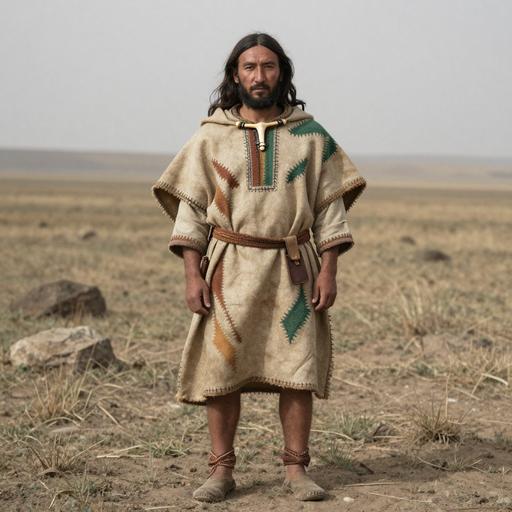
Portrait reconstruction of BOT14
Ancient Individual

A man buried in Kazakhstan in the Eneolithic era

BOT14
3517 BCE - 3111 BCE
Male
Eneolithic Kazakhstan
Kazakhstan
Scroll to begin
Chapter I

Identity

The biological and cultural markers that define this ancient individual

Sample ID

BOT14

Date Range

3517 BCE - 3111 BCE

Biological Sex

Male

mtDNA Haplogroup

K1b2c

Y-DNA Haplogroup

R-L1432

Cultural Period

Eneolithic Kazakhstan

Chapter II

Place

Where this individual was discovered

Country Kazakhstan
Locality Botai
Coordinates 53.3060, 67.6482
Chapter III

Time

When this individual lived in the broader context of human history

BOT14 3517 BCE - 3111 BCE
Chapter IV

Story

The narrative of this ancient life

The Eneolithic period, also known as the Chalcolithic or Copper Age, represents a significant era in human history characterized by the transition from the use of stone tools to the utilization of copper alongside them. In the context of the Eurasian Steppe, and particularly in Kazakhstan, the Eneolithic period is most notably represented by the Botai culture. This time frame roughly spans from 3700 to 3100 BCE, although exact dates may vary between sources.

Geography and Environment

The Botai culture was situated in the steppe regions of northern Kazakhstan, an area known for its vast grasslands and diverse ecosystems. This environment provided an ideal setting for the Botai people, who were among the first to domesticate horses and develop early forms of mobile pastoralism. The ecology of the steppe played a crucial role in shaping the cultural and economic practices of the Botai society, offering resources such as pasturelands for grazing and game for hunting.

Technological and Economic Practices

One of the defining characteristics of the Botai culture is its role in the early domestication of the horse. Evidence from Botai sites suggests that horses were not only hunted but also possibly kept for riding or other practical uses. This domestication and use of horses would later have significant implications for the development of nomadic cultures across the Eurasian Steppe.

In addition to the domestication of horses, the Botai culture also showcased advanced skills in pottery and lithic technology. Archaeological findings reveal a variety of pottery styles, which were likely used for storing food and other materials. The presence of copper artifacts, although limited, indicates an acquaintance with metalworking, marking a technological transition from the solely stone-based toolkits of earlier periods.

Settlement Patterns

Botai settlements are characterized by semi-permanent villages comprised of circular or oval-shaped dwellings. These structures were typically constructed using wood and earth, featuring a fireplace at the center, which suggests a sedentary lifestyle interspersed with periods of mobility. This settlement strategy likely balanced between exploiting fixed resources and the needs of opportunistic hunting and herding.

Social and Cultural Aspects

The social structure of the Botai culture is less well-defined due to a lack of written records, but archaeological evidence provides some insights. The organization of Botai settlements and the distribution of grave goods suggest a society with some degree of social stratification or specialization. The possible communal nature of horse management and the shared responsibilities in pottery production also hint at cooperative group dynamics.

Culturally, the Botai people may have had spiritual beliefs linked to nature and animals, particularly horses, given their central role in Botai society. While direct evidence of religious practices is sparse, the investment in horse domestication points to a potential symbolic significance.

Impact and Legacy

The legacy of the Botai culture is profound, primarily because of its pioneering role in horse domestication. This achievement had long-term effects on the mobility and sociopolitical dynamics of the Eurasian Steppe cultures that followed. The use of horses facilitated trade, communication, and cultural exchange across vast distances, contributing to the development of the Silk Road and influencing the rise of nomadic empires.

In summary, the Eneolithic period in Kazakhstan, exemplified by the Botai culture, represents a transformative era in human history, driven by innovations in technology, economy, and social organization. Its contributions, particularly in terms of horse domestication, set the stage for subsequent cultural developments and interactions across Eurasia.

Chapter V

Genetics

The genetic ancestry of this ancient individual

Ancient Genetic Admixture

This analysis compares the DNA profile of BOT14 with ancient reference populations, showing the genetic composition in terms of prehistoric ancestral groups.

Western Steppe Pastoralists 47.8%
Ancient Asians 29.0%
Ancient Native Americans 14.0%
Neolithic Farmers 5.5%
European Hunter-Gatherers 3.7%

Modern Genetic Admixture

This analysis compares the DNA profile with present-day reference populations, showing what percentage of genetic makeup resembles modern populations from different regions.

Europe 50.5%
Eastern European 50.5%
Asia 27.4%
Northern Asian 17.8%
Siberian 17.8%
Central Asian, Northern Indian & Pakistani 9.7%
Pakistan 9.0%
Indian 0.6%
America 22.1%
America 22.1%
Native American 22.1%

Closest Modern Populations

These are the modern populations showing the closest statistical alignment to A man buried in Kazakhstan in the Eneolithic era, ranked by genetic distance. Lower distance values indicate closer statistical similarity.

1
Tlingit
9.3613
2
Mari
10.3748
3
Khanty O1
10.6781
4
Bashkir
10.8057
5
Tatar Siberian
11.5579
6
Udmurt
12.2544
7
Tatar Siberian Zabolotniye
12.2545
8
Chuvash
12.6683
9
Komi B
12.9384
10
Besermyan
13.2374
Chapter VI

Context

Other ancient individuals connected to this sample

Sources

References

Scientific publications and genetic data

Scientific Publication

The first horse herders and the impact of early Bronze Age steppe expansions into Asia

Authors de Barros Damgaard P, Martiniano R, Kamm J
Abstract

The Yamnaya expansions from the western steppe into Europe and Asia during the Early Bronze Age (~3000 BCE) are believed to have brought with them Indo-European languages and possibly horse husbandry. We analyzed 74 ancient whole-genome sequences from across Inner Asia and Anatolia and show that the Botai people associated with the earliest horse husbandry derived from a hunter-gatherer population deeply diverged from the Yamnaya. Our results also suggest distinct migrations bringing West Eurasian ancestry into South Asia before and after, but not at the time of, Yamnaya culture. We find no evidence of steppe ancestry in Bronze Age Anatolia from when Indo-European languages are attested there. Thus, in contrast to Europe, Early Bronze Age Yamnaya-related migrations had limited direct genetic impact in Asia.

G25 Coordinates

The G25 coordinates for sample BOT14 can be used for detailed admixture analysis in our G25 Studio tool.

BOT14,0.09334726,-0.10338022,0.0783378,0.0716304,-0.04528182,0.00339374,-0.03883974,-0.042713,-0.00361202,-0.03057252,0.02392032,-0.01099024,0.02538356,-0.0261442,-0.02537012,-0.0235206,-0.00881924,-0.00717174,-0.03149246,-0.02539214,0.01179138,0.00574678,-0.03378724,0.00570088,-0.00570375
Analyze in G25 Studio
Use code for 40% off Expires Feb 27