Menu
Store
Blog
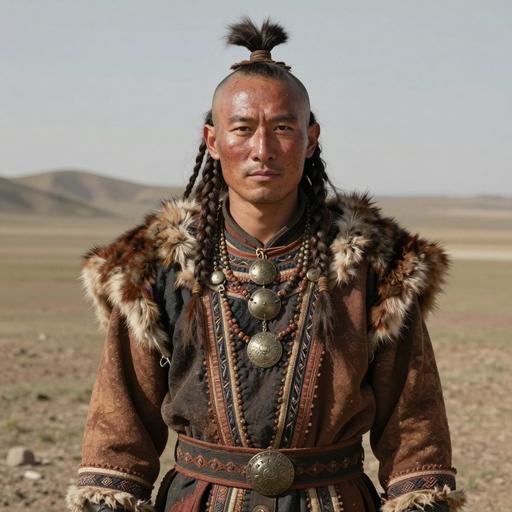
Portrait reconstruction of BTO001
Ancient Individual

A man buried in Mongolia in the Iron Age era

BTO001
200 BCE - 100 CE
Male
Xiongnu Period Bulgan, Mongolia
Mongolia
Scroll to begin
Chapter I

Identity

The biological and cultural markers that define this ancient individual

Sample ID

BTO001

Date Range

200 BCE - 100 CE

Biological Sex

Male

mtDNA Haplogroup

Z4a

Y-DNA Haplogroup

Q-BZ180

Cultural Period

Xiongnu Period Bulgan, Mongolia

Chapter II

Place

Where this individual was discovered

Country Mongolia
Locality Bulgan. Burkhan Tolgoi
Chapter III

Time

When this individual lived in the broader context of human history

BTO001 200 BCE - 100 CE
Chapter IV

Story

The narrative of this ancient life

The Xiongnu period in Bulgan, Mongolia, forms a significant chapter in the history of nomadic steppe cultures. Emerging around the 3rd century BCE and lasting until the late 1st century CE, the Xiongnu were a confederation of nomadic tribes that played a crucial role in the Central Asian steppes. This period represents a time of socio-political complexity, economic prosperity, and cultural development among the steppe nomads.

Geographical Context:

Bulgan, a province in north-central Mongolia, is characterized by its diverse landscape of rolling steppes, mountains, and expansive grasslands. This region provided an advantageous position for the Xiongnu, offering extensive pastures for their livestock, and serving as a key transit area for trade and military campaigns.

Political Structure and Society:

The Xiongnu were among the first steppe nomads to establish a centralized and hierarchical political organization, with a ruler known as the \Chanyu" at the apex. Their tribal confederation was a complex amalgamation of different clans and ethnic groups, bound together by kinship ties and allegiance to the Chanyu. This political structure allowed the Xiongnu to exert considerable influence over a vast area, extending their reach from Mongolia into parts of China, Siberia, and Central Asia.

Socially, the Xiongnu society was stratified, with the nobility and warrior classes holding significant power and privileges. The common people were primarily herders, raising horses, cattle, sheep, and camels, which were essential for transportation, trade, and sustenance.

Economy and Trade:

The economy of the Xiongnu was predominantly pastoral, relying on animal husbandry. However, their strategic location enabled them to control and facilitate trade along the Silk Road. The Xiongnu engaged in commerce with neighboring civilizations, trading furs, livestock, and manufactured goods, such as metalwork and textiles, with the Chinese, Sogdians, and other steppe tribes. The flow of goods, ideas, and technology enhanced their cultural and economic vitality.

Military Prowess:

The Xiongnu were renowned for their military capabilities, particularly their highly skilled cavalry, which was unmatched in speed and mobility. Their military organization and tactics allowed them to conduct raids and complex warfare strategies against their rivals, most notably the Han Dynasty of China. The Xiongnu's military expeditions and the threat they posed to Chinese territories led to the construction of parts of the Great Wall as a defensive measure.

Cultural Aspects:

Culturally, the Xiongnu period was rich and diverse, marked by a syncretism of local traditions and foreign influences due to their extensive interactions across regions. Their art and craftsmanship were evident in intricate metalwork, jewelry, and weaponry. Burial practices and tomb architecture reflect their beliefs in the afterlife and social hierarchies. The Xiongnu adopted various religious and spiritual beliefs, including shamanism and ancestor worship, which played a significant role in their daily lives and rituals.

Decline and Legacy:

The decline of the Xiongnu began around the 1st century CE due to internal strife, resource depletion, and pressure from the Han Dynasty. Their fragmentation led to splinter groups dispersing across the steppes, influencing subsequent nomadic cultures such as the Huns. The legacy of the Xiongnu period in Bulgan and beyond is evident in the historical and archaeological records that provide insights into the dynamics of one of the earliest and most influential nomadic empires of the Eurasian steppe.

Overall, the Xiongnu period in Bulgan, Mongolia, exemplifies the complex interplay of political power, economic strategies, and cultural developments that characterized nomadic steppe cultures. Their influence spanned far beyond their time, leaving a lasting impact on the history and culture of the region."

Chapter V

Genetics

The genetic ancestry of this ancient individual

Ancient Genetic Admixture

This analysis compares the DNA profile of BTO001 with ancient reference populations, showing the genetic composition in terms of prehistoric ancestral groups.

Ancient Asians 86.2%
Neolithic Farmers 7.5%
Western Steppe Pastoralists 6.3%

Modern Genetic Admixture

This analysis compares the DNA profile with present-day reference populations, showing what percentage of genetic makeup resembles modern populations from different regions.

Asia 99.0%
Northern Asian 48.5%
Siberian 27.0%
Mongolian 21.5%
Chinese & Southeast Asian 26.6%
Chinese 15.9%
Tibetan 10.7%
Central Asian, Northern Indian & Pakistani 23.9%
Central Asian 23.9%
America 1.1%
America 1.1%
Native American 1.1%

Closest Modern Populations

These are the modern populations showing the closest statistical alignment to A man buried in Mongolia in the Iron Age era, ranked by genetic distance. Lower distance values indicate closer statistical similarity.

1
Kalmyk
3.6146
2
Mongol Xinjiang
3.6288
3
Mongol
3.6390
4
Mongolian
4.2441
5
Mongol Inner Mongolia
5.8450
6
Mogush
5.8796
7
Khamnegan
6.0420
8
Buryat
6.1996
9
Altaian Kizhi
6.2185
10
Tuvinian
6.3911
Chapter VI

Context

Other ancient individuals connected to this sample

Sources

References

Scientific publications and genetic data

Scientific Publication

A Dynamic 6,000-Year Genetic History of Eurasia's Eastern Steppe

Authors Jeong C, Wang K, Wilkin S
Abstract

The Eastern Eurasian Steppe was home to historic empires of nomadic pastoralists, including the Xiongnu and the Mongols. However, little is known about the region's population history. Here, we reveal its dynamic genetic history by analyzing new genome-wide data for 214 ancient individuals spanning 6,000 years. We identify a pastoralist expansion into Mongolia ca. 3000 BCE, and by the Late Bronze Age, Mongolian populations were biogeographically structured into three distinct groups, all practicing dairy pastoralism regardless of ancestry. The Xiongnu emerged from the mixing of these populations and those from surrounding regions. By comparison, the Mongols exhibit much higher eastern Eurasian ancestry, resembling present-day Mongolic-speaking populations. Our results illuminate the complex interplay between genetic, sociopolitical, and cultural changes on the Eastern Steppe.

G25 Coordinates

The G25 coordinates for sample BTO001 can be used for detailed admixture analysis in our G25 Studio tool.

BTO001,0.04115546,-0.3449909,0.05786008,-0.01566064,-0.04496012,-0.0186565,0.00807778,0.0104316,0.00131222,0.00417618,-0.01669666,-0.0056578,0.00490282,-0.0090143,-0.00537658,-0.00526342,-0.00550644,0.00106604,0.00932788,0.00758426,-0.00705724,-0.00601844,-0.00185174,0.00343528,0.00134931
Analyze in G25 Studio
Use code for 40% off Expires Feb 27