Menu
Store
Blog
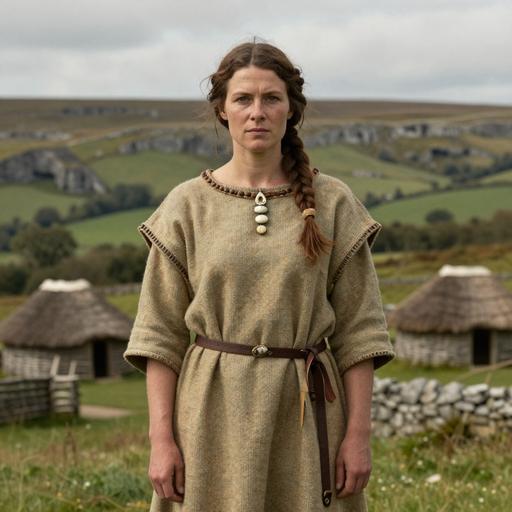
Portrait reconstruction of CE003
Ancient Individual

A woman buried in United Kingdom in the Iron Age era

CE003
758 BCE - 416 BCE
Female
Iron Age Derbyshire, England
United Kingdom
Scroll to begin
Chapter I

Identity

The biological and cultural markers that define this ancient individual

Sample ID

CE003

Date Range

758 BCE - 416 BCE

Biological Sex

Female

mtDNA Haplogroup

X2b4

Cultural Period

Iron Age Derbyshire, England

Chapter II

Place

Where this individual was discovered

Country United Kingdom
Locality England. Derbyshire. Carsington Pasture Cave
Coordinates 53.0803, -1.6406
Chapter III

Time

When this individual lived in the broader context of human history

CE003 758 BCE - 416 BCE
Chapter IV

Story

The narrative of this ancient life

Iron Age Derbyshire was a fascinating period marked by the vibrant culture of the Celtic tribes inhabiting what is now central England. The Iron Age spanned from around 800 BCE to the Roman invasion in 43 CE, and Derbyshire, with its rugged landscapes of rolling hills, moorlands, and river valleys, was an integral part of this era.

Geography and Environment

Derbyshire's terrain made it both a strategic location and a challenging environment for its inhabitants. The Peak District, with its notable hills such as Mam Tor and Kinder Scout, offered natural defenses and vantage points. The River Derwent and other waterways provided essential resources for agriculture and settlement. This geography influenced the settlement patterns, leading to the construction of hillforts and small farms, which are iconic remnants of the area’s Iron Age past.

Society and Culture

The Iron Age in Britain was dominated by Celtic tribes, and Derbyshire was no exception. The people here were part of a broader Celtic culture characterized by its art, religion, language, and social structure. Communities were organized into tribes, each led by chieftains who held power through familial lineage, martial prowess, and wealth.

Iron Age Derbyshire saw the rise of complex societies with hierarchical structures. Beyond chieftains, there were warrior elites, craftsmen, farmers, and druids—spiritual leaders who also acted as judges and advisors. The social fabric was woven with kinship ties and alliances, often reinforced through marriage and trade.

Hillforts and Settlements

Hillforts are among the most enduring symbols of the Iron Age in Derbyshire. Sites like Mam Tor and Fin Cop stand as testament to the period's architectural and strategic ingenuity. These structures served multiple purposes: defensive bastions against rival tribes, communal centers for trade and ritual, and symbols of tribal power.

Within these hillforts and associated settlements, homes were built using wattle-and-daub techniques, with thatched roofs offering protection against the elements. The agricultural landscape surrounding these sites was a patchwork of small fields, primarily used for growing cereals like barley and emmer wheat, alongside pastoral activities involving cattle, sheep, and pigs.

Economy and Technology

Economically, Iron Age Derbyshire was dynamic, with a blend of agriculture, metalworking, and trade. The development and use of iron tools and weapons revolutionized farming and warfare. Iron plowshares improved agricultural productivity, while iron-tipped spears and swords enhanced the effectiveness of tribal warriors.

Trade networks stretched across Britain and into continental Europe, exchanging goods such as salt, metals, pottery, and woven textiles. Derbyshire's natural resources, particularly its rich deposits of lead and limestone, were valuable trade commodities.

Art and Religion

Celtic art from the Iron Age is renowned for its intricate designs and symbolism, reflecting a deep connection to nature and spirituality. This artistic expression is evident in jewelry, pottery, and weaponry, characterized by motifs like spirals, knots, and animal forms.

Religion in Iron Age Derbyshire was polytheistic, with a pantheon of gods and goddesses tied to natural elements. Rituals were conducted in sacred groves, water bodies, and atop hills. Druids, as the learned class, oversaw these spiritual practices, maintaining oral traditions and astronomical knowledge.

Interaction with Rome

By the late Iron Age, the influence of the Roman Empire began to encroach upon Derbyshire and the wider region. The Romans viewed Britain as a source of resources and a strategic outpost, leading to increased trade and cultural exchanges. Eventually, this culminated in the Roman invasion and the establishment of Roman rule, transforming the social and cultural landscape permanently.

Legacy

The legacy of Iron Age Derbyshire is still visible today in its archaeology, place names, and cultural narratives. Hillforts dot the landscape, and many local traditions and legends trace their roots back to this era. Understanding this period provides insight into the resilience and adaptability of its people, who navigated a complex tapestry of internal dynamics and external pressures, laying the foundations for the region's subsequent historical developments.

Chapter V

Genetics

The genetic ancestry of this ancient individual

Ancient Genetic Admixture

This analysis compares the DNA profile of CE003 with ancient reference populations, showing the genetic composition in terms of prehistoric ancestral groups.

European Hunter-Gatherers 39.9%
Western Steppe Pastoralists 33.5%
Neolithic Farmers 22.5%
Ancient Asians 4.0%

Modern Genetic Admixture

This analysis compares the DNA profile with present-day reference populations, showing what percentage of genetic makeup resembles modern populations from different regions.

Europe 85.9%
Northwestern European 70.4%
English 49.2%
Northwestern European 12.5%
Scandinavian 7.8%
Finnish 0.8%
Eastern European 15.1%
Asia 14.1%
Northern West Asian 14.1%
Caucasian 14.1%

Closest Modern Populations

These are the modern populations showing the closest statistical alignment to A woman buried in United Kingdom in the Iron Age era, ranked by genetic distance. Lower distance values indicate closer statistical similarity.

1
Orcadian
2.7142
2
Scottish
2.7769
3
Irish
2.9667
4
English
3.0512
5
Dutch
3.1096
6
Afrikaner
3.1358
7
Shetlandic
3.1732
8
English Cornwall
3.2451
9
Welsh
3.2594
10
Belgiana
3.2820
Chapter VI

Context

Other ancient individuals connected to this sample

Sources

References

Scientific publications and genetic data

Scientific Publication

Ancient DNA at the edge of the world: Continental immigration and the persistence of Neolithic male lineages in Bronze Age Orkney

Authors Dulias K, Foody MGB, Justeau P
Abstract

Orkney was a major cultural center during the Neolithic, 3800 to 2500 BC. Farming flourished, permanent stone settlements and chambered tombs were constructed, and long-range contacts were sustained. From ∼3200 BC, the number, density, and extravagance of settlements increased, and new ceremonial monuments and ceramic styles, possibly originating in Orkney, spread across Britain and Ireland. By ∼2800 BC, this phenomenon was waning, although Neolithic traditions persisted to at least 2500 BC. Unlike elsewhere in Britain, there is little material evidence to suggest a Beaker presence, suggesting that Orkney may have developed along an insular trajectory during the second millennium BC. We tested this by comparing new genomic evidence from 22 Bronze Age and 3 Iron Age burials in northwest Orkney with Neolithic burials from across the archipelago. We identified signals of inward migration on a scale unsuspected from the archaeological record: As elsewhere in Bronze Age Britain, much of the population displayed significant genome-wide ancestry deriving ultimately from the Pontic-Caspian Steppe. However, uniquely in northern and central Europe, most of the male lineages were inherited from the local Neolithic. This suggests that some male descendants of Neolithic Orkney may have remained distinct well into the Bronze Age, although there are signs that this had dwindled by the Iron Age. Furthermore, although the majority of mitochondrial DNA lineages evidently arrived afresh with the Bronze Age, we also find evidence for continuity in the female line of descent from Mesolithic Britain into the Bronze Age and even to the present day.

G25 Coordinates

The G25 coordinates for sample CE003 can be used for detailed admixture analysis in our G25 Studio tool.

CE003,0.12385172,0.12507922,0.05281978,0.04212992,0.03124726,0.0147221,0.00339832,-0.00119944,-0.0017335,-0.00430426,-0.00722426,0.00860774,-0.01229634,-0.01096762,0.02391942,-0.00959598,-0.01897506,6.836E-05,0.00133492,-0.00262896,0.00628744,0.00085702,-0.00623334,0.01195216,-0.00522021
Analyze in G25 Studio
Use code for 40% off Expires Feb 27