Menu
Store
Blog
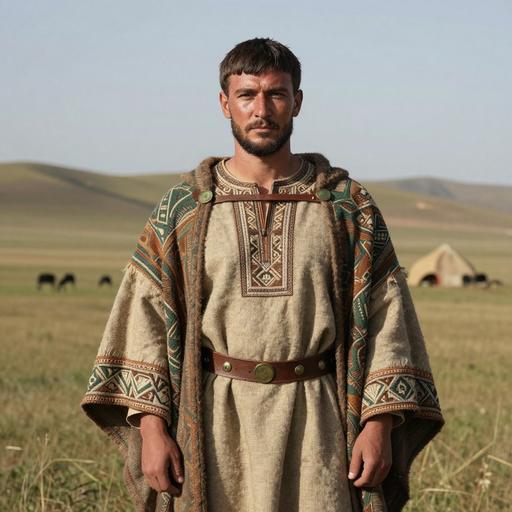
Portrait reconstruction of I11541
Ancient Individual

A man buried in Kazakhstan in the Middle Bronze Age era

I11541
1872 BCE - 1636 BCE
Male
Middle Bronze Georgievsky
Kazakhstan
Scroll to begin
Chapter I

Identity

The biological and cultural markers that define this ancient individual

Sample ID

I11541

Date Range

1872 BCE - 1636 BCE

Biological Sex

Male

mtDNA Haplogroup

N1a1a1a1

Y-DNA Haplogroup

R-Z2124

Cultural Period

Middle Bronze Georgievsky

Chapter II

Place

Where this individual was discovered

Country Kazakhstan
Locality Georgievsky Bugor
Coordinates 50.4501, 57.0401
Chapter III

Time

When this individual lived in the broader context of human history

I11541 1872 BCE - 1636 BCE
Chapter IV

Story

The narrative of this ancient life

The Middle Bronze Age Georgievsky culture is a fascinating and integral part of the broader Steppe cultures, which inhabited the vast Eurasian steppe region. This era is typically dated to the middle of the 2nd millennium BCE and is characterized by its unique adaptation to the steppe environment, distinctive burial practices, metallurgy, and mobility. Here is an extensive description of this culture:

Geographical Context

The Georgievsky culture was primarily centered in the expansive Eurasian steppe, a vast region of grassland plains without trees apart from those near rivers and lakes. This culture was part of a larger tapestry of steppe civilizations that stretched from modern-day Eastern Europe to Central Asia. The geography of the steppe, with its harsh climatic conditions and vast open spaces, highly influenced the lifestyles and subsistence strategies of the Georgievsky culture.

Subsistence and Economy

The Georgievsky culture, like many steppe cultures, was primarily pastoral. The economy was heavily reliant on the domestication and herding of animals such as sheep, goats, cattle, and, notably, horses. Horses were particularly significant, not only as a source of mobility and transportation but also as a symbol of wealth and status. The nomadic lifestyle enabled them to efficiently exploit the seasonal availability of resources across vast territories.

Social Structure and Lifestyle

The social structure of the Georgievsky culture was likely organized around kinship groups or clans. While there is limited direct evidence of complex societal hierarchies due to the challenges of steppe archaeology, the prominence of elaborate burial mounds, or kurgans, suggests that there were distinctions of wealth and social status. These groups were highly mobile, with seasonal migrations in search of pastures for their herds, indicative of a semi-nomadic or transhumant lifestyle.

Burial Practices and Religion

Burial practices provide significant insight into the beliefs and social structure of the Georgievsky culture. The construction of kurgans, large burial mounds, is a distinctive feature. These mounds often contain individual or group burials, with grave goods that include pottery, weapons, and ornaments, reflecting the social status of the deceased. The practice suggests a belief in an afterlife where such goods would be needed. The burial practices also indicate a degree of ancestor worship and the possible existence of ritualistic and spiritual life, although the specifics of their religious beliefs remain largely speculative.

Metallurgy and Artifacts

The Middle Bronze Age is marked by advancements in metallurgy, and the Georgievsky culture was no exception. Artifacts from this period reveal a high level of craftsmanship in metalwork, particularly in bronze. This included the production of tools, weapons, and decorative items, which indicate trade connections with neighboring regions, as well as the sharing of technological innovations.

Cultural Interactions

The Georgievsky culture was not isolated but part of a dynamic network of interactions across the steppe and beyond. They likely engaged in both trade and conflict with neighboring cultures. This interaction facilitated the exchange of goods, technologies, and ideas, contributing to the cultural dynamism of the region. Furthermore, the role of the Georgievsky culture in the wider phenomena of Indo-European migrations has been a subject of scholarly interest, positing that these steppe peoples significantly impacted the cultural and linguistic landscapes of Europe and Asia.

Legacy

The legacy of the Georgievsky culture is intertwined with the broader narrative of steppe cultures, which played a crucial role in shaping the prehistory of Eurasia. The innovations in mobility, particularly horse domestication, and the development of nomadic pastoralism were significant contributions that influenced later cultures and historical developments in Eurasia.

In conclusion, the Middle Bronze Age Georgievsky culture exemplifies the adaptability and resilience of human societies in challenging environments. Through their innovative subsistence strategies, distinctive social practices, and dynamic interactions, they played a vital role in the cultural and historical tapestry of the Eurasian steppe.

Chapter V

Genetics

The genetic ancestry of this ancient individual

Ancient Genetic Admixture

This analysis compares the DNA profile of I11541 with ancient reference populations, showing the genetic composition in terms of prehistoric ancestral groups.

Western Steppe Pastoralists 49.3%
European Hunter-Gatherers 30.7%
Neolithic Farmers 12.3%
Ancient Asians 4.0%
Ancient Native Americans 3.9%

Modern Genetic Admixture

This analysis compares the DNA profile with present-day reference populations, showing what percentage of genetic makeup resembles modern populations from different regions.

Europe 89.6%
Northwestern European 63.7%
English 31.3%
Scandinavian 17.9%
Finnish 14.5%
Eastern European 25.9%
Asia 7.3%
Central Asian, Northern Indian & Pakistani 5.5%
Pakistan 5.5%
Northern West Asian 1.8%
Caucasian 1.8%
America 3.1%
America 3.1%
Native American 3.1%

Closest Modern Populations

These are the modern populations showing the closest statistical alignment to A man buried in Kazakhstan in the Middle Bronze Age era, ranked by genetic distance. Lower distance values indicate closer statistical similarity.

1
Tatar Mishar
5.2715
2
Moksha
5.9116
3
Mordovian
6.0423
4
Erzya
6.1772
5
Russian Kostroma
6.4814
6
Russian Krasnoborsky
6.5786
7
Finnish Southwest
6.8075
8
Finnish Central
6.9090
9
Finnish North
7.0923
10
Moldovan O
7.2815
Chapter VI

Context

Other ancient individuals connected to this sample

Sources

References

Scientific publications and genetic data

Scientific Publication

The formation of human populations in South and Central Asia

Authors Narasimhan VM, Patterson N, Moorjani P
Abstract

By sequencing 523 ancient humans, we show that the primary source of ancestry in modern South Asians is a prehistoric genetic gradient between people related to early hunter-gatherers of Iran and Southeast Asia. After the Indus Valley Civilization's decline, its people mixed with individuals in the southeast to form one of the two main ancestral populations of South Asia, whose direct descendants live in southern India. Simultaneously, they mixed with descendants of Steppe pastoralists who, starting around 4000 years ago, spread via Central Asia to form the other main ancestral population. The Steppe ancestry in South Asia has the same profile as that in Bronze Age Eastern Europe, tracking a movement of people that affected both regions and that likely spread the distinctive features shared between Indo-Iranian and Balto-Slavic languages.

G25 Coordinates

The G25 coordinates for sample I11541 can be used for detailed admixture analysis in our G25 Studio tool.

I11541,0.11797966,0.07471716,0.04745486,0.04846868,0.00582812,0.01539168,0.00453726,0.00610882,-0.00898506,-0.01906428,0.00278108,-0.00280118,5.724E-05,-0.0076456,0.00516198,-0.00635802,-0.01598484,0.00076392,-0.00587574,-0.00872208,-0.00096206,0.00500192,-0.00758882,0.01055114,-0.00106641
Analyze in G25 Studio
Use code for 40% off Expires Feb 26