Menu
Store
Blog
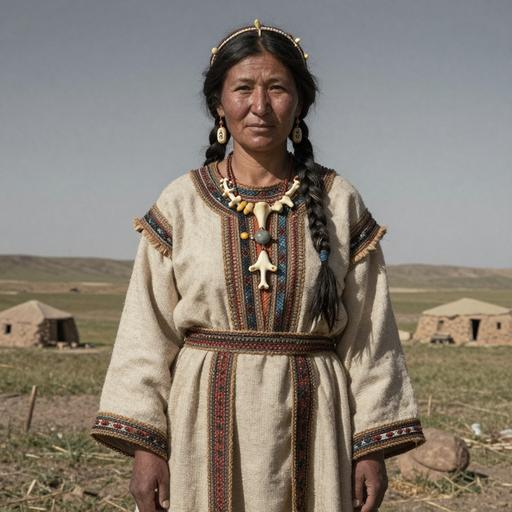
Portrait reconstruction of I11736
Ancient Individual

A woman buried in Kazakhstan in the Middle Bronze Age era

I11736
3315 BCE - 2928 BCE
Female
Middle Bronze Mereke
Kazakhstan
Scroll to begin
Chapter I

Identity

The biological and cultural markers that define this ancient individual

Sample ID

I11736

Date Range

3315 BCE - 2928 BCE

Biological Sex

Female

mtDNA Haplogroup

U4

Cultural Period

Middle Bronze Mereke

Chapter II

Place

Where this individual was discovered

Country Kazakhstan
Locality Mereke. Taskala district. Zapadno-Kazahstanskaya Oblast
Coordinates 50.7702, 49.3400
Chapter III

Time

When this individual lived in the broader context of human history

I11736 3315 BCE - 2928 BCE
Chapter IV

Story

The narrative of this ancient life

The Middle Bronze Mereke phase of the Andronovo culture represents an intriguing and significant period in the Bronze Age, specifically spanning from approximately 2000 BCE to 1500 BCE. This cultural phase was centered in the vast steppes of Central Asia, encompassing parts of present-day Kazakhstan, and illustrates a rich tapestry of cultural, technological, and social developments.

Geography and Environment

The Mereke phase of the Andronovo culture thrived in the diverse and often harsh environments of Central Asia's steppe regions. This area is characterized by expansive grasslands interspersed with river valleys, mountain ranges, and arid deserts. The climate and geography necessitated a nomadic or semi-nomadic lifestyle, which greatly influenced the cultural practices of the Mereke peoples.

Society and Culture

The Mereke phase reflects a society that was both agrarian and pastoralist. The people engaged in livestock breeding, which included cattle, sheep, and horses, a practice facilitated by the vast grazing lands of the steppe. Agriculture, though secondary, complemented their diet and economy, with evidence of cereal cultivation.

Social organization during the Mereke phase is believed to have been clan-based. The presence of kurgans (burial mounds) suggests a hierarchical society with emerging social stratifications. The burials often included grave goods such as pottery, metal tools, and personal ornaments, indicating differences in wealth and status.

Craftsmanship in pottery and metallurgy reached notable sophistication during this era. Pottery often featured intricate geometric motifs and was typically used for both domestic and ceremonial purposes. Metallurgy, particularly the use of bronze, was highly developed, with artifacts including weapons, tools, and ornaments that demonstrate advanced skills in metalworking.

Religion and Rituals

The Mereke people likely practiced a form of proto-Indo-Iranian religion, characterised by animistic and possibly shamanistic elements. Evidences suggest that the Andronovo culture held a strong belief in an afterlife, as indicated by their burial customs. The kurgans often contained symbolic items intended for use in the afterlife, including horse sacrifices and other animal remains, signifying the importance of these animals in their spiritual and everyday life.

Interaction and Influence

The Mereke phase reflects significant interactions with other contemporary cultures, facilitated by trade routes across the expansive steppes. There is evidence of exchanges with civilizations in the Indus Valley to the south, as well as contacts with other steppe cultures to the east and west, resulting in a blend of technological and cultural influences.

Technological and Economic Development

One of the hallmark achievements of the Mereke phase was its advancements in chariotry and horsemanship. The domestication and use of horses not only revolutionized transportation but also military strategies, influencing later nomadic cultures across Eurasia.

Bronze tools and weapons, including axes, spearheads, and knives, underscore the technological sophistication of the Mereke people. These advancements were not only pivotal in everyday life but also crucial in reinforcing the power dynamics within and beyond the region.

Legacy

The Middle Bronze Mereke phase of the Andronovo culture left a lasting legacy, particularly as it laid the foundations for subsequent cultures and tribal confederations in Central Asia, such as the Scythians. The advancements in metallurgy, horsemanship, and social organization resonated throughout the region and influenced broader Eurasian developments.

In summary, the Middle Bronze Mereke phase represents a vibrant and dynamic period in the Andronovo culture, characterized by a harmonious blend of pastoralism and agriculture, sophisticated craftsmanship, evolving social hierarchies, and deep-seated spiritual beliefs. Its contributions to horsemanship, metallurgy, and social structure provided an enduring influence on the cultures of the Eurasian steppes and beyond.

Chapter V

Genetics

The genetic ancestry of this ancient individual

Ancient Genetic Admixture

This analysis compares the DNA profile of I11736 with ancient reference populations, showing the genetic composition in terms of prehistoric ancestral groups.

Western Steppe Pastoralists 49.7%
European Hunter-Gatherers 22.7%
Neolithic Farmers 16.1%
Ancient Asians 8.6%
Ancient Native Americans 2.9%

Modern Genetic Admixture

This analysis compares the DNA profile with present-day reference populations, showing what percentage of genetic makeup resembles modern populations from different regions.

Europe 71.6%
Northwestern European 41.1%
English 23.9%
Scandinavian 11.5%
Finnish 5.7%
Eastern European 30.5%
Asia 23.7%
Northern West Asian 12.7%
Caucasian 12.7%
Central Asian, Northern Indian & Pakistani 11.0%
Pakistan 11.0%
America 4.0%
America 4.0%
Native American 4.0%
Africa 0.8%
Northern East African 0.8%
Eastern African 0.8%

Closest Modern Populations

These are the modern populations showing the closest statistical alignment to A woman buried in Kazakhstan in the Middle Bronze Age era, ranked by genetic distance. Lower distance values indicate closer statistical similarity.

1
Tatar Mishar
5.4251
2
Tatar Kazan
6.3296
3
Komi A
7.4186
4
Mordovian
7.4670
5
Pamiri Rushan
7.5341
6
Erzya
7.5544
7
Moksha
7.6200
8
Russian Leshukonsky
8.0745
9
Tajik Yaghnobi
8.1285
10
Pamiri Shugnan
8.2364
Chapter VI

Context

Other ancient individuals connected to this sample

Sources

References

Scientific publications and genetic data

Scientific Publication

The formation of human populations in South and Central Asia

Authors Narasimhan VM, Patterson N, Moorjani P
Abstract

By sequencing 523 ancient humans, we show that the primary source of ancestry in modern South Asians is a prehistoric genetic gradient between people related to early hunter-gatherers of Iran and Southeast Asia. After the Indus Valley Civilization's decline, its people mixed with individuals in the southeast to form one of the two main ancestral populations of South Asia, whose direct descendants live in southern India. Simultaneously, they mixed with descendants of Steppe pastoralists who, starting around 4000 years ago, spread via Central Asia to form the other main ancestral population. The Steppe ancestry in South Asia has the same profile as that in Bronze Age Eastern Europe, tracking a movement of people that affected both regions and that likely spread the distinctive features shared between Indo-Iranian and Balto-Slavic languages.

G25 Coordinates

The G25 coordinates for sample I11736 can be used for detailed admixture analysis in our G25 Studio tool.

I11736,0.11173058,0.05659266,0.02761186,0.05293796,-0.01536404,0.01914498,0.00792634,0.00487978,-0.0192421,-0.0310787,0.00139076,-0.0044845,0.0096741,0.00033268,-0.00483622,-0.00280308,-0.00684006,-0.0017647,-0.00488874,-0.00815942,-0.0022226,0.00188568,-0.0038464,0.0032037,-0.00408134
Analyze in G25 Studio
Use code for 40% off Expires Feb 27