Menu
Store
Blog
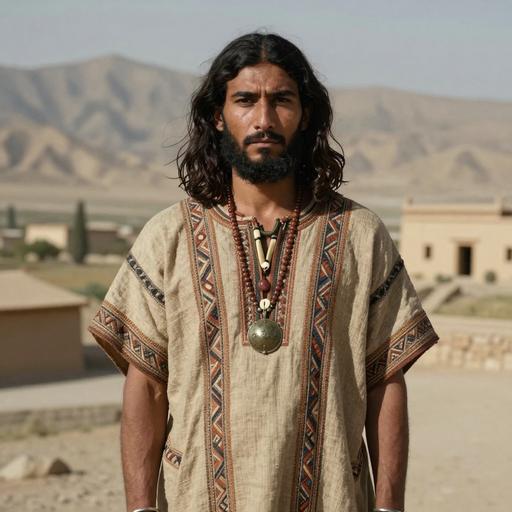
Portrait reconstruction of I12450
Ancient Individual

A man buried in Pakistan in the Iron Age era

I12450
819 BCE - 785 BCE
Male
Butkara: Iron Age Religious and Cultural Center in Swat Valley, Pakistan
Pakistan
Scroll to begin
Chapter I

Identity

The biological and cultural markers that define this ancient individual

Sample ID

I12450

Date Range

819 BCE - 785 BCE

Biological Sex

Male

mtDNA Haplogroup

M3a2

Y-DNA Haplogroup

R-Z94

Cultural Period

Butkara: Iron Age Religious and Cultural Center in Swat Valley, Pakistan

Chapter II

Place

Where this individual was discovered

Country Pakistan
Locality Swat Valley. Butkara II
Coordinates 34.7658, 72.3491
Chapter III

Time

When this individual lived in the broader context of human history

I12450 819 BCE - 785 BCE
Chapter IV

Story

The narrative of this ancient life

The region of Butkara in the Swat Valley, located in present-day Pakistan, holds significant archaeological importance, particularly for its Iron Age religious and cultural developments. During this time, the area transitioned from its roots in the Indus Valley Civilization influences to a distinct culture characterized by its own advancements and adaptations. Here's an extensive look into the historical and cultural parameters of Butkara during the Iron Age:

Geographical Context

Butkara is situated in the Swat Valley, a fertile region that lies between the high mountains of the Hindu Kush and the plains of the Indus River. This location made it a melting pot of cultural influences, owing to its position along trade routes connecting China, Central Asia, and the Indian subcontinent. The valley's rich natural resources supported flourishing agricultural communities and became a cultural and religious hub.

Historical Overview

The Iron Age in Butkara spans approximately from the early 1st millennium BCE to around the 1st millennium CE, a period which saw significant socio-cultural transformations. This era followed the decline of the Bronze Age civilizations of the Indus Valley. The Indo-Aryan migrations, occurring towards the tail-end of the Bronze Age, ushered in a new era marked by Vedic influences, which intermingled with existing local traditions to create a unique cultural amalgamation.

Archaeological Significance

  1. Religious Structures:

    • Butkara is renowned for its stupas, which are among the earliest Buddhist monuments in the region. The largest and most famous is Stupa I, originally founded in the 3rd century BCE. These structures suggest a strong Buddhist presence initiated during the Mauryan period under the influence of Emperor Ashoka, and continued to thrive throughout the Kushan period.
    • The numerous stupas and monastic ruins indicate the area's role as a significant religious center, attracting monks and pilgrims across Asia.
  2. Artifacts and Inscriptions:

    • Excavations at Butkara have revealed a wealth of artifacts including coins, pottery, terracotta figurines, and tools, which reflect the material culture and artistic sensibilities of the time.
    • Inscriptions in Brahmi and Kharosthi script provide valuable insights into the linguistic landscape, showcasing interactions with other cultures such as the Greeks and the Persians.
  3. Architectural Styles:

    • The architecture at Butkara combines Greco-Bactrian and Buddhist influences. The Gandhara style, known for its Hellenistic features, is evident in the sculptures and ornamentations found at the site.
    • The use of stone and wood in construction indicates technological advancements typical of the Iron Age, moving away from the mud-brick structures of earlier eras.

Cultural and Religious Dynamics

  1. Buddhism:

    • Following the Mauryan Empire's expansion into the region, Buddhism became a major religious force. The Swat Valley, and Butkara in particular, evolved into a prominent center for Buddhist learning and spirituality.
    • The construction of stupas and monasteries points to organized religious activities and suggests patronage by local rulers who adopted Buddhism.
  2. Hindu Influence:

    • Despite the prominence of Buddhism, Hindu practices continued alongside, as evidenced by finds that reveal the presence of Vedic rituals and iconography.
  3. Social Structure and Economy:

    • The Iron Age ushered in new socio-economic structures, moving from tribal configurations to more centralized state-like entities. These were possibly ruled by chieftains or kings who controlled trade and agriculture.
    • The economy was likely a combination of agriculture, facilitated by the fertile lands of the Swat Valley, and trade, given Butkara’s strategic location.

Conclusion

Butkara during the Iron Age was a vibrant center of cultural and religious activity. It serves as a testament to the region's dynamic history, reflecting a blend of indigenous traditions with external influences, including those from the Greek, Persian, and Indian civilizations. This period was critical in shaping the religious landscape of the region, marking the transition from Vedic traditions to a predominantly Buddhist philosophical system, which would dominate the socio-cultural framework for centuries to come. The archaeological remains in Butkara not only illuminate the past of the Swat Valley but also offer broader insights into the cultural exchanges that occurred across ancient Asia.

Chapter V

Genetics

The genetic ancestry of this ancient individual

Ancient Genetic Admixture

This analysis compares the DNA profile of I12450 with ancient reference populations, showing the genetic composition in terms of prehistoric ancestral groups.

Neolithic Farmers 52.8%
Ancient Asians 30.2%
Western Steppe Pastoralists 11.5%
Ancient Oceanians 2.8%
Ancient Native Americans 2.7%

Modern Genetic Admixture

This analysis compares the DNA profile with present-day reference populations, showing what percentage of genetic makeup resembles modern populations from different regions.

Asia 98.6%
Central Asian, Northern Indian & Pakistani 71.4%
Pakistan 40.6%
Indian 30.8%
Northern West Asian 26.5%
Caucasian 24.4%
Mesopotamian 2.1%
America 1.0%
America 1.0%
Native American 1.0%

Closest Modern Populations

These are the modern populations showing the closest statistical alignment to A man buried in Pakistan in the Iron Age era, ranked by genetic distance. Lower distance values indicate closer statistical similarity.

1
Pashtun Yusufzai
2.3564
2
Pashtun Uthmankhel
2.4548
3
Pashtun Tarkalani
2.5808
4
Pashtun Pakistan Khattak Nowshera
2.7311
5
Kamboj
2.9512
6
Kalash
3.0053
7
Pashtun Pakistan
3.0109
8
Pashtun Afghanistan Northeast
3.1163
9
Arain
3.6052
10
Kho
3.7807
Chapter VI

Context

Other ancient individuals connected to this sample

Sources

References

Scientific publications and genetic data

Scientific Publication

The formation of human populations in South and Central Asia

Authors Narasimhan VM, Patterson N, Moorjani P
Abstract

By sequencing 523 ancient humans, we show that the primary source of ancestry in modern South Asians is a prehistoric genetic gradient between people related to early hunter-gatherers of Iran and Southeast Asia. After the Indus Valley Civilization's decline, its people mixed with individuals in the southeast to form one of the two main ancestral populations of South Asia, whose direct descendants live in southern India. Simultaneously, they mixed with descendants of Steppe pastoralists who, starting around 4000 years ago, spread via Central Asia to form the other main ancestral population. The Steppe ancestry in South Asia has the same profile as that in Bronze Age Eastern Europe, tracking a movement of people that affected both regions and that likely spread the distinctive features shared between Indo-Iranian and Balto-Slavic languages.

G25 Coordinates

The G25 coordinates for sample I12450 can be used for detailed admixture analysis in our G25 Studio tool.

I12450,0.0790551,0.02504422,-0.09322532,0.05513858,-0.07352666,0.03494986,0.00622176,0.00373594,-0.02040638,-0.01817108,-0.00653746,0.00151926,-0.00704612,-0.00458,0.01076122,0.00164732,-0.00202842,-0.00274588,-0.00328412,-0.00647044,-0.00126844,-0.0022224,0.00175792,-0.00189912,-0.00496438
Analyze in G25 Studio
Use code for 40% off Expires Feb 26