Menu
Store
Blog
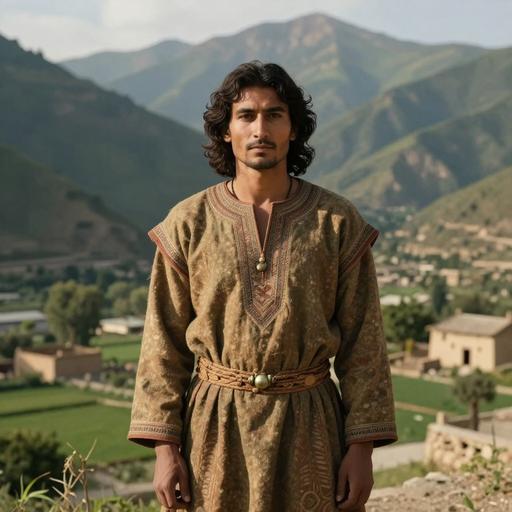
Portrait reconstruction of I12472
Ancient Individual

A man buried in Pakistan in the Middle Iron Age to Late Iron Age era

I12472
1000 BCE - 800 BCE
Male
Transition from Middle to Late Iron Age in Swat Valley, Pakistan
Pakistan
Scroll to begin
Chapter I

Identity

The biological and cultural markers that define this ancient individual

Sample ID

I12472

Date Range

1000 BCE - 800 BCE

Biological Sex

Male

mtDNA Haplogroup

M65a-a

Y-DNA Haplogroup

E-CTS10298

Cultural Period

Transition from Middle to Late Iron Age in Swat Valley, Pakistan

Chapter II

Place

Where this individual was discovered

Country Pakistan
Locality Swat Valley. Katelai
Coordinates 34.7658, 72.3491
Chapter III

Time

When this individual lived in the broader context of human history

I12472 1000 BCE - 800 BCE
Chapter IV

Story

The narrative of this ancient life

The transition from the Middle to the Late Iron Age in the Swat Valley of present-day Pakistan marks a significant period in the cultural and historical landscape of South Asia. This era, roughly spanning from the early 1st millennium BCE to the mid-1st millennium BCE, was marked by considerable socio-cultural evolution, technological advancements, and complex interactions among various communities.

Geographic and Cultural Context

The Swat Valley, located in the northern mountain region of modern-day Pakistan, serves as a confluence of influences from Central Asia, the Indian subcontinent, and the Persian plateau. This strategic location has historically made it a vibrant crossroads for cultural exchange and trade. During this transitionary period, the valley was home to Indo-Aryan communities, who were already established in the region following their migrations from Central Asia.

Archaeological Evidence

Archaeological findings in the Swat Valley from this era reveal a blend of continuity and change. The material culture showcases advancements in metallurgy, pottery, and settlement patterns. Excavations have uncovered a variety of artifacts, including:

  1. Iron Tools and Weapons: Technological advancements included the refinement of iron smelting techniques. There is evidence of sophisticated iron tools and weapons, indicating a shift towards more complex and efficient agricultural practices and military capabilities.

  2. Pottery: Ceramics from this period exhibit both continuity and innovation. The pottery is characterized by distinctive designs and craftsmanship, suggesting a blend of indigenous styles with outside influences.

  3. Settlements and Architecture: The transition marks a shift from smaller, dispersed settlements to more nucleated and fortified villages, implying increased social complexity and possibly a response to external threats or trade opportunities.

Socio-Political Structures

As the Indo-Aryan communities in Swat transitioned from the Middle to the Late Iron Age, they experienced shifts in social organization. There is evidence to suggest the emergence of more hierarchical societies. This period may have seen the consolidation of tribal or clan structures into more organized chieftainships or early forms of kingdom governance.

  1. Social Stratification: The presence of elite burial goods and fortified settlements suggests an increase in social stratification. Leaders or chieftains likely amassed wealth and asserted control over resources and trade routes.

  2. Religious Practices: The region’s religious landscape was characterized by a synthesis of Vedic and local traditions. Rituals likely included fire sacrifices and offerings, with deities that reflected both Indo-Aryan pantheons and regional beliefs.

Cultural Interactions

The transition period in the Swat Valley was marked by significant cultural interactions. The valley's location as a bridge between civilizations facilitated the exchange of ideas, goods, and peoples.

  1. Trade and Economy: The valley’s communities engaged in trade with neighboring regions, exchanging local goods such as textiles, spices, and crafted items for metals, grains, and other goods. This trade network extended towards the Gandhara region and beyond to Central Asia.

  2. Cultural Exchange: There was a dynamic flow of cultural traits, including artistic styles, religious practices, and linguistic elements, influenced by interactions with Dardic, Iranian, and other South Asian cultures.

Decline and Transformation

The transition from the Middle to the Late Iron Age eventually gave way to new cultural and political realities by the mid-1st millennium BCE. The region would later become part of the larger empires, such as the Achaemenid Empire, the Mauryan Empire, and later, the Indo-Greek Kingdoms, which further transformed the cultural landscape of the Swat Valley to what would become the foundational elements for the region’s historical trajectory.

In summary, the transition from the Middle to the Late Iron Age in the Swat Valley of Pakistan was a period of significant transformation characterized by technological advancements, the growing complexity of social and political organizations, and extensive cultural interactions. These changes laid the groundwork for the region's historical developments in subsequent centuries.

Chapter V

Genetics

The genetic ancestry of this ancient individual

Ancient Genetic Admixture

This analysis compares the DNA profile of I12472 with ancient reference populations, showing the genetic composition in terms of prehistoric ancestral groups.

Neolithic Farmers 44.9%
Ancient Asians 43.2%
Western Steppe Pastoralists 11.9%

Modern Genetic Admixture

This analysis compares the DNA profile with present-day reference populations, showing what percentage of genetic makeup resembles modern populations from different regions.

Asia 100.0%
Central Asian, Northern Indian & Pakistani 94.6%
Indian 59.8%
Pakistan 34.8%
Chinese & Southeast Asian 4.3%
Chinese 3.6%
Northern West Asian 1.2%
Mesopotamian 1.2%

Closest Modern Populations

These are the modern populations showing the closest statistical alignment to A man buried in Pakistan in the Middle Iron Age to Late Iron Age era, ranked by genetic distance. Lower distance values indicate closer statistical similarity.

1
Punjabi Muslim India
3.0181
2
Syed Uttar Pradesh West
3.1766
3
Punjabi Lahore
3.2183
4
Cochin Jew B
3.2836
5
Pathan Bhopal
3.4101
6
Brahmin Gujarat
3.4850
7
Gujar Rajasthan
3.5057
8
Brahmin Gujarat Audichya
3.5975
9
Khatri O
3.6735
10
Knanaya
3.7021
Chapter VI

Context

Other ancient individuals connected to this sample

Sources

References

Scientific publications and genetic data

Scientific Publication

The formation of human populations in South and Central Asia

Authors Narasimhan VM, Patterson N, Moorjani P
Abstract

By sequencing 523 ancient humans, we show that the primary source of ancestry in modern South Asians is a prehistoric genetic gradient between people related to early hunter-gatherers of Iran and Southeast Asia. After the Indus Valley Civilization's decline, its people mixed with individuals in the southeast to form one of the two main ancestral populations of South Asia, whose direct descendants live in southern India. Simultaneously, they mixed with descendants of Steppe pastoralists who, starting around 4000 years ago, spread via Central Asia to form the other main ancestral population. The Steppe ancestry in South Asia has the same profile as that in Bronze Age Eastern Europe, tracking a movement of people that affected both regions and that likely spread the distinctive features shared between Indo-Iranian and Balto-Slavic languages.

G25 Coordinates

The G25 coordinates for sample I12472 can be used for detailed admixture analysis in our G25 Studio tool.

I12472,0.06104006,-0.02605156,-0.13808692,0.0751254,-0.07330612,0.04517854,0.00171868,0.00669362,0.01128196,0.00775144,-0.00521808,0.00346978,-0.00636974,0.00334292,0.0026696,-0.00204252,0.00436056,0.00194266,0.00121464,-0.00259348,0.00602712,-0.00091946,0.00340142,0.00021748,-0.00385918
Analyze in G25 Studio
Use code for 40% off Expires Feb 26