Menu
Store
Blog
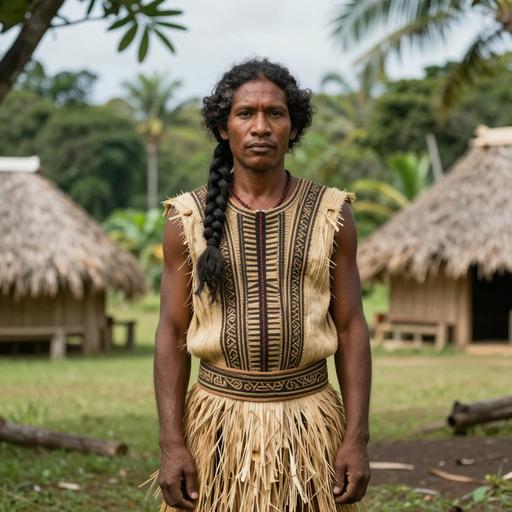
Portrait reconstruction of I14493
Ancient Individual

A man buried in Vanuatu in the Late Prehistoric era

I14493
1502 CE - 1643 CE
Male
Vanuatu 400 Years Ago
Vanuatu
Scroll to begin
Chapter I

Identity

The biological and cultural markers that define this ancient individual

Sample ID

I14493

Date Range

1502 CE - 1643 CE

Biological Sex

Male

mtDNA Haplogroup

P2

Y-DNA Haplogroup

C-M38

Cultural Period

Vanuatu 400 Years Ago

Chapter II

Place

Where this individual was discovered

Country Vanuatu
Locality Retoka
Chapter III

Time

When this individual lived in the broader context of human history

I14493 1502 CE - 1643 CE
Chapter IV

Story

The narrative of this ancient life

Vanuatu, an archipelago in the South Pacific, has a rich cultural tapestry woven over thousands of years. Around 400 years ago, a period estimated to be during the late 17th century, the culture and society of Vanuatu were thriving and deeply rooted in Melanesian traditions. Here's an extensive look into this era:

Geographical Context and Environment: Vanuatu consists of approximately 83 islands, each with its unique geology and ecological diversity. The islands are characterized by diverse landscapes, ranging from volcanic mountains to coral atolls. The climate is tropical, with distinct wet and dry seasons, fostering lush rainforests and fertile lands suitable for agriculture.

Social Structure and Society: The social organization in Vanuatu was primarily communal, with an emphasis on kinship and clan relationships. Society was structured around chiefly systems, where leadership was often hereditary or achieved through displays of wisdom, bravery, and wealth. Chiefs played a crucial role in maintaining order, mediating disputes, and leading religious and cultural ceremonies.

Language and Communication: Vanuatu is known for its linguistic diversity, possessing one of the highest densities of languages per capita in the world. Around 400 years ago, it is likely that each island or even individual communities had their distinct languages or dialects. Oral tradition was fundamental, with stories, history, and knowledge passed down through generations by word of mouth.

Economy and Subsistence: The economy was primarily subsistence-based. Agriculture was the mainstay, with yam, taro, bananas, and coconuts being staple crops. Communities practiced shifting cultivation to maintain soil fertility. Fishing was also a crucial part of daily life, with coastal communities utilizing traditional techniques and tools made from locally sourced materials.

Craftsmanship and Material Culture: Artisans in Vanuatu were skilled in various crafts, including pottery, weaving, and wood carving. Each island had its own distinct styles and techniques. For instance, intricate mats woven from pandanus leaves were used for ceremonial purposes. Canoes, essential for transportation and fishing, were expertly crafted, showcasing the technical knowledge and artistry of the islanders.

Religious Beliefs and Practices: Religion in Vanuatu during this period was deeply interwoven with daily life and centered around animistic beliefs. The spiritual realm was believed to be inhabited by a variety of spirits and deities associated with natural elements and ancestors. Rituals and ceremonies were vital for appeasing these spirits, ensuring community well-being, and marking significant life events. Men’s houses, known as akamal," served as centers for rituals and social gatherings.

Art and Expression: Art in Vanuatu was not only decorative but also held religious or social significance. Masks, sculptures, and sand drawings were commonly created for rituals and storytelling. Music and dance were integral cultural expressions, using traditional instruments like drums and bamboo flutes. These art forms were passed down through generations, preserving cultural identity and history.

Inter-island Interaction and Trade: Despite being spread across distant islands, communities in Vanuatu engaged in active trade and interaction. Exchange networks facilitated the movement of goods such as pottery, food, and pigs, which were highly valued. Inter-island marriages helped to strengthen alliances and cultural ties.

Challenges and Adaptations: Island communities often faced environmental challenges such as cyclones and volcanic eruptions. These natural events shaped societies, compelling them to develop resilient strategies and adaptive practices.

In conclusion, Vanuatu 400 years ago was a vibrant society characterized by its diversity in language, culture, and ecological adaptation. The practices and values of this era laid the foundation for modern Vanuatu, continuing to influence the cultural identity and social structures of its people today."

Chapter V

Genetics

The genetic ancestry of this ancient individual

Ancient Genetic Admixture

This analysis compares the DNA profile of I14493 with ancient reference populations, showing the genetic composition in terms of prehistoric ancestral groups.

Ancient Oceanians 59.9%
Ancient Asians 33.8%
Western Steppe Pastoralists 3.9%
Neolithic Farmers 2.4%

Modern Genetic Admixture

This analysis compares the DNA profile with present-day reference populations, showing what percentage of genetic makeup resembles modern populations from different regions.

Oceania 71.5%
Melanesian 71.5%
Papuan 71.5%
Asia 25.0%
Chinese & Southeast Asian 15.5%
Chinese 13.0%
Vietnamese 1.5%
Indonesian Khmer Thai Myanma 1.1%
Japanese & Korean 5.4%
Japanese 5.4%
Central Asian, Northern Indian & Pakistani 4.1%
Indian 4.1%
Africa 2.5%
Northern East African 1.3%
Eastern African 1.3%
North African 1.1%
North African 0.9%
Europe 0.9%
Northwestern European 0.5%

Closest Modern Populations

These are the modern populations showing the closest statistical alignment to A man buried in Vanuatu in the Late Prehistoric era, ranked by genetic distance. Lower distance values indicate closer statistical similarity.

1
Nasoi
4.1452
2
Australian
8.9522
3
Papuan Highland B
10.4307
4
Kosipe
22.7362
5
Koinanbe
24.9407
6
Papuan
25.0470
7
Papuan Highland A
25.5332
8
Bajo
36.6800
9
Agta
37.0743
10
Jarawa
37.2074
Chapter VI

Context

Other ancient individuals connected to this sample

Sources

References

Scientific publications and genetic data

Scientific Publication

Three Phases of Ancient Migration Shaped the Ancestry of Human Populations in Vanuatu

Authors Lipson M, Spriggs M, Valentin F
Abstract

The archipelago of Vanuatu has been at the crossroads of human population movements in the Pacific for the past three millennia. To help address several open questions regarding the history of these movements, we generated genome-wide data for 11 ancient individuals from the island of Efate dating from its earliest settlement to the recent past, including five associated with the Chief Roi Mata's Domain World Heritage Area, and analyzed them in conjunction with 34 published ancient individuals from Vanuatu and elsewhere in Oceania, as well as present-day populations. Our results outline three distinct periods of population transformations. First, the four earliest individuals, from the Lapita-period site of Teouma, are concordant with eight previously described Lapita-associated individuals from Vanuatu and Tonga in having almost all of their ancestry from a "First Remote Oceanian" source related to East and Southeast Asians. Second, both the Papuan ancestry predominating in Vanuatu for the past 2,500 years and the smaller component of Papuan ancestry found in Polynesians can be modeled as deriving from a single source most likely originating in New Britain, suggesting that the movement of people carrying this ancestry to Remote Oceania closely followed that of the First Remote Oceanians in time and space. Third, the Chief Roi Mata's Domain individuals descend from a mixture of Vanuatu- and Polynesian-derived ancestry and are related to Polynesian-influenced communities today in central, but not southern, Vanuatu, demonstrating Polynesian genetic input in multiple groups with independent histories.

G25 Coordinates

The G25 coordinates for sample I14493 can be used for detailed admixture analysis in our G25 Studio tool.

I14493,-0.03058386,-0.28278656,-0.18777234,0.18793196,0.17026728,-0.31406692,-0.00153032,0.00222296,-0.02844272,-0.01336624,0.00223486,0.00337686,-0.0022258,-0.00384742,0.00255232,0.00016276,-0.00183686,-0.0011394,-0.00073282,-0.00448234,0.0043844,-0.00175938,-0.00148132,0.0014036,0.00187256
Analyze in G25 Studio
Use code for 40% off Expires Feb 27