Menu
Store
Blog
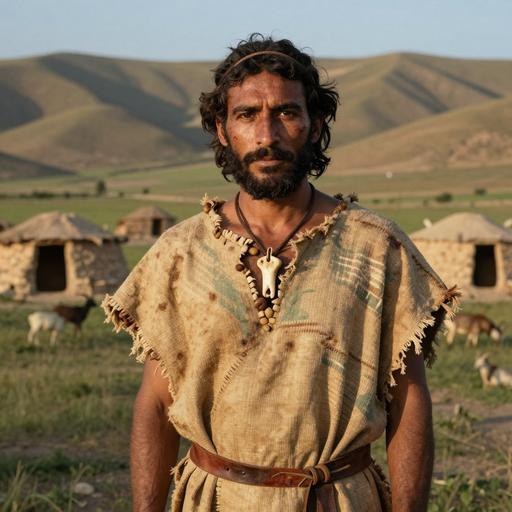
Portrait reconstruction of I1954
Ancient Individual

A man buried in Iran in the Neolithic era

I1954
8295 BCE - 7976 BCE
Male
Neolithic Ganj Dareh
Iran
Scroll to begin
Chapter I

Identity

The biological and cultural markers that define this ancient individual

Sample ID

I1954

Date Range

8295 BCE - 7976 BCE

Biological Sex

Male

mtDNA Haplogroup

R2

Y-DNA Haplogroup

R-M124

Cultural Period

Neolithic Ganj Dareh

Chapter II

Place

Where this individual was discovered

Country Iran
Locality Ganj Dareh
Coordinates 34.4500, 48.1160
Chapter III

Time

When this individual lived in the broader context of human history

I1954 8295 BCE - 7976 BCE
Chapter IV

Story

The narrative of this ancient life

Ganj Dareh, located in the central Zagros Mountains of present-day Iran, is one of the most significant Neolithic sites in the Ancient Near East. It provides crucial insights into the early development of agriculture, animal domestication, and the rise of settled communities during the Neolithic period, approximately around 7900 to 7500 BCE. This era marks a pivotal transformation in human history, transitioning from nomadic hunter-gatherer lifestyles to more sedentary agricultural communities, known as the Neolithic Revolution.

Archaeological Significance

Ganj Dareh is considered one of the earliest known sites where evidence of goat domestication has been discovered, a critical development in the history of human civilization. This domestication is a key characteristic of early Neolithic communities in the region, showcasing the shift towards more sustainable and controlled food sources.

The site consists of a mound, or \tell," formed by successive layers of human habitation. Excavations at Ganj Dareh have uncovered five distinct occupation levels, providing archaeologists with a detailed record of the Neolithic lifestyle and technological advancements. The settlement's stratigraphy highlights changes in architecture, subsistence strategies, and social organization over time.

Architecture and Settlement Patterns

The remains of structures at Ganj Dareh suggest a sophisticated understanding of construction techniques for the period. The houses were typically rectangular or circular, built using mud bricks and featuring plastered floors. These dwellings provide evidence of an early form of urban planning, with organized layouts suggesting a communal living arrangement.

The settlement patterns at Ganj Dareh demonstrate a move towards permanent living arrangements, with evidence of storage facilities and specialized areas for processing and storing food resources. This change facilitated the ability to support larger populations and laid the foundation for more complex societal structures.

Subsistence and Economy

Ganj Dareh offers important insights into the subsistence strategies of early Neolithic communities. Archaeobotanical and archaeozoological evidence indicate a mixed economy of agriculture and animal husbandry. The domestication of goats, along with the cultivation of plants like wheat and barley, allowed for a more reliable food supply, reducing dependence on wild resources.

This era also marks the beginning of plant cultivation and gathering, with evidence of early experimentation in agriculture. The domestication of animals and the cultivation of plants were monumental steps toward the establishment of agrarian societies in the Near East.

Social and Cultural Aspects

The social structure of the Ganj Dareh community likely involved kinship-based and egalitarian relationships, typical of early Neolithic societies. The presence of communal storage facilities suggests some level of resource sharing and collective management.

Cultural practices, including burial customs, also provide insights into the beliefs and social organization of the inhabitants. Human remains found at the site have revealed burial practices that may have included the use of ochre, indicating ritualistic or symbolic significance.

Technological Innovation

The material culture of Ganj Dareh includes a variety of stone tools and pottery, reflecting the technological advancements of the time. The site's lithic assemblages consist of tools used for farming, hunting, and domestic activities, indicating a wide range of practical applications.

The development of pottery at Ganj Dareh marks another significant technological innovation, as ceramic production represents a major leap in the storage and preparation of food resources. Although early pottery was simple and undecorated, it laid the groundwork for more complex ceramic traditions in later periods.

Conclusion

Ganj Dareh stands as a testament to the early stages of human adaptation and innovation during the Neolithic period in the Ancient Near East. Its archaeological record provides vital evidence of the transition from foraging to farming, the domestication of animals, and the development of permanent settlements. These changes had profound implications for the development of human societies, setting the stage for the rise of complex civilizations in the region. The site remains a focal point for understanding the processes that shaped the trajectory of human history in the Neolithic era."

Chapter V

Genetics

The genetic ancestry of this ancient individual

Ancient Genetic Admixture

This analysis compares the DNA profile of I1954 with ancient reference populations, showing the genetic composition in terms of prehistoric ancestral groups.

Neolithic Farmers 71.0%
Ancient Asians 21.9%
Western Steppe Pastoralists 7.1%

Modern Genetic Admixture

This analysis compares the DNA profile with present-day reference populations, showing what percentage of genetic makeup resembles modern populations from different regions.

Asia 98.3%
Central Asian, Northern Indian & Pakistani 76.6%
Pakistan 57.3%
Indian 19.3%
Northern West Asian 21.7%
Mesopotamian 14.0%
Anatolian 7.7%
Africa 1.0%
West African 1.0%
Ghanaian, Liberian, Sierra Leonean 1.0%
Oceania 0.7%
Melanesian 0.7%
Papuan 0.7%

Closest Modern Populations

These are the modern populations showing the closest statistical alignment to A man buried in Iran in the Neolithic era, ranked by genetic distance. Lower distance values indicate closer statistical similarity.

1
Iranian Persian Khorasan
5.4691
2
Parsi Pakistan
5.6589
3
Parsi India
5.7489
4
Iranian Mazandarani O
6.2700
5
Turkmen O
6.5098
6
Iranian Mazandarani
6.6862
7
Irani Zoroastrian India
6.7559
8
Iranian Persian Shiraz
6.8016
9
Iranian Central
6.8429
10
Azerbaijani Dagestan
6.9395
Chapter VI

Context

Other ancient individuals connected to this sample

Sources

References

Scientific publications and genetic data

Scientific Publication

The formation of human populations in South and Central Asia

Authors Narasimhan VM, Patterson N, Moorjani P
Abstract

By sequencing 523 ancient humans, we show that the primary source of ancestry in modern South Asians is a prehistoric genetic gradient between people related to early hunter-gatherers of Iran and Southeast Asia. After the Indus Valley Civilization's decline, its people mixed with individuals in the southeast to form one of the two main ancestral populations of South Asia, whose direct descendants live in southern India. Simultaneously, they mixed with descendants of Steppe pastoralists who, starting around 4000 years ago, spread via Central Asia to form the other main ancestral population. The Steppe ancestry in South Asia has the same profile as that in Bronze Age Eastern Europe, tracking a movement of people that affected both regions and that likely spread the distinctive features shared between Indo-Iranian and Balto-Slavic languages.

G25 Coordinates

The G25 coordinates for sample I1954 can be used for detailed admixture analysis in our G25 Studio tool.

I1954,0.0909705,0.06463234,-0.08100552,0.0015677,-0.05724862,0.00928232,0.00813346,-0.0014952,-0.03708988,-0.01621926,-0.00438188,0.00570298,-0.01517526,0.0048795,0.00701472,-0.01326094,0.01531082,-0.00421846,-0.00586416,0.01045672,0.0106108,-0.00058044,0.00673262,-0.00602116,-0.00586703
Analyze in G25 Studio
Use code for 40% off Expires Feb 26