Menu
Store
Blog
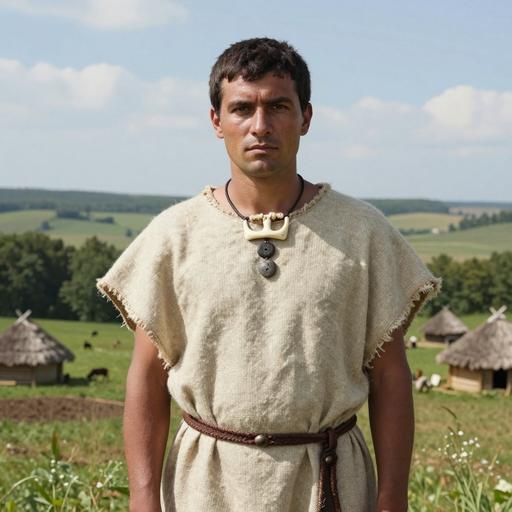
Portrait reconstruction of I2395
Ancient Individual

A man buried in Hungary in the Copper Age era

I2395
4500 BCE - 4000 BCE
Male
Early Chalcolithic Tiszapolgár Culture, Hungary
Hungary
Scroll to begin
Chapter I

Identity

The biological and cultural markers that define this ancient individual

Sample ID

I2395

Date Range

4500 BCE - 4000 BCE

Biological Sex

Male

mtDNA Haplogroup

H26

Y-DNA Haplogroup

G-L30

Cultural Period

Early Chalcolithic Tiszapolgár Culture, Hungary

Chapter II

Place

Where this individual was discovered

Country Hungary
Locality Pusztataskony-Ledence I
Coordinates 47.4593, 20.5128
Chapter III

Time

When this individual lived in the broader context of human history

I2395 4500 BCE - 4000 BCE
Chapter IV

Story

The narrative of this ancient life

The Tiszapolgár culture, a fascinating part of the early Chalcolithic or Copper Age of Central Europe, flourished approximately between 4500 and 4000 BCE in the Carpathian Basin, predominantly in what is now Hungary. This era marked a transition from the Neolithic way of life, characterized by stone tool use and agricultural settlements, to a period where the early use of metal, especially copper, began to appear alongside traditional practices. This transition period is critical in understanding the evolution of European societies towards more complex social structures and technological advancements.

Geography and Settlement

The Tiszapolgár culture is named after the town of Tiszapolgár in Hungary, where significant archaeological finds have been made. It occupied the Great Hungarian Plain, which provided rich alluvial soil and a hospitable environment for early farming communities. The settlements of this period were typically located near rivers or water bodies, facilitating agriculture and providing resources for daily activities.

These communities usually consisted of small, dispersed settlements rather than large, centralized towns. The typical settlement pattern suggests a community of interconnected but autonomous groups, each managing its agricultural activities and communal resources. Houses were generally rectangular, constructed using wattle-and-daub techniques, and often featured thatched roofs.

Economy and Subsistence

The subsistence strategy of the Tiszapolgár people was diverse, involving agriculture, animal husbandry, hunting, and gathering. They cultivated crops such as wheat, barley, peas, and lentils, utilizing the fertile plains to their advantage. Livestock, including cattle, sheep, goats, and pigs, played a significant role in their economy, not only providing meat but also secondary products like milk, wool, and leather.

The Tiszapolgár culture also shows evidence of trade and exchange networks for goods not locally available. This is exemplified by the presence of materials like obsidian and flint, which were used for tool-making and were likely obtained through trade or travel.

Technology and Craftsmanship

One of the defining features of the Chalcolithic period is the early use of copper, and the Tiszapolgár culture is no exception. Although stone tools were still predominantly used, copper began to appear in the form of small tools and ornaments, indicating a nascent metallurgical industry. This included the production of simple axes, awls, and jewelry, which were likely status symbols or used in trade.

Ceramics from the Tiszapolgár culture are particularly noteworthy. Pottery was often decorated with intricate geometric patterns or incised designs, and the quality of craftsmanship suggests a high level of skill. These ceramics were not only utilitarian but also played a role in cultural and ritual practices.

Social Structure and Culture

The Tiszapolgár culture exhibits signs of increasing social complexity. The presence of different burial practices suggests a stratified society, possibly with distinct social classes or roles within the community. Burial sites often contain grave goods, such as pottery, tools, and personal ornaments, indicating beliefs in an afterlife or social status display.

Rituals and spiritual life during this period are less clearly understood but are integral to understanding the cultural fabric. The presence of figurines and decorated objects suggests a symbolic or religious aspect to their material culture, possibly revolving around fertility, ancestry, or natural elements.

Conclusion

The Early Chalcolithic Tiszapolgár culture represents a significant period of transition in European prehistory. It stands out for its combination of traditional Neolithic practices with emerging Copper Age innovations, laying the groundwork for subsequent cultural developments in the region. This era reflects adaptability and ingenuity in the face of changing environmental and social conditions, indicating a proactive approach to technological and cultural advancements. Through a combination of agriculture, nascent metallurgy, and intricate craftsmanship, the Tiszapolgár people contributed to the dynamic tapestry of Chalcolithic Europe, providing a foundation for future complexities in societal structures and interactions.

Chapter V

Genetics

The genetic ancestry of this ancient individual

Ancient Genetic Admixture

This analysis compares the DNA profile of I2395 with ancient reference populations, showing the genetic composition in terms of prehistoric ancestral groups.

Neolithic Farmers 66.7%
European Hunter-Gatherers 20.2%
Western Steppe Pastoralists 9.9%
Ancient Asians 3.3%

Modern Genetic Admixture

This analysis compares the DNA profile with present-day reference populations, showing what percentage of genetic makeup resembles modern populations from different regions.

Europe 91.6%
Southern European 91.6%
Italian 65.9%
Sardinian 25.3%
Asia 8.4%
Northern West Asian 8.4%
Cypriot 8.4%

Closest Modern Populations

These are the modern populations showing the closest statistical alignment to A man buried in Hungary in the Copper Age era, ranked by genetic distance. Lower distance values indicate closer statistical similarity.

1
Sardinian
3.2739
2
French Corsica
6.3698
3
Belmonte Jew
6.6133
4
Italian Lazio
7.4880
5
Italian Umbria
7.7192
6
Sicilian West
7.8179
7
Italian Lombardy
7.8447
8
Spanish Murcia
7.8573
9
Spanish Andalucia
7.9855
10
Spanish Menorca
7.9959
Chapter VI

Context

Other ancient individuals connected to this sample

Sources

References

Scientific publications and genetic data

Scientific Publication

Parallel palaeogenomic transects reveal complex genetic history of early European farmers

Authors Lipson M, Szécsényi-Nagy A, Mallick S
Abstract

Ancient DNA studies have established that Neolithic European populations were descended from Anatolian migrants who received a limited amount of admixture from resident hunter-gatherers. Many open questions remain, however, about the spatial and temporal dynamics of population interactions and admixture during the Neolithic period. Here we investigate the population dynamics of Neolithization across Europe using a high-resolution genome-wide ancient DNA dataset with a total of 180 samples, of which 130 are newly reported here, from the Neolithic and Chalcolithic periods of Hungary (6000-2900 bc, n = 100), Germany (5500-3000 bc, n = 42) and Spain (5500-2200 bc, n = 38). We find that genetic diversity was shaped predominantly by local processes, with varied sources and proportions of hunter-gatherer ancestry among the three regions and through time. Admixture between groups with different ancestry profiles was pervasive and resulted in observable population transformation across almost all cultural transitions. Our results shed new light on the ways in which gene flow reshaped European populations throughout the Neolithic period and demonstrate the potential of time-series-based sampling and modelling approaches to elucidate multiple dimensions of historical population interactions.

G25 Coordinates

The G25 coordinates for sample I2395 can be used for detailed admixture analysis in our G25 Studio tool.

I2395,0.10854982,0.15895924,0.01466388,-0.05365512,0.05213988,-0.02595234,-0.0032729,0.00482006,0.04152002,0.06557322,-0.0016704,0.01089358,-0.01800598,-0.01265898,-0.0126465,0.00603092,0.01371904,7.528E-05,-0.00059424,-0.00236538,-0.00042298,0.00375122,-0.01076018,-0.01795534,0.0035561
Analyze in G25 Studio
Use code for 40% off Expires Feb 27