Menu
Store
Blog
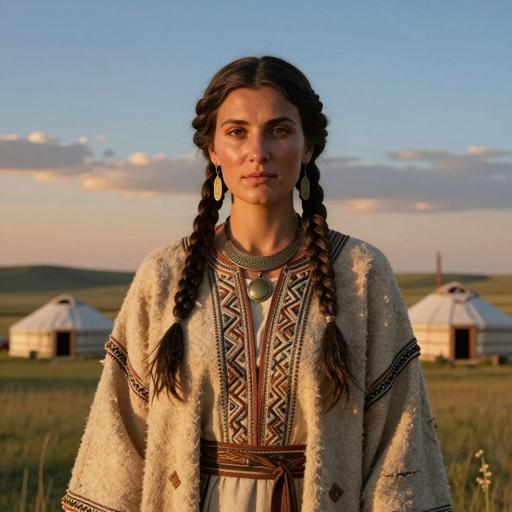
Portrait reconstruction of I3451
Ancient Individual

A woman buried in Kazakhstan in the Iron Age era

I3451
930 BCE - 806 BCE
Female
Iron Age Tasbas
Kazakhstan
Scroll to begin
Chapter I

Identity

The biological and cultural markers that define this ancient individual

Sample ID

I3451

Date Range

930 BCE - 806 BCE

Biological Sex

Female

mtDNA Haplogroup

D4e1

Cultural Period

Iron Age Tasbas

Chapter II

Place

Where this individual was discovered

Country Kazakhstan
Locality Tasbas. Byan Zherek
Coordinates 45.1343, 79.3679
Chapter III

Time

When this individual lived in the broader context of human history

I3451 930 BCE - 806 BCE
Chapter IV

Story

The narrative of this ancient life

The Iron Age Tasbas culture of the Eurasian Steppe represents a fascinating period in the archaeological and historical landscapes of Central Asia. This culture is part of the larger tapestry of Steppe cultures that thrived in the region, known for their dynamic interactions with diverse neighboring societies, and their own unique developments in technology, economy, and social structures.

Geographic Location and Environment

The Tasbas culture primarily occupied regions within modern-day Kazakhstan, which is characterized by its vast steppes, semi-deserts, and mountainous zones. This geographical setting offered both challenges and opportunities, influencing the cultural evolution of the Tasbas people. The steppe environment provided ample space for pastoralism, while the proximity to mountains and rivers offered resources such as metal ores, essential for Iron Age developments.

Chronology and Archaeological Discoveries

Dating to approximately the 9th to 3rd centuries BCE, the Tasbas culture is part of the broader Iron Age epoch on the Eurasian Steppe. Archaeological investigations have uncovered settlements, kurgans (burial mounds), and artifacts characteristic of the Tasbas. These findings provide insights into the daily life, spiritual beliefs, and technological advancements of this culture.

Economy and Subsistence

The economy of the Tasbas culture was primarily based on pastoralism, with horse, sheep, and cattle herding playing a central role. The domestication and use of horses facilitated mobility and trade across vast distances, a hallmark of Steppe cultures. This mobility enabled the Tasbas to engage in long-distance trade networks, exchanging goods with cultures as far-flung as the Mediterranean and China.

Agriculture, while less prominent due to the arid climate, may have supplemented their diet. Evidence of millet and other grains suggests limited farming activities near rivers and oases. The dietary reliance on livestock is reflected in the faunal remains found at Tasbas archaeological sites.

Social Structure and Organization

The social organization of the Tasbas culture is inferred from burial practices and settlement patterns. The presence of kurgans, often containing rich grave goods, suggests a hierarchical society with distinctions of status and wealth. These burials indicate the importance of clan or familial units, where chiefs or influential figures may have held sway.

The Tasbas people likely lived in semi-nomadic groups, moving seasonally to exploit diverse ecological niches. Seasonal camps and more permanent settlements suggest flexibility in social organization, balancing mobility with the need for stable community centers.

Material Culture and Technology

The Tasbas culture marked a significant period of technological innovation, notably in metallurgy. The production and use of iron tools and weapons gave them a strategic advantage in both agriculture and warfare. Artifacts such as swords, arrowheads, and farming implements reflect advanced ironworking skills.

Ceramics from this era show both utilitarian and artistic elements, with some pottery bearing intricate designs. Gold and other precious metals have been found in burial sites, signifying both wealth and craftsmanship.

Spiritual and Artistic Expression

Tasbas spirituality and artistic expression are glimpsed through burial customs and decorative motifs. The kurgans often contained objects believed to serve individuals in the afterlife, hinting at beliefs in an existence beyond death. Animal motifs prevalent in Tasbas art connect to broader Steppe artistic traditions, depicting wildlife common to the region and symbolically important creatures like the horse.

Shamanistic practices may have been part of their spiritual life, as suggested by artifacts believed to hold ritual significance. The integration of art and spirituality is evident in personal adornments like jewelry, which often incorporated symbolic designs.

Interaction with Other Cultures

The Tasbas culture, as part of the Iron Age Steppe cultures, was not isolated. It engaged dynamically with neighboring cultures, like the Scythians to the west and various Siberian groups to the north. These interactions were marked by both conflict and trade, influencing the cultural and technological exchange.

In conclusion, the Iron Age Tasbas culture represents a vibrant and adaptive society within the challenging environment of the Eurasian Steppe. Its development in metallurgy, complex social structures, and rich artistic traditions provide invaluable insights into the broader narrative of human cultural evolution in Central Asia.

Chapter V

Genetics

The genetic ancestry of this ancient individual

Ancient Genetic Admixture

This analysis compares the DNA profile of I3451 with ancient reference populations, showing the genetic composition in terms of prehistoric ancestral groups.

Ancient Asians 32.9%
Western Steppe Pastoralists 26.4%
Neolithic Farmers 19.6%
European Hunter-Gatherers 17.0%
Ancient Native Americans 4.1%

Modern Genetic Admixture

This analysis compares the DNA profile with present-day reference populations, showing what percentage of genetic makeup resembles modern populations from different regions.

Asia 61.3%
Central Asian, Northern Indian & Pakistani 30.3%
Central Asian 17.9%
Pakistan 12.2%
Northern West Asian 22.5%
Caucasian 22.5%
Northern Asian 6.3%
Siberian 6.3%
Chinese & Southeast Asian 2.1%
Chinese 2.1%
Europe 34.0%
Eastern European 28.0%
Northwestern European 6.0%
Northwestern European 4.2%
English 1.8%
America 4.7%
America 4.7%
Native American 4.7%

Closest Modern Populations

These are the modern populations showing the closest statistical alignment to A woman buried in Kazakhstan in the Iron Age era, ranked by genetic distance. Lower distance values indicate closer statistical similarity.

1
Besermyan
5.8175
2
Tatar Lipka
6.4105
3
Tatar Kazan
6.4212
4
Udmurt
6.6787
5
Tajik Tajikistan Hisor
7.5317
6
Tatar Crimean Steppe
7.9419
7
Turkmen
7.9658
8
Tajik Tajikistan Ayni
8.0044
9
Pamiri Sarikoli
8.2353
10
Turkmen Uzbekistan
8.3554
Chapter VI

Context

Other ancient individuals connected to this sample

Sources

References

Scientific publications and genetic data

Scientific Publication

The formation of human populations in South and Central Asia

Authors Narasimhan VM, Patterson N, Moorjani P
Abstract

By sequencing 523 ancient humans, we show that the primary source of ancestry in modern South Asians is a prehistoric genetic gradient between people related to early hunter-gatherers of Iran and Southeast Asia. After the Indus Valley Civilization's decline, its people mixed with individuals in the southeast to form one of the two main ancestral populations of South Asia, whose direct descendants live in southern India. Simultaneously, they mixed with descendants of Steppe pastoralists who, starting around 4000 years ago, spread via Central Asia to form the other main ancestral population. The Steppe ancestry in South Asia has the same profile as that in Bronze Age Eastern Europe, tracking a movement of people that affected both regions and that likely spread the distinctive features shared between Indo-Iranian and Balto-Slavic languages.

G25 Coordinates

The G25 coordinates for sample I3451 can be used for detailed admixture analysis in our G25 Studio tool.

I3451,0.09831854,-0.01831528,0.03071414,0.04323996,-0.03782354,0.0077637,-0.00374904,-0.00679262,-0.01750448,-0.02327708,0.00702618,-0.00114346,0.00393416,-0.02202002,0.00283876,-0.00509104,-0.0053069,-0.00339944,-0.00751478,-0.00264186,-0.0038993,0.00483996,-0.0060304,0.0031184,-0.00576961
Analyze in G25 Studio
Use code for 40% off Expires Feb 26