Menu
Store
Blog
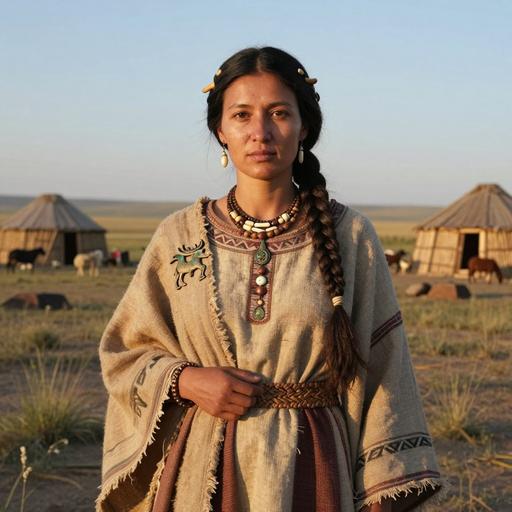
Portrait reconstruction of I3864
Ancient Individual

A woman buried in Kazakhstan in the Middle Late Bronze Age era

I3864
1729 BCE - 1538 BCE
Female
Mid-Late Bronze Solyanka
Kazakhstan
Scroll to begin
Chapter I

Identity

The biological and cultural markers that define this ancient individual

Sample ID

I3864

Date Range

1729 BCE - 1538 BCE

Biological Sex

Female

mtDNA Haplogroup

R1b1

Cultural Period

Mid-Late Bronze Solyanka

Chapter II

Place

Where this individual was discovered

Country Kazakhstan
Locality Solyanka Vodokhranilische. West Kazakhstan
Coordinates 49.6308, 50.7567
Chapter III

Time

When this individual lived in the broader context of human history

I3864 1729 BCE - 1538 BCE
Chapter IV

Story

The narrative of this ancient life

The Mid-Late Bronze Age Solyanka period of the Andronovo Culture represents a fascinating and integral component of Eurasian prehistory, dating from approximately 2000 to 900 BCE. This era witnessed the expansion and elaboration of the Andronovo cultural traditions across the steppes of Central Asia, particularly in what is now modern-day Kazakhstan, with influences radiating into areas of Russia and the western parts of China.

Geography and Environment

The geographical setting of the Solyanka period was characterized by the vast steppes and semi-arid regions of Central Asia, providing a backdrop that influenced the lifestyles and adaptations of its people. This region, with its harsh climate and expansive plains, was conducive to a nomadic and semi-nomadic lifestyle, with periodic settlements fostered by the presence of river valleys and other natural resources.

Social Structure and Lifestyle

The social structure of the Solyanka era appears to have been complex and primarily centered around clan or tribal affiliations. These societies were typically hierarchical, with evidence suggesting the presence of a social elite who exerted influence over economic and religious activities. Family units and lineages were likely crucial, with kinship ties playing a central role in social organization.

The economy was predominantly pastoral, focusing on the herding of cattle, sheep, goats, and horses. The domestication and strategic breeding of the horse during this period significantly influenced mobility, warfare, and trade. This mobility facilitated the spread of cultural elements and technological innovations across vast distances.

Settlements and Architecture

While the Solyanka culture was largely nomadic, there were also semi-permanent settlements characterized by round or oval-shaped dwellings constructed of wood, adobe, or stone, sometimes complemented by temporary shelters made from animal skins. These settlements were often strategically located near water sources and pastures. Archaeological findings, such as fortified structures, indicate that some communities invested resources in defense, possibly due to inter-tribal conflicts or external threats.

Material Culture and Technology

The Solyanka period is noted for its advancements in metallurgy. The Andronovo craftsmen were proficient in copper and bronze work, producing tools, weapons, and ornaments that reveal high levels of skill and artistry. Pottery from this era, frequently decorated with incised or stamped geometric patterns, illustrates a distinct aesthetic and served both utilitarian and ceremonial purposes.

The production and use of textiles, though less well-documented archaeologically, were likely significant, with wool and perhaps plant fibers being used to create clothing and other goods.

Trade and Interaction

Trade networks were vital in the Mid-Late Bronze Age, facilitating the exchange of goods, ideas, and technologies between the Solyanka communities and neighboring cultures. These interactions are evidenced by the distribution of Andronovo-style artifacts and influences as far afield as the Indian Subcontinent, suggesting a dynamic cultural exchange.

Religion and Burial Practices

Religious beliefs of the Solyanka culture were animistic and shamanistic, often centered around natural phenomena and ancestor worship. Burial practices provide critical insights into their belief systems, with kurgans (burial mounds) being the most distinctive mortuary feature. These kurgans often contained grave goods, including pottery, weapons, and ornaments, which indicate a belief in an afterlife where such items would be necessary.

Human remains found in these burials present evidence of social stratification, as well as hints at ritualistic practices. The construction and complexity of these burial sites also demonstrate the communal effort and respect accorded to the deceased, particularly those of high status.

Legacy

The Solyanka phase of the Andronovo Culture contributed significantly to the cultural and technological development of the region, laying foundations for later civilizations. Their mastery of horseback riding would later play a pivotal role in the mobility and conquests of Eurasian nomads, and their metallurgical techniques set precedents for future advancements.

In conclusion, the Mid-Late Bronze Age Solyanka culture represents a period of vibrant cultural development within the Andronovo tradition. It exemplifies the adaptability and resilience of human societies faced with challenging environments and highlights the intricate web of cultural interactions across the Bronze Age Eurasian landscape.

Chapter V

Genetics

The genetic ancestry of this ancient individual

Ancient Genetic Admixture

This analysis compares the DNA profile of I3864 with ancient reference populations, showing the genetic composition in terms of prehistoric ancestral groups.

Western Steppe Pastoralists 45.3%
European Hunter-Gatherers 30.4%
Neolithic Farmers 20.0%
Ancient Asians 4.3%

Modern Genetic Admixture

This analysis compares the DNA profile with present-day reference populations, showing what percentage of genetic makeup resembles modern populations from different regions.

Europe 88.0%
Northwestern European 61.8%
English 39.9%
Scandinavian 8.0%
Northwestern European 7.4%
Finnish 6.5%
Eastern European 26.2%
Asia 12.0%
Northern West Asian 7.4%
Caucasian 7.4%
Central Asian, Northern Indian & Pakistani 4.6%
Pakistan 4.6%

Closest Modern Populations

These are the modern populations showing the closest statistical alignment to A woman buried in Kazakhstan in the Middle Late Bronze Age era, ranked by genetic distance. Lower distance values indicate closer statistical similarity.

1
Swedish
4.4747
2
German Hamburg
4.6759
3
Norwegian
4.7182
4
Afrikaner
4.7602
5
Shetlandic
4.8634
6
Orcadian
4.8868
7
Icelandic
4.9396
8
Scottish
4.9600
9
Danish
4.9758
10
Finnish Southwest
4.9780
Chapter VI

Context

Other ancient individuals connected to this sample

Sources

References

Scientific publications and genetic data

Scientific Publication

The formation of human populations in South and Central Asia

Authors Narasimhan VM, Patterson N, Moorjani P
Abstract

By sequencing 523 ancient humans, we show that the primary source of ancestry in modern South Asians is a prehistoric genetic gradient between people related to early hunter-gatherers of Iran and Southeast Asia. After the Indus Valley Civilization's decline, its people mixed with individuals in the southeast to form one of the two main ancestral populations of South Asia, whose direct descendants live in southern India. Simultaneously, they mixed with descendants of Steppe pastoralists who, starting around 4000 years ago, spread via Central Asia to form the other main ancestral population. The Steppe ancestry in South Asia has the same profile as that in Bronze Age Eastern Europe, tracking a movement of people that affected both regions and that likely spread the distinctive features shared between Indo-Iranian and Balto-Slavic languages.

G25 Coordinates

The G25 coordinates for sample I3864 can be used for detailed admixture analysis in our G25 Studio tool.

I3864,0.12418148,0.10018948,0.05367192,0.05409686,0.02058142,0.0205986,0.0031532,0.0074185,-0.00242636,-0.01391522,-0.0018435,-0.00151672,-0.00353444,-0.0048761,0.0118047,-0.00289518,-0.01741376,0.00264744,-0.00182326,-0.00395762,0.00089122,0.00305824,-0.00180566,0.01196788,0.00263418
Analyze in G25 Studio
Use code for 40% off Expires Feb 26