Menu
Store
Blog
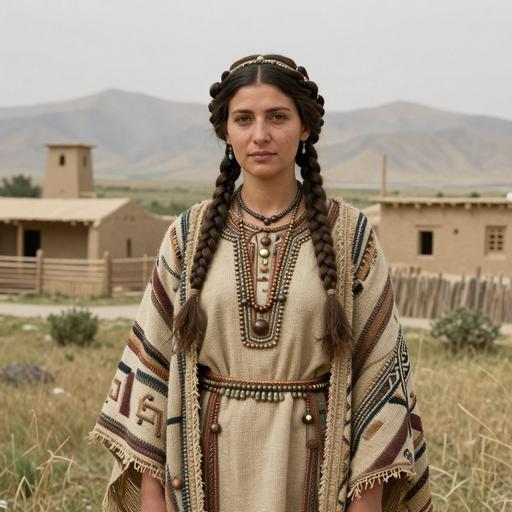
Portrait reconstruction of I4257
Ancient Individual

A woman buried in Tajikistan in the Bronze Age era

I4257
1511 BCE - 1432 BCE
Female
Bronze Age Dashti Kozy
Tajikistan
Scroll to begin
Chapter I

Identity

The biological and cultural markers that define this ancient individual

Sample ID

I4257

Date Range

1511 BCE - 1432 BCE

Biological Sex

Female

mtDNA Haplogroup

T2a1b1

Cultural Period

Bronze Age Dashti Kozy

Chapter II

Place

Where this individual was discovered

Country Tajikistan
Locality Dashty-Kozy
Coordinates 39.4481, 68.0314
Chapter III

Time

When this individual lived in the broader context of human history

I4257 1511 BCE - 1432 BCE
Chapter IV

Story

The narrative of this ancient life

The Bronze Age Dashti Kozy culture is a lesser-known but fascinating aspect of Central Asian civilization that flourished during a period marked by significant development and transformation. This era is characterized by its unique cultural practices, technological advancements, and its contributions to the socio-economic framework within Central Asia. The Dashti Kozy culture can be explored from various perspectives, including its geographical setting, archaeological findings, societal structure, technological progress, economic activities, and cultural influences.

Geographical Setting:

The Dashti Kozy culture is believed to have thrived in the expansive region of Central Asia, particularly within the fertile valleys and vast steppes of modern-day Tajikistan. The terrain, consisting of river valleys and mountainous areas, provided the essential resources needed for sustenance and development. This geographic advantage facilitated trade routes that connected the culture with neighboring regions, making it a crossroads for exchanges of goods, ideas, and technologies.

Archaeological Findings:

Archaeological excavations in the Dashti Kozy region have uncovered a plethora of artifacts that provide insight into the life of its people. Notable findings include pottery, tools, ornaments, and remnants of domestic architecture. The pottery is distinctive, often decorated with intricate designs that reflect both aesthetic values and symbolic meanings. Tools crafted from bronze and stone reveal a sophisticated understanding of metallurgy and craftsmanship, signifying a technological progression beyond mere subsistence needs.

Societal Structure:

The societal structure of the Dashti Kozy culture was complex and hierarchical. Evidence suggests the existence of social stratification, which manifested in differentiated burial practices. Elite burials, often accompanied by valuable grave goods such as weapons, jewelry, and ceremonial items, indicate a society that valued warriors and leaders. The presence of fortified settlements points to organized communal living and possibly a ruling class responsible for defense and governance.

Technological Progress:

The Bronze Age marks a period of significant technological innovation for the Dashti Kozy culture. The development of bronze metallurgy was a critical advancement, allowing for the production of superior tools and weapons. This technological leap not only improved agricultural efficiency but also bolstered military capabilities. Innovations in pottery and textile production further illustrate the culture’s adaptability and ingenuity.

Economic Activities:

Economically, the Dashti Kozy culture was diverse and largely based on agriculture, animal husbandry, and trade. The fertile lands supported the cultivation of cereals, fruits, and vegetables, while pastoralism fostered the rearing of cattle, sheep, and goats. Trade played a pivotal role, with the region acting as a conduit for the exchange of goods such as metals, textiles, and agricultural produce with adjoining civilizations. Such interactions facilitated economic prosperity and cultural diffusion.

Cultural Influences and Legacy:

The Dashti Kozy culture, while distinctly its own, was influenced by neighboring cultures such as the Bactria-Margiana Archaeological Complex (BMAC) and the Indus Valley Civilization. These interactions are evident in shared artistic motifs, technological practices, and possibly linguistic exchanges. The legacy of the Dashti Kozy culture is seen in its contribution to the broader tapestry of Central Asian history, laying the foundations for future civilizations in the region.

In conclusion, the Bronze Age Dashti Kozy culture represents a dynamic and integral chapter in Central Asian history. Through a blend of innovation, trade, and cultural exchange, it contributed significantly to the development of the region. Its legacy, though not as widely recognized as some other contemporary cultures, offers vital insights into the intricate web of human history and the progression of early societies.

Chapter V

Genetics

The genetic ancestry of this ancient individual

Ancient Genetic Admixture

This analysis compares the DNA profile of I4257 with ancient reference populations, showing the genetic composition in terms of prehistoric ancestral groups.

Western Steppe Pastoralists 38.8%
European Hunter-Gatherers 29.9%
Neolithic Farmers 23.0%
Ancient Asians 5.7%
Ancient Native Americans 2.7%

Modern Genetic Admixture

This analysis compares the DNA profile with present-day reference populations, showing what percentage of genetic makeup resembles modern populations from different regions.

Europe 77.3%
Northwestern European 49.4%
English 24.2%
Scandinavian 13.6%
Finnish 10.8%
Northwestern European 0.9%
Eastern European 25.0%
Southern European 3.0%
Iberian 3.0%
Asia 19.9%
Central Asian, Northern Indian & Pakistani 10.4%
Pakistan 7.6%
Indian 2.8%
Northern West Asian 9.6%
Caucasian 5.6%
Anatolian 4.0%
America 2.8%
America 2.8%
Native American 2.8%

Closest Modern Populations

These are the modern populations showing the closest statistical alignment to A woman buried in Tajikistan in the Bronze Age era, ranked by genetic distance. Lower distance values indicate closer statistical similarity.

1
Afrikaner
6.4063
2
Moksha
6.6084
3
Turkish Deliorman
6.7067
4
Hungarian
6.7423
5
Moldovan O
6.8516
6
Mordovian
6.8965
7
German Hamburg
6.9622
8
Moldovan
6.9741
9
Tatar Mishar
6.9838
10
Erzya
7.0010
Chapter VI

Context

Other ancient individuals connected to this sample

Sources

References

Scientific publications and genetic data

Scientific Publication

The formation of human populations in South and Central Asia

Authors Narasimhan VM, Patterson N, Moorjani P
Abstract

By sequencing 523 ancient humans, we show that the primary source of ancestry in modern South Asians is a prehistoric genetic gradient between people related to early hunter-gatherers of Iran and Southeast Asia. After the Indus Valley Civilization's decline, its people mixed with individuals in the southeast to form one of the two main ancestral populations of South Asia, whose direct descendants live in southern India. Simultaneously, they mixed with descendants of Steppe pastoralists who, starting around 4000 years ago, spread via Central Asia to form the other main ancestral population. The Steppe ancestry in South Asia has the same profile as that in Bronze Age Eastern Europe, tracking a movement of people that affected both regions and that likely spread the distinctive features shared between Indo-Iranian and Balto-Slavic languages.

G25 Coordinates

The G25 coordinates for sample I4257 can be used for detailed admixture analysis in our G25 Studio tool.

I4257,0.11770686,0.08855098,0.03590944,0.04667748,0.00633706,0.01868194,0.00458432,0.006281,-0.00931308,-0.01608958,-0.00047126,-0.00100226,-0.0041342,-0.0069086,0.01104468,-0.00266486,-0.01617154,0.00164432,-0.00345844,-0.00739298,-0.00089236,0.00387366,-0.00384036,0.0115611,0.00019085
Analyze in G25 Studio
Use code for 40% off Expires Feb 26