Menu
Store
Blog
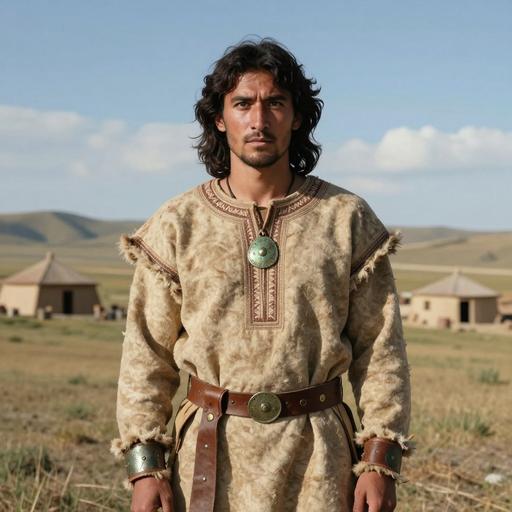
Portrait reconstruction of I4263
Ancient Individual

A man buried in Kazakhstan in the Middle Late Bronze Age era

I4263
1867 BCE - 1625 BCE
Male
Mid-Late Bronze Karagash
Kazakhstan
Scroll to begin
Chapter I

Identity

The biological and cultural markers that define this ancient individual

Sample ID

I4263

Date Range

1867 BCE - 1625 BCE

Biological Sex

Male

mtDNA Haplogroup

U5a1d2b

Y-DNA Haplogroup

R-Z2124

Cultural Period

Mid-Late Bronze Karagash

Chapter II

Place

Where this individual was discovered

Country Kazakhstan
Locality Karagash 2
Coordinates 48.7818, 76.4530
Chapter III

Time

When this individual lived in the broader context of human history

I4263 1867 BCE - 1625 BCE
Chapter IV

Story

The narrative of this ancient life

The Karagash phase of the Mid-Late Bronze Age is an integral part of the broader Andronovo cultural complex, which thrived primarily in the steppes of Central Asia, encompassing parts of modern-day Kazakhstan, Russia, and other surrounding regions. This culture, often dated from about 2000 to 900 BCE, represents a fascinating period of prehistoric development marked by advancements in metallurgy, agriculture, and socio-political organization. The Karagash phase, in particular, has been identified through archeological discoveries in areas like the Pavlodar region in Kazakhstan.

Archaeological Significance

The Andronovo culture is renowned for its contributions to the development of Bronze Age technology and society in Central Asia. The Karagash phase showcases remarkable sophistication in metalwork, with archeological sites revealing numerous bronze artifacts, including tools, weapons, and ornaments. These reflect advanced metallurgical techniques that were a hallmark of the era. The presence of copper mines in the region suggests the availability of raw materials that facilitated these advancements.

Settlements and Architecture

Settlements from the Karagash phase typically include semi-nomadic dwellings, reflecting a lifestyle that combined sedentary agriculture with pastoral nomadism. Archaeological sites reveal structures built from a mix of stone, wood, and clay, with some settlements exhibiting circular or rectangular plans. These settlements often contained storage pits and hearths, indicating knowledge of food preservation and domestic activities.

Economy and Subsistence

The economy of the Karagash phase was predominantly based on mixed farming practices. The Andronovo people cultivated various crops, including wheat and barley, and engaged in animal husbandry, raising cattle, horses, sheep, and goats. The evidence suggests a well-established pastoral economy complemented by hunting and fishing, which provided additional resources for sustenance.

Social Structure and Burial Practices

Social organization during the Karagash phase was complex and likely featured hierarchical structures. Burial sites provide significant insights into their social stratification. Kurgans, or burial mounds, are prevalent in the region. These mounds often contain multiple burials, including those of high-status individuals accompanied by rich grave goods, indicating the possible existence of social elites and a warrior class.

Rituals and Beliefs

The funerary practices of the Karagash phase, such as the construction of kurgans, suggest a belief system centered around ancestral veneration and possibly an early form of ancestor worship. The artifacts found in these burials, including pottery with distinctive geometric patterns, metal adornments, and animal sacrifices, point to ritualistic practices and beliefs in an afterlife.

Cultural Interactions

The Karagash phase of the Andronovo culture was not isolated. Evidence of trade and cultural exchange with neighboring cultures is apparent, as seen in the spread of pottery styles and metalwork techniques. These interactions likely facilitated the transmission of technological innovations and cultural ideas across the Eurasian steppe.

Impact and Legacy

The influence of the Andronovo culture, including the Karagash phase, extended beyond its time, contributing significantly to the cultural and technological foundation of subsequent societies in the region. The advancements in metallurgy, agriculture, and social organization laid the groundwork for the development of later civilizations in Central Asia.

In summary, the Mid-Late Bronze Age Karagash phase represents a period of cultural richness and technological advancement within the Andronovo cultural complex. Its legacy is reflected in the archaeological record, offering insights into the ways in which prehistoric societies adapted to and thrived in the challenging environments of the Central Asian steppes.

Chapter V

Genetics

The genetic ancestry of this ancient individual

Ancient Genetic Admixture

This analysis compares the DNA profile of I4263 with ancient reference populations, showing the genetic composition in terms of prehistoric ancestral groups.

Western Steppe Pastoralists 46.6%
European Hunter-Gatherers 34.1%
Neolithic Farmers 15.3%
Ancient Asians 4.0%

Modern Genetic Admixture

This analysis compares the DNA profile with present-day reference populations, showing what percentage of genetic makeup resembles modern populations from different regions.

Europe 87.6%
Northwestern European 59.4%
English 35.4%
Scandinavian 15.2%
Finnish 4.9%
Northwestern European 3.9%
Eastern European 28.2%
Asia 12.5%
Northern West Asian 6.8%
Caucasian 6.8%
Central Asian, Northern Indian & Pakistani 5.7%
Pakistan 4.9%
Indian 0.8%

Closest Modern Populations

These are the modern populations showing the closest statistical alignment to A man buried in Kazakhstan in the Middle Late Bronze Age era, ranked by genetic distance. Lower distance values indicate closer statistical similarity.

1
Moksha
4.6161
2
Swedish
4.8152
3
Finnish Southwest
4.9308
4
German Hamburg
4.9808
5
Moldovan O
5.0360
6
Mordovian
5.0523
7
Czech
5.1089
8
Russian Kostroma
5.1279
9
Hungarian
5.1387
10
Erzya
5.1556
Chapter VI

Context

Other ancient individuals connected to this sample

Sources

References

Scientific publications and genetic data

Scientific Publication

The formation of human populations in South and Central Asia

Authors Narasimhan VM, Patterson N, Moorjani P
Abstract

By sequencing 523 ancient humans, we show that the primary source of ancestry in modern South Asians is a prehistoric genetic gradient between people related to early hunter-gatherers of Iran and Southeast Asia. After the Indus Valley Civilization's decline, its people mixed with individuals in the southeast to form one of the two main ancestral populations of South Asia, whose direct descendants live in southern India. Simultaneously, they mixed with descendants of Steppe pastoralists who, starting around 4000 years ago, spread via Central Asia to form the other main ancestral population. The Steppe ancestry in South Asia has the same profile as that in Bronze Age Eastern Europe, tracking a movement of people that affected both regions and that likely spread the distinctive features shared between Indo-Iranian and Balto-Slavic languages.

G25 Coordinates

The G25 coordinates for sample I4263 can be used for detailed admixture analysis in our G25 Studio tool.

I4263,0.12492922,0.09761738,0.05316082,0.05375646,0.0190143,0.02161058,0.00616686,0.00890448,-0.00547302,-0.018304,-0.00091482,-0.00032644,0.0023083,-0.00457952,0.0072593,-0.00262298,-0.0110032,0.0002272,-0.0028449,-0.00458884,0.00179076,0.00297878,-0.00418942,0.00990806,-0.00074118
Analyze in G25 Studio
Use code for 40% off Expires Feb 26