Menu
Store
Blog
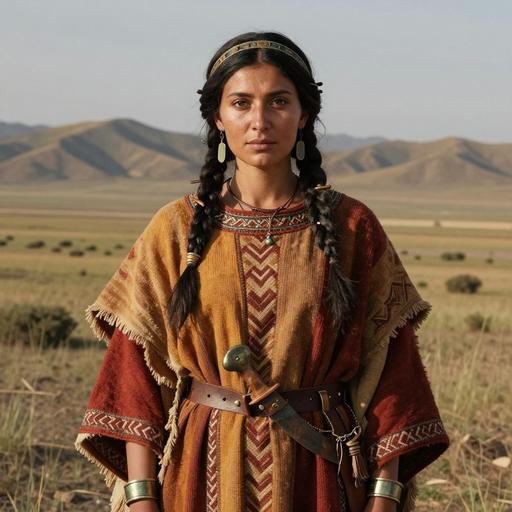
Portrait reconstruction of I6707
Ancient Individual

A woman buried in Kazakhstan in the Middle Late Bronze Age era

I6707
1531 BCE - 1442 BCE
Female
Mid-Late Bronze Bylkyldak
Kazakhstan
Scroll to begin
Chapter I

Identity

The biological and cultural markers that define this ancient individual

Sample ID

I6707

Date Range

1531 BCE - 1442 BCE

Biological Sex

Female

mtDNA Haplogroup

U4a1

Cultural Period

Mid-Late Bronze Bylkyldak

Chapter II

Place

Where this individual was discovered

Country Kazakhstan
Locality Karaganda region. Bylkyldak
Coordinates 49.7099, 73.8828
Chapter III

Time

When this individual lived in the broader context of human history

I6707 1531 BCE - 1442 BCE
Chapter IV

Story

The narrative of this ancient life

The Mid-Late Bronze Age Bylkyldak phase of the Andronovo Culture in Kazakhstan represents a fascinating period marked by significant developments in metallurgy, social organization, and cultural practices. This era, which spans from approximately the 16th to the 9th centuries BCE, is integral to understanding the broader Andronovo culture, which stretched across vast regions of Central Asia and parts of Russia.

Geographical Context: The Bylkyldak phase is primarily associated with the steppes of Central Kazakhstan, a region characterized by open grasslands that facilitated pastoral nomadism. This landscape played a crucial role in shaping the livelihoods and movements of the people during this time. The semi-arid conditions required adaptive strategies for survival and resource management.

Settlement Patterns: During the Mid-Late Bronze Age, settlements were typically located near water sources such as rivers and lakes. These communities were often composed of semi-permanent dwellings, which suggest a degree of sedentism combined with seasonal migrations. Housing structures commonly included yurts or circular huts made of wood and covered with felt or skins, reflecting a blend of nomadic traditions and stationary life.

Economic Activities: The economy of the Bylkyldak phase was predominantly based on pastoralism, with cattle, sheep, goats, and horses being the main domestic animals. The breeding and management of these animals were central to their way of life, providing not only meat and milk but also materials for clothing and tools. Agriculture, though less prevalent, was practiced in some areas, with barley and millet being among the crops cultivated.

Metallurgical Advancements: One of the defining features of this era was the advancement in metallurgy. The people of the Bylkyldak phase were skilled in bronze production, which played a crucial role in their tool-making and weaponry. This metalworking skill is evidenced by the discovery of artifacts such as axes, daggers, and ornaments, which highlight their technological proficiency.

Social Structure: The social organization during this period was likely hierarchical, with indications of emerging social stratification. Burial practices provide insights into this hierarchy, with elite individuals being interred with richer grave goods, including weapons, jewelry, and pottery. These burials often took the form of kurgans (burial mounds), which were prominent features in the landscape and served as markers of status and power.

Cultural Practices: The Bylkyldak phase is also noted for its distinctive cultural practices, including intricate pottery decorated with geometric patterns, which are linked to broader Andronovo artistic trends. These patterns are believed to have symbolic meanings, possibly related to religious or cultural beliefs. Additionally, there are indications of ritual practices, perhaps linked to a form of ancestor worship or animism, which were crucial to their societal cohesion.

Interactions and Exchange: The communities of the Bylkyldak phase were not isolated; they engaged in interactions and exchanges with neighboring cultures. This is supported by the presence of foreign artifacts and influences seen in the style of pottery and metal objects. Such interactions likely facilitated the spread of ideas, technologies, and goods across the Andronovo cultural horizon.

Legacy and Influence: The Mid-Late Bronze Bylkyldak phase contributed to the development of subsequent cultures and societies in the region. The technological and cultural achievements of this period laid the groundwork for the transition to later historical phases, influencing both their immediate successors and distant cultures through trade and cultural interchange.

In conclusion, the Mid-Late Bronze Bylkyldak phase of the Andronovo Culture in Kazakhstan encapsulates a dynamic period of human history characterized by adaptive strategies to the environment, technological innovation, and rich cultural expressions. Understanding this era enhances our comprehension of the broader prehistoric developments in Central Asia and the complex web of interactions that shaped human societies in antiquity.

Chapter V

Genetics

The genetic ancestry of this ancient individual

Ancient Genetic Admixture

This analysis compares the DNA profile of I6707 with ancient reference populations, showing the genetic composition in terms of prehistoric ancestral groups.

Western Steppe Pastoralists 43.0%
European Hunter-Gatherers 30.7%
Neolithic Farmers 20.9%
Ancient Asians 3.5%
Ancient Oceanians 2.0%

Modern Genetic Admixture

This analysis compares the DNA profile with present-day reference populations, showing what percentage of genetic makeup resembles modern populations from different regions.

Europe 81.7%
Northwestern European 58.2%
English 29.8%
Scandinavian 14.5%
Northwestern European 14.0%
Eastern European 23.5%
Asia 18.3%
Northern West Asian 10.1%
Caucasian 10.1%
Central Asian, Northern Indian & Pakistani 8.2%
Pakistan 5.7%
Indian 2.4%

Closest Modern Populations

These are the modern populations showing the closest statistical alignment to A woman buried in Kazakhstan in the Middle Late Bronze Age era, ranked by genetic distance. Lower distance values indicate closer statistical similarity.

1
Afrikaner
4.9857
2
German Hamburg
5.2626
3
Swedish
5.3144
4
Shetlandic
5.3783
5
Hungarian
5.4048
6
Norwegian
5.4122
7
Orcadian
5.4177
8
Dutch
5.4216
9
Scottish
5.4535
10
German Erlangen
5.5450
Chapter VI

Context

Other ancient individuals connected to this sample

Sources

References

Scientific publications and genetic data

Scientific Publication

The formation of human populations in South and Central Asia

Authors Narasimhan VM, Patterson N, Moorjani P
Abstract

By sequencing 523 ancient humans, we show that the primary source of ancestry in modern South Asians is a prehistoric genetic gradient between people related to early hunter-gatherers of Iran and Southeast Asia. After the Indus Valley Civilization's decline, its people mixed with individuals in the southeast to form one of the two main ancestral populations of South Asia, whose direct descendants live in southern India. Simultaneously, they mixed with descendants of Steppe pastoralists who, starting around 4000 years ago, spread via Central Asia to form the other main ancestral population. The Steppe ancestry in South Asia has the same profile as that in Bronze Age Eastern Europe, tracking a movement of people that affected both regions and that likely spread the distinctive features shared between Indo-Iranian and Balto-Slavic languages.

G25 Coordinates

The G25 coordinates for sample I6707 can be used for detailed admixture analysis in our G25 Studio tool.

I6707,0.12232196,0.0980083,0.04608914,0.0489853,0.01647294,0.01965122,0.00392642,0.0068472,-0.00527712,-0.01385346,-0.00136438,-0.00032258,-0.00362418,-0.00632756,0.0118215,-0.00249404,-0.01598556,0.00184442,-0.00287518,-0.0059737,0.00033874,0.00396354,-0.0033773,0.01196298,0.00049885
Analyze in G25 Studio
Use code for 40% off Expires Feb 26