Menu
Store
Blog
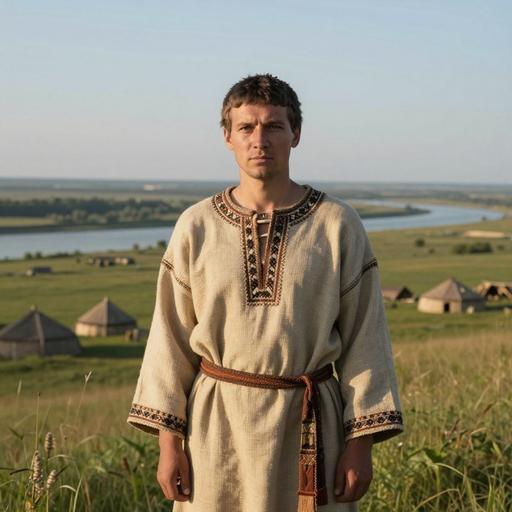
Portrait reconstruction of I7670
Ancient Individual

A man buried in Russia in the Middle Late Bronze Age era

I7670
2129 BCE - 1940 BCE
Male
Mid-Late Bronze Potapovka
Russia
Scroll to begin
Chapter I

Identity

The biological and cultural markers that define this ancient individual

Sample ID

I7670

Date Range

2129 BCE - 1940 BCE

Biological Sex

Male

mtDNA Haplogroup

J1c1b1a

Y-DNA Haplogroup

R-M269

Cultural Period

Mid-Late Bronze Potapovka

Chapter II

Place

Where this individual was discovered

Country Russia
Locality Samara Oblast. Volga River Valley. Sok River. Grachevka
Coordinates 53.5898, 50.5713
Chapter III

Time

When this individual lived in the broader context of human history

I7670 2129 BCE - 1940 BCE
Chapter IV

Story

The narrative of this ancient life

The Potapovka culture is a fascinating archaeological culture of the Mid-Late Bronze Age, primarily located in the Eurasian Steppe region. This culture is part of a broader cultural phenomenon associated with the Indo-Iranian and Andronovo horizon, spanning areas of present-day Russia and surrounding territories. It dates approximately from the 2nd millennium BCE, a time characterized by significant sociocultural and technological developments.

Geographical Extent

The Potapovka culture was centered around the Volga-Ural region, which spans parts of what is now southwestern Russia. This area is characterized by vast steppes and riverine landscapes, providing a fertile ground for the pastoral economy that the Potapovka people primarily relied upon. The strategic location allowed for interactions and exchanges with neighboring cultures such as the Catacomb, Abashevo, and later Srubnaya cultures.

Economy and Subsistence

The economy of the Potapovka culture was predominantly based on pastoralism, with evidence suggesting a strong emphasis on cattle herding, supplemented by sheep and horse rearing. The domestication of horses was particularly significant, both for transportation and as a status symbol, indicating a possible precursor to the nomadic equestrian lifestyle that later cultures in this region would adopt.

Agriculture played a less significant role but was not entirely absent. There is evidence of some limited cereal cultivation, which would have been used for both subsistence and trade. The combination of pastoralism and limited agriculture allowed the Potapovka people to sustain relatively stable communities within the challenging environment of the steppe.

Settlement Patterns

Archaeological findings suggest that Potapovka settlements were typically composed of small, transient communities, reflecting their pastoral lifestyle. Seasonal camps were likely common, aligning with the migratory patterns necessary to provide grazing for livestock. Permanent settlements, when present, were typically located near water sources such as rivers and lakes.

Material Culture

Pottery from the Potapovka culture is distinguished by its basic, utilitarian design, often with simple geometric decorations. These ceramics played a crucial role in their daily lives, used for cooking, storage, and ritual purposes. Metalwork, though limited, primarily involved bronze, with findings including tools, weapons, and ornaments. The ability to work with bronze marked a technological advancement that facilitated societal development and trade.

Social Structure and Burial Practices

The Potapovka culture exhibited a hierarchical social structure, as evidenced by burial practices. Kurgan burials (mound graves) are prevalent in this culture, often including goods such as pottery, weapons, and ornaments, indicating social stratification and the importance of status. The inclusion of horse remains in some graves suggests the symbolic and practical significance of horses within their society.

Religion and Rituals

The ritual and religious practices of the Potapovka culture are gleaned primarily from burial sites and material artifacts. The kurgan burial tradition not only reflects their views on the afterlife but also indicates a potentially ancestral or shamanistic form of early Indo-Iranian spirituality. The distribution and orientation of grave goods suggest rituals aimed at ensuring prosperity in the next life.

Interactions and Influences

The Potapovka culture did not exist in isolation, and there is substantial evidence of interaction with neighboring cultures. This interaction facilitated the exchange of goods, technologies, and ideas. The Potapovka culture contributed to the proto-Indo-Iranian cultural complex that would later influence vast regions across Eurasia.

Legacy and Importance

The Potapovka culture is considered integral to understanding the broader developments of the Bronze Age in the Eurasian Steppe. It provides insight into the transitions leading to the more complex societies that would follow, particularly in terms of pastoralism, social hierarchy, and the early stages of the Indo-Iranian cultural expansion. The practices and innovations of the Potapovka people laid the groundwork for future cultures in this region, highlighting their pivotal role in prehistoric Eurasia.

Chapter V

Genetics

The genetic ancestry of this ancient individual

Ancient Genetic Admixture

This analysis compares the DNA profile of I7670 with ancient reference populations, showing the genetic composition in terms of prehistoric ancestral groups.

Western Steppe Pastoralists 45.5%
European Hunter-Gatherers 29.9%
Neolithic Farmers 13.3%
Ancient Asians 9.1%
Ancient Native Americans 2.2%

Modern Genetic Admixture

This analysis compares the DNA profile with present-day reference populations, showing what percentage of genetic makeup resembles modern populations from different regions.

Europe 61.1%
Eastern European 46.7%
Northwestern European 14.5%
English 13.6%
Scandinavian 0.9%
Asia 28.6%
Northern West Asian 14.5%
Caucasian 14.5%
Central Asian, Northern Indian & Pakistani 14.1%
Pakistan 14.1%
America 10.3%
America 10.3%
Native American 10.3%

Closest Modern Populations

These are the modern populations showing the closest statistical alignment to A man buried in Russia in the Middle Late Bronze Age era, ranked by genetic distance. Lower distance values indicate closer statistical similarity.

1
Tatar Mishar
4.2762
2
Tatar Kazan
5.8103
3
Komi A
5.9304
4
Mordovian
5.9531
5
Erzya
6.0776
6
Moksha
6.1387
7
Russian Leshukonsky
6.3660
8
Russian Krasnoborsky
6.5592
9
Russian Kostroma
6.7115
10
Russian Pinezhsky
6.9621
Chapter VI

Context

Other ancient individuals connected to this sample

Sources

References

Scientific publications and genetic data

Scientific Publication

The formation of human populations in South and Central Asia

Authors Narasimhan VM, Patterson N, Moorjani P
Abstract

By sequencing 523 ancient humans, we show that the primary source of ancestry in modern South Asians is a prehistoric genetic gradient between people related to early hunter-gatherers of Iran and Southeast Asia. After the Indus Valley Civilization's decline, its people mixed with individuals in the southeast to form one of the two main ancestral populations of South Asia, whose direct descendants live in southern India. Simultaneously, they mixed with descendants of Steppe pastoralists who, starting around 4000 years ago, spread via Central Asia to form the other main ancestral population. The Steppe ancestry in South Asia has the same profile as that in Bronze Age Eastern Europe, tracking a movement of people that affected both regions and that likely spread the distinctive features shared between Indo-Iranian and Balto-Slavic languages.

G25 Coordinates

The G25 coordinates for sample I7670 can be used for detailed admixture analysis in our G25 Studio tool.

I7670,0.11359314,0.05934694,0.04540716,0.05636634,-0.00624966,0.01938172,0.00451402,0.0039123,-0.01657222,-0.03244124,0.00480324,-0.00520272,0.00902914,-0.00083152,-0.00303354,-0.00499502,-0.00564388,-0.00231356,-0.0040943,-0.00727486,-0.00069652,0.00114038,-0.00847916,0.00672306,-0.00231705
Analyze in G25 Studio
Use code for 40% off Expires Feb 26