Menu
Store
Blog
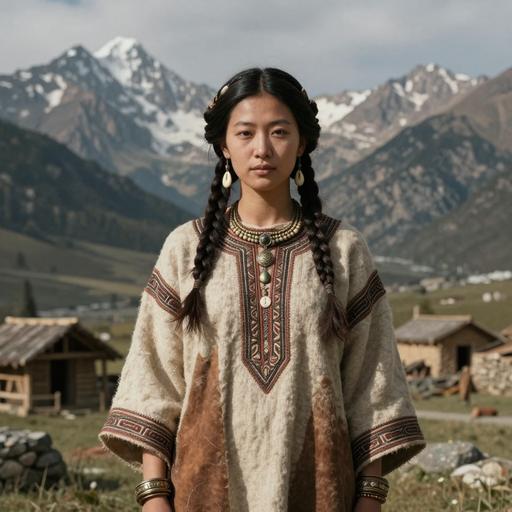
Portrait reconstruction of KBD002
Ancient Individual

A woman buried in Russia in the Middle Bronze Age era

KBD002
2192 BCE - 1985 BCE
Female
Middle Bronze Age North Caucasus, Russia
Russia
Scroll to begin
Chapter I

Identity

The biological and cultural markers that define this ancient individual

Sample ID

KBD002

Date Range

2192 BCE - 1985 BCE

Biological Sex

Female

mtDNA Haplogroup

W1

Cultural Period

Middle Bronze Age North Caucasus, Russia

Chapter II

Place

Where this individual was discovered

Country Russia
Locality North Caucasus mountains. Kabardinka
Coordinates 43.8263, 42.7162
Chapter III

Time

When this individual lived in the broader context of human history

KBD002 2192 BCE - 1985 BCE
Chapter IV

Story

The narrative of this ancient life

The Middle Bronze Age in the North Caucasus region of Russia is a fascinating period and culture characterized by significant developments in technology, social organization, and cultural interactions, often associated with the ancestral Proto-Indo-European peoples. This era typically spans from around 2500 to 1500 BCE, a time of considerable transformation and interaction among various groups.

Geography and Environment

The North Caucasus region, stretching between the Black Sea and the Caspian Sea, is marked by diverse landscapes including rolling steppes, the formidable Caucasus Mountains, and lush river valleys. This geographical diversity influenced the movement, lifestyle, and economy of its inhabitants. The climate during the Middle Bronze Age was likely similar to today's, featuring cold, snowy winters and hot summers, which would have affected agricultural and pastoral practices.

Cultural Characteristics

1. Social Structure and Organization: The people of the Middle Bronze Age North Caucasus likely lived in tribal societies with complex social hierarchies. The emergence of more stratified communities is evidenced by differences in grave goods and burial practices. Elites would have wielded power over trade routes and controlled resources, facilitating an increase in wealth and social differentiation.

2. Economy and Subsistence: The economy during this period was predominantly based on agro-pastoralism, with communities relying on cattle, sheep, and goats for meat, wool, and dairy products. Agriculture was practiced in fertile areas, with wheat and barley being staple crops. Interaction with neighboring cultures facilitated trade, leading to the exchange of goods like metals and crafts, which helped stimulate local economies and craft specialization.

3. Technology and Craftsmanship: Significant advancements in metallurgy are a hallmark of this era. The North Caucasus is particularly noted for its bronze-working, producing tools, weapons, and ornaments of high quality. Artisans crafted intricate items, including sickles, axes, and daggers, which were not only practical tools but also items of prestige and trade.

4. Burial Practices and Beliefs: Burial mounds, or kurgans, are a defining feature of the North Caucasus cultural landscape during the Middle Bronze Age. These tumuli served as both burial sites and territorial markers. Richly furnished graves, sometimes with multiple bodies and grave goods like weapons and jewelry, suggest a belief system centered around an afterlife where one’s earthly status and wealth had significance.

Interaction with Proto-Indo-European Cultures

The Middle Bronze Age North Caucasus is often linked with the broader Proto-Indo-European world. This association is primarily due to the region's strategic location along migration and trade routes that connected the Eurasian steppes with Europe and Asia. The cultural exchange facilitated by these routes likely played a key role in the dissemination of Indo-European languages and cultural practices.

1. Linguistic Influence: The Proto-Indo-European language family, from which many modern languages descend, is thought to have disseminated across the region through migration and interaction. Linguists and archaeologists use evidence from material culture and reconstructed vocabularies to trace these movements.

2. Cultural Exchange: Archaeological findings indicate a high degree of cultural syncretism, where local traditions blended with influences from the Indo-European world. This is reflected in burial rites, pottery styles, and artistic motifs, suggesting a complex web of interaction rather than outright cultural dominance or replacement.

Conclusion

The Middle Bronze Age in the North Caucasus was a dynamic and transformative period marked by significant technological and cultural advancements. The region's inhabitants actively participated in the exchange of ideas and goods across the Eurasian landscape, contributing to the broader tapestry of human history. As a crossroad of cultural interactions, the North Caucasus played a crucial role in the diffusion of Proto-Indo-European languages and traditions, impacting societies well beyond its immediate geographical boundaries.

Chapter V

Genetics

The genetic ancestry of this ancient individual

Ancient Genetic Admixture

This analysis compares the DNA profile of KBD002 with ancient reference populations, showing the genetic composition in terms of prehistoric ancestral groups.

Western Steppe Pastoralists 38.8%
European Hunter-Gatherers 25.7%
Neolithic Farmers 23.2%
Ancient Asians 9.4%
Ancient Native Americans 2.9%

Modern Genetic Admixture

This analysis compares the DNA profile with present-day reference populations, showing what percentage of genetic makeup resembles modern populations from different regions.

Asia 50.5%
Northern West Asian 41.5%
Caucasian 41.5%
Central Asian, Northern Indian & Pakistani 9.1%
Pakistan 9.1%
Europe 49.5%
Eastern European 25.3%
Northwestern European 24.1%
Scandinavian 10.7%
Finnish 10.4%
English 2.3%
Northwestern European 0.8%

Closest Modern Populations

These are the modern populations showing the closest statistical alignment to A woman buried in Russia in the Middle Bronze Age era, ranked by genetic distance. Lower distance values indicate closer statistical similarity.

1
Lezgin
4.2492
2
Kaitag
4.5232
3
Tabasaran
4.5365
4
Andian B
4.5910
5
Lak
4.6533
6
Kumyk
4.7062
7
Avar
4.8399
8
Darginian
4.9639
9
Tat Dagestan Dzhalgan
5.0229
10
Akhvakh
5.0431
Chapter VI

Context

Other ancient individuals connected to this sample

Sources

References

Scientific publications and genetic data

Scientific Publication

Ancient human genome-wide data from a 3000-year interval in the Caucasus corresponds with eco-geographic regions

Authors Wang CC, Reinhold S, Kalmykov A
Abstract

Archaeogenetic studies have described the formation of Eurasian 'steppe ancestry' as a mixture of Eastern and Caucasus hunter-gatherers. However, it remains unclear when and where this ancestry arose and whether it was related to a horizon of cultural innovations in the 4th millennium BCE that subsequently facilitated the advance of pastoral societies in Eurasia. Here we generated genome-wide SNP data from 45 prehistoric individuals along a 3000-year temporal transect in the North Caucasus. We observe a genetic separation between the groups of the Caucasus and those of the adjacent steppe. The northern Caucasus groups are genetically similar to contemporaneous populations south of it, suggesting human movement across the mountain range during the Bronze Age. The steppe groups from Yamnaya and subsequent pastoralist cultures show evidence for previously undetected farmer-related ancestry from different contact zones, while Steppe Maykop individuals harbour additional Upper Palaeolithic Siberian and Native American related ancestry.

G25 Coordinates

The G25 coordinates for sample KBD002 can be used for detailed admixture analysis in our G25 Studio tool.

KBD002,0.11014556,0.08412406,-0.00053438,0.01831738,-0.02204164,0.01168754,0.00529928,-0.00624936,-0.03779296,-0.02921304,-0.00124818,0.00397686,-0.00352716,-0.00385262,0.0075937,0.00171964,-0.00299432,0.00177046,-0.00034214,-0.00357182,0.00092648,0.00197992,0.00447808,0.01102632,-0.00023506
Analyze in G25 Studio
Use code for 40% off Expires Feb 27