Menu
Store
Blog
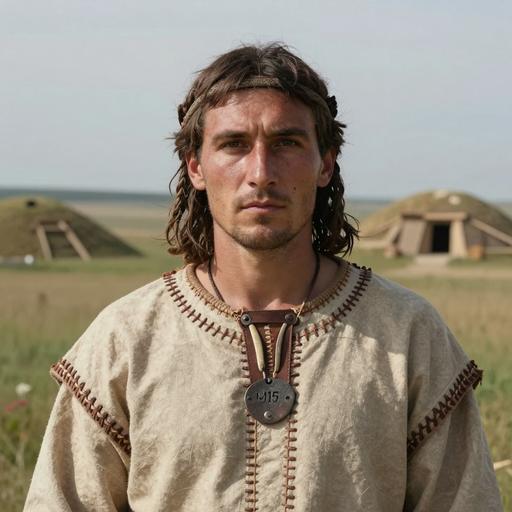
Portrait reconstruction of MJ-15
Ancient Individual

A man buried in Ukraine in the Iron Age era

MJ-15
393 BCE - 206 BCE
Male
Iron Age Western Scythian-Cimmerian Culture, Ukraine
Ukraine
Scroll to begin
Chapter I

Identity

The biological and cultural markers that define this ancient individual

Sample ID

MJ-15

Date Range

393 BCE - 206 BCE

Biological Sex

Male

mtDNA Haplogroup

U2e2

Y-DNA Haplogroup

R-Z2124

Cultural Period

Iron Age Western Scythian-Cimmerian Culture, Ukraine

Chapter II

Place

Where this individual was discovered

Country Ukraine
Locality Bidylo I. Mound 2. burial 1
Coordinates 49.9718, 35.3930
Chapter III

Time

When this individual lived in the broader context of human history

MJ-15 393 BCE - 206 BCE
Chapter IV

Story

The narrative of this ancient life

The Iron Age Western Scythian-Cimmerian culture, particularly in the Ukrainian region, represents a fascinating period marked by significant sociopolitical dynamics, cultural interchanges, and advancements in various aspects of life. This era is crucial in understanding the interactions between nomadic and sedentary peoples on the Eurasian steppes from roughly the 9th to the 7th centuries BCE.

Geographical and Historical Context

The Scythians and Cimmerians were nomadic groups that occupied the steppes of what is now Ukraine, extending their influence across a vast expanse from the northern Black Sea to the borders of modern-day Russia and beyond. The Cimmerians were among the early nomadic pastoralists of the region, known from ancient Assyrian and Greek sources, who were later replaced or assimilated by the Scythians, a more dominant and culturally rich group.

Cultural Composition

The Cimmerians

The Cimmerians, one of the earliest recorded steppe nomads, are thought to have originated from the northern Black Sea region. They were formidable horsemen and warriors, often depicted in Near Eastern records as engaging in raids into the territories of more sedentary civilizations. Their exact ethnic origins remain partly obscure, though they are often linked to Iranian linguistic groups.

The Scythians

The Scythians, succeeding the Cimmerians, established one of the most powerful nomadic empires in Eurasia. They are renowned for their formidable horseback riding, mastery of mounted warfare, and distinctive artistic expressions. The Scythians spoke an Iranian language and are known to have practiced a nomadic-pastoral economy, revolving around horse breeding, cattle herding, and some agriculture.

Sociopolitical Structure

The Scythian society was stratified, with a chieftain or king at the top, surrounded by an elite warrior class. Beneath them, the commoners were responsible for the daily labor involved in herding and other economic activities. The social hierarchy was reflected in the kurgans—large burial mounds—where the elite were interred with great riches, weapons, and horses for the afterlife.

Economic Practices

The Scythians excelled in cross-cultural trade, connecting classical Greek, Persian, and various Eurasian cultures. Through their dominance of the steppes and control of crucial trade routes, they facilitated the exchange of goods such as gold, textiles, and even ideas between East and West.

Art and Material Culture

Scythian art is characterized by the so-called \Animal Style," which includes intricate depictions of animals and mythological creatures in metalwork, often seen in gold jewelry and ceremonial objects. These artistic expressions not only served a decorative purpose but also likely held religious or symbolic significance, possibly reflecting shamanistic beliefs.

Military Prowess

Renowned for their military tactics, the Scythians were expert horse archers, able to effectively utilize the composite bow on horseback. Their warfare strategies often incorporated swift raids, hit-and-run tactics, and the psychological impact of their swift-mounted assaults.

Religious and Burial Practices

The Scythians practiced a polytheistic religion, apparently with an emphasis on reverence for nature and ancestor worship. Their elaborate burial rituals, as evidenced by archaeological finds in the kurgans, involved the interment of high-status individuals with numerous grave goods. These may have included gold artifacts, weapons, and even sacrificed horses, indicating a belief in an afterlife where such items were deemed necessary.

Decline and Legacy

The decline of Scythian dominance began around the 3rd century BCE, as they faced pressure from other emerging groups, such as the Sarmatians. Nevertheless, their cultural and genetic legacy persisted, influencing later nomadic cultures across the steppes. The Scytho-Sarmatian elements permeated into Slavic and other Eurasian cultures, contributing to the region's ethno-cultural tapestry.

Conclusion

The Iron Age Western Scythian-Cimmerian culture in Ukraine encapsulates a pivotal chapter in the annals of ancient nomadic civilizations. Through their interactions with neighboring cultures, their contributions in trade, and their unique cultural expressions, the Scythians and Cimmerians significantly shaped the historical and cultural landscape of ancient Eurasia. Their legacy is captured in the archaeological record, offering profound insights into their way of life and influence across centuries."

Chapter V

Genetics

The genetic ancestry of this ancient individual

Ancient Genetic Admixture

This analysis compares the DNA profile of MJ-15 with ancient reference populations, showing the genetic composition in terms of prehistoric ancestral groups.

Western Steppe Pastoralists 33.5%
European Hunter-Gatherers 28.0%
Ancient Asians 21.1%
Neolithic Farmers 13.0%
Ancient Native Americans 4.4%

Modern Genetic Admixture

This analysis compares the DNA profile with present-day reference populations, showing what percentage of genetic makeup resembles modern populations from different regions.

Europe 58.5%
Eastern European 36.1%
Northwestern European 22.4%
English 22.4%
Asia 35.5%
Northern West Asian 23.5%
Caucasian 23.5%
Central Asian, Northern Indian & Pakistani 7.7%
Central Asian 7.7%
Northern Asian 4.4%
Siberian 4.4%
America 5.7%
America 5.7%
Native American 5.7%

Closest Modern Populations

These are the modern populations showing the closest statistical alignment to A man buried in Ukraine in the Iron Age era, ranked by genetic distance. Lower distance values indicate closer statistical similarity.

1
Tatar Kazan
3.8335
2
Tatar Mishar
4.4826
3
Besermyan
5.6438
4
Komi A
5.6565
5
Russian Leshukonsky
7.0777
6
Udmurt
7.4465
7
Tatar Lipka
7.7659
8
Saami Kola
8.0956
9
Mordovian
8.3376
10
Erzya
8.4049
Chapter VI

Context

Other ancient individuals connected to this sample

Sources

References

Scientific publications and genetic data

Scientific Publication

Shifts in the Genetic Landscape of the Western Eurasian Steppe Associated with the Beginning and End of the Scythian Dominance

Authors Järve M, Saag L, Scheib CL
Abstract

The Early Iron Age nomadic Scythians have been described as a confederation of tribes of different origins, based on ancient DNA evidence [1-3]. It is still unclear how much of the Scythian dominance in the Eurasian Steppe was due to movements of people and how much reflected cultural diffusion and elite dominance. We present new whole-genome sequences of 31 ancient Western and Eastern Steppe individuals, including Scythians as well as samples pre- and postdating them, allowing us to set the Scythians in a temporal context (in the Western, i.e., Ponto-Caspian Steppe). We detect an increase of eastern (Altaian) affinity along with a decrease in eastern hunter-gatherer (EHG) ancestry in the Early Iron Age Ponto-Caspian gene pool at the start of the Scythian dominance. On the other hand, samples of the Chernyakhiv culture postdating the Scythians in Ukraine have a significantly higher proportion of Near Eastern ancestry than other samples of this study. Our results agree with the Gothic source of the Chernyakhiv culture and support the hypothesis that the Scythian dominance did involve a demic component.

G25 Coordinates

The G25 coordinates for sample MJ-15 can be used for detailed admixture analysis in our G25 Studio tool.

MJ-15,0.11161692,0.0341461,0.04645448,0.05020278,-0.01447794,0.01432524,0.00285608,0.0009587,-0.01292924,-0.02366008,0.00914232,-0.0029488,0.00615784,-0.01614408,-0.00021582,-0.00653614,-0.00672966,-0.00014768,-0.0093367,-0.0052439,0.00085038,0.00228172,-0.0033185,0.0051504,-0.00321446
Analyze in G25 Studio
Use code for 40% off Expires Feb 27