Menu
Store
Blog
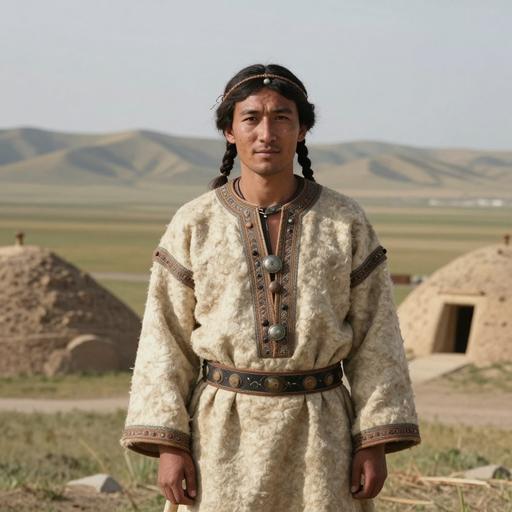
Portrait reconstruction of MJ-52
Ancient Individual

A man buried in Kazakhstan in the Iron Age era

MJ-52
795 BCE - 546 BCE
Male
Tasmola Culture in Kazakhstan
Kazakhstan
Scroll to begin
Chapter I

Identity

The biological and cultural markers that define this ancient individual

Sample ID

MJ-52

Date Range

795 BCE - 546 BCE

Biological Sex

Male

mtDNA Haplogroup

A23

Y-DNA Haplogroup

J-ZS6592

Cultural Period

Tasmola Culture in Kazakhstan

Chapter II

Place

Where this individual was discovered

Country Kazakhstan
Locality Aksu-Ayuly-4. Mound 3
Coordinates 48.7494, 73.6997
Chapter III

Time

When this individual lived in the broader context of human history

MJ-52 795 BCE - 546 BCE
Chapter IV

Story

The narrative of this ancient life

The Tasmola Culture, also known as the Tasmola period, is an archaeological culture that emerged during the early Iron Age, roughly spanning from the 7th to the 3rd century BCE, in the central region of Kazakhstan. This culture is named after the Tasmola burial sites found in the Sary-Arka region, particularly in the Karaganda area. The Tasmola Culture represents an essential phase in the history of the steppe nomads and provides valuable insights into the lifestyle, social organization, and material culture of the ancient pastoral communities inhabiting the vast Eurasian steppes.

Geography and Environment

The Tasmola Culture developed in the central part of Kazakhstan, a region characterized by open steppe landscapes, rolling hills, and sparse vegetation. The environment of the area played a crucial role in shaping the lifestyle of the Tasmola people. The steppe was suitable for pastoralism, providing ample grazing land for livestock such as horses, sheep, and cattle, which were central to the nomadic economy.

Social and Political Organization

The Tasmola Culture is indicative of a society that was largely nomadic and organized into tribes or clans. Evidence from burial sites suggests some degree of social stratification, with elite members of society being buried with a variety of grave goods, indicating distinctions in status and wealth. The presence of weapons, jewelry, and horse tack in some burials points to the importance of warfare, horsemanship, and possibly the emergence of warrior elites.

Burial Practices

One of the most distinctive features of the Tasmola Culture is its burial practices. The Tasmola sites are notable for their kurgans, or burial mounds, which often contain stone constructions and circular stone enclosures. These kurgans vary significantly in size, with the larger ones likely belonging to more prominent individuals or families. Burials often include human remains accompanied by grave goods such as pottery, weapons, animal bones, and ornaments, which reflect the deceased's status and the beliefs about the afterlife.

Economy and Subsistence

The economy of the Tasmola Culture was largely based on nomadic pastoralism, with a heavy reliance on livestock. Horses were particularly important, both as a means of transportation and as a symbol of wealth and power. The equestrian lifestyle facilitated mobility across the vast steppe, enabling effective herding and trade with neighboring cultures. There is also evidence of some limited agriculture and gathering of wild plants, but pastoralism remained the primary economic activity.

Art and Material Culture

The material culture of the Tasmola people included a variety of artifacts that have been uncovered through archaeological excavations. These include pottery, metal objects, stone implements, and personal ornaments. Pottery from this culture is typically hand-made and undecorated, reflecting utilitarian uses. Metal artifacts, particularly those made of bronze and iron, demonstrate advanced metallurgical skills and include weapons, tools, and decorative items.

Interaction and Influence

The Tasmola Culture was not isolated but had interactions with neighboring cultures and peoples across the Eurasian steppe. These interactions were likely facilitated by the trade networks that crossed the steppe and connected the East and West. The Tasmola Culture is part of the broader Scythian-Saka cultural horizon, sharing similarities in art, burial practices, and economic activities. Such connections indicate a flow of ideas, goods, and people across the vast expanse of Central Asia.

Conclusion

The Tasmola Culture represents a dynamic and significant period in the history of the Eurasian steppe. Its contributions to our understanding of early Iron Age nomadic societies are invaluable, highlighting the complexities of social organization, economic practices, and cultural interactions on the steppes of Kazakhstan. The legacy of the Tasmola Culture is reflected in the rich archaeological record it left behind, offering insight into the lives and beliefs of its people and their lasting impact on the region's historical trajectory.

Chapter V

Genetics

The genetic ancestry of this ancient individual

Ancient Genetic Admixture

This analysis compares the DNA profile of MJ-52 with ancient reference populations, showing the genetic composition in terms of prehistoric ancestral groups.

Neolithic Farmers 32.0%
Western Steppe Pastoralists 28.0%
European Hunter-Gatherers 27.1%
Ancient Asians 8.6%
Ancient Africans 2.3%
Ancient Native Americans 2.0%

Modern Genetic Admixture

This analysis compares the DNA profile with present-day reference populations, showing what percentage of genetic makeup resembles modern populations from different regions.

Asia 80.2%
Central Asian, Northern Indian & Pakistani 46.5%
Pakistan 37.2%
Indian 9.3%
Northern West Asian 33.7%
Caucasian 30.4%
Mesopotamian 3.3%
Europe 18.5%
Northwestern European 18.5%
Scandinavian 10.7%
Finnish 7.8%
Africa 1.3%
African Hunter-Gatherer 1.3%

Closest Modern Populations

These are the modern populations showing the closest statistical alignment to A man buried in Kazakhstan in the Iron Age era, ranked by genetic distance. Lower distance values indicate closer statistical similarity.

1
Tajik Yaghnobi
4.2286
2
Iranian Persian Khorasan
5.0368
3
Pamiri Rushan
5.5554
4
Pamiri Shugnan
5.8241
5
Tat Dagestan Dzhalgan
5.9619
6
Tajik Tajikistan Kulob
6.0644
7
Azerbaijani Dagestan
6.0972
8
Kumyk
6.2089
9
Lezgin
6.2526
10
Turkmen O
6.2619
Chapter VI

Context

Other ancient individuals connected to this sample

Sources

References

Scientific publications and genetic data

Scientific Publication

Shifts in the Genetic Landscape of the Western Eurasian Steppe Associated with the Beginning and End of the Scythian Dominance

Authors Järve M, Saag L, Scheib CL
Abstract

The Early Iron Age nomadic Scythians have been described as a confederation of tribes of different origins, based on ancient DNA evidence [1-3]. It is still unclear how much of the Scythian dominance in the Eurasian Steppe was due to movements of people and how much reflected cultural diffusion and elite dominance. We present new whole-genome sequences of 31 ancient Western and Eastern Steppe individuals, including Scythians as well as samples pre- and postdating them, allowing us to set the Scythians in a temporal context (in the Western, i.e., Ponto-Caspian Steppe). We detect an increase of eastern (Altaian) affinity along with a decrease in eastern hunter-gatherer (EHG) ancestry in the Early Iron Age Ponto-Caspian gene pool at the start of the Scythian dominance. On the other hand, samples of the Chernyakhiv culture postdating the Scythians in Ukraine have a significantly higher proportion of Near Eastern ancestry than other samples of this study. Our results agree with the Gothic source of the Chernyakhiv culture and support the hypothesis that the Scythian dominance did involve a demic component.

G25 Coordinates

The G25 coordinates for sample MJ-52 can be used for detailed admixture analysis in our G25 Studio tool.

MJ-52,0.07015504,0.07092932,-0.03008022,0.01777174,-0.03936686,0.01349998,0.00846518,0.00637368,-0.02977374,-0.02028252,0.00236188,-0.00173554,0.00339192,-0.0048337,0.0048894,0.00491306,-0.00505256,0.00023072,-0.001481,-0.01073608,0.00036498,-0.00441258,-0.00135042,-0.00409054,0.00539285
Analyze in G25 Studio
Use code for 40% off Expires Feb 27