Menu
Store
Blog
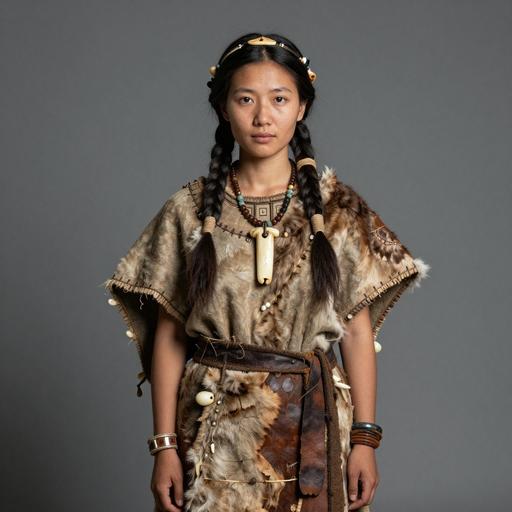
Portrait reconstruction of NE20
Ancient Individual

A woman buried in China in the Pleistocene era

NE20
32159 BCE - 31169 BCE
Female
Paleolithic China
China
Scroll to begin
Chapter I

Identity

The biological and cultural markers that define this ancient individual

Sample ID

NE20

Date Range

32159 BCE - 31169 BCE

Biological Sex

Female

mtDNA Haplogroup

B4'5

Cultural Period

Paleolithic China

Chapter II

Place

Where this individual was discovered

Country China
Locality Amur River Basin
Chapter III

Time

When this individual lived in the broader context of human history

NE20 32159 BCE - 31169 BCE
Chapter IV

Story

The narrative of this ancient life

The Paleolithic era, also known as the Old Stone Age, marks a profoundly significant period in human history, stretching from approximately 2.5 million years ago to around 10,000 years ago. In the context of China, particularly the region around the Amur River, this era embodies the early stages of human settlement, adaptation, and innovation in prehistoric times. Here, the complex interplay of environmental conditions, human evolution, and cultural developments unfolded over millions of years, contributing to the broader East Asian Paleolithic narrative.

Geological and Environmental Context

The Amur River region, located at the northeastern border of modern-day China and Russia, presents a diverse landscape characterized by rugged terrain, dense forests, and vast river systems. During the Paleolithic era, this area experienced several climatic changes due to glacial and interglacial cycles. These shifts in climate significantly influenced the flora and fauna, and consequently, the subsistence strategies of early humans. The region's ecological diversity provided a variety of resources that facilitated human occupation and cultural development.

Early Human Occupation

The presence of hominins in the Amur River region dates back to the Lower Paleolithic period, approximately 1.6 million years ago. It is believed that early human groups, possibly Homo erectus or a related hominin species, were the first to venture into this area. These early inhabitants were predominantly nomadic, relying on hunting, gathering, and fishing to sustain their communities. Stone tools, such as choppers and bifaces, represent the technological advancements of this time, emphasizing functionality and survival.

Middle Paleolithic Developments

Transitioning to the Middle Paleolithic period, which spans from around 300,000 to 30,000 years ago, there is evidence of more sophisticated tool-making techniques in the Amur River region. The emergence of prepared-core technology and the production of flake tools suggest an evolutionary leap in cognitive capabilities. These innovations reflect a greater understanding of the environment and the ability to manipulate natural resources more effectively.

This period also witnessed changes in social structures, with increased evidence of regional interactions and cultural exchanges. The presence of similar tool types across distant sites indicates the possibility of shared knowledge and communication among different groups. Additionally, the archaeological record suggests the use of fire and the construction of simple shelters, underscoring the adaptation to colder climates.

Upper Paleolithic Cultural Flourishing

The Upper Paleolithic era, dating from approximately 40,000 to 10,000 years ago, marks a peak in cultural complexity and artistic expression in the Amur River region. During this time, anatomically modern humans, Homo sapiens, were the primary inhabitants. The technological toolkit expanded to include blade technology, microliths, and composite tools, reflecting increased skill and creativity.

Artistic endeavors, such as carvings, engravings, and possibly even early forms of symbolic art, began to appear, offering insights into the cognitive and cultural evolution of these communities. These artistic expressions likely played a role in social cohesion, identity formation, and spiritual beliefs.

Subsistence strategies diversified further, with evidence of fishing, trapping, and advanced hunting techniques. The ability to exploit a wide range of ecological niches speaks to the adaptability and resilience of Upper Paleolithic communities in the Amur River region.

Legacy and Impact

The Paleolithic era in the Amur River region and broader East Asia set the stage for subsequent cultural and technological developments, shaping the trajectory of human evolution in this part of the world. The innovations and adaptations of these early human societies laid the groundwork for the Neolithic revolution, which brought about agriculture, settled communities, and the advent of new social and economic structures.

In summary, the Paleolithic era in the Amur River region reflects a journey of survival, adaptation, and innovation. The archaeological and anthropological records from this period provide a window into the lives of early humans, highlighting their ingenuity and resilience in the face of challenging environments. Through their legacy, we gain a deeper understanding of the fundamental aspects of human development and the shared heritage of East Asian cultures.

Chapter V

Genetics

The genetic ancestry of this ancient individual

Ancient Genetic Admixture

This analysis compares the DNA profile of NE20 with ancient reference populations, showing the genetic composition in terms of prehistoric ancestral groups.

Ancient Asians 66.6%
Ancient Oceanians 13.2%
Neolithic Farmers 8.1%
Ancient Africans 7.7%
Western Steppe Pastoralists 4.4%

Modern Genetic Admixture

This analysis compares the DNA profile with present-day reference populations, showing what percentage of genetic makeup resembles modern populations from different regions.

Asia 83.0%
Northern Asian 37.0%
Mongolian 37.0%
Central Asian, Northern Indian & Pakistani 31.9%
Indian 31.9%
Chinese & Southeast Asian 14.2%
Indonesian Khmer Thai Myanma 14.2%
Oceania 9.8%
Melanesian 9.8%
Papuan 9.8%
Africa 7.2%
African Hunter-Gatherer 7.2%

Closest Modern Populations

These are the modern populations showing the closest statistical alignment to A woman buried in China in the Pleistocene era, ranked by genetic distance. Lower distance values indicate closer statistical similarity.

1
Nepali Indo Aryan O1
9.0560
2
Tharu
9.8213
3
Brahmin Manipuri
9.8537
4
Newar
9.8770
5
Kusunda
10.0203
6
Nyishi
10.0285
7
Nepali Indo Aryan O2
11.4486
8
Onge
12.0797
9
Tharu O2
12.0950
10
Jarawa
12.2548
Chapter VI

Context

Other ancient individuals connected to this sample

Sources

References

Scientific publications and genetic data

Scientific Publication

The deep population history of northern East Asia from the Late Pleistocene to the Holocene

Authors Mao X, Zhang H, Qiao S
Abstract

Northern East Asia was inhabited by modern humans as early as 40 thousand years ago (ka), as demonstrated by the Tianyuan individual. Using genome-wide data obtained from 25 individuals dated to 33.6-3.4 ka from the Amur region, we show that Tianyuan-related ancestry was widespread in northern East Asia before the Last Glacial Maximum (LGM). At the close of the LGM stadial, the earliest northern East Asian appeared in the Amur region, and this population is basal to ancient northern East Asians. Human populations in the Amur region have maintained genetic continuity from 14 ka, and these early inhabitants represent the closest East Asian source known for Ancient Paleo-Siberians. We also observed that EDAR V370A was likely to have been elevated to high frequency after the LGM, suggesting the possible timing for its selection. This study provides a deep look into the population dynamics of northern East Asia.

G25 Coordinates

The G25 coordinates for sample NE20 can be used for detailed admixture analysis in our G25 Studio tool.

NE20,-0.03108404,-0.2575236,-0.06891718,0.0500104,-0.00757148,-0.0267421,0.00463934,0.0070492,0.02361262,0.00985226,-0.03548008,0.00027502,0.00253008,0.0013622,-0.00686276,-0.00783224,0.00502516,-0.00167862,0.00157212,-0.00042508,0.00304508,0.00824816,0.00263394,0.0040951,0.01377284
Analyze in G25 Studio
Use code for 40% off Expires Feb 27