Menu
Store
Blog
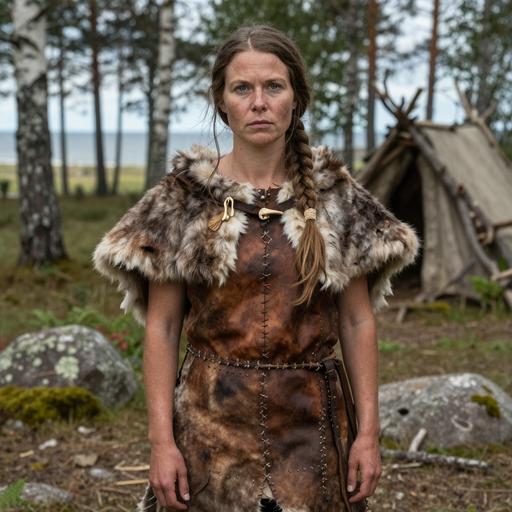
Portrait reconstruction of SF12
Ancient Individual

A woman buried in Sweden in the Mesolithic era

SF12
7083 BCE - 6807 BCE
Female
Mesolithic Sweden
Sweden
Scroll to begin
Chapter I

Identity

The biological and cultural markers that define this ancient individual

Sample ID

SF12

Date Range

7083 BCE - 6807 BCE

Biological Sex

Female

mtDNA Haplogroup

U4a1

Cultural Period

Mesolithic Sweden

Chapter II

Place

Where this individual was discovered

Country Sweden
Locality Stora Förvar
Coordinates 57.2850, 17.9710
Chapter III

Time

When this individual lived in the broader context of human history

SF12 7083 BCE - 6807 BCE
Chapter IV

Story

The narrative of this ancient life

The Mesolithic era in Sweden, part of the broader European Mesolithic period, spans roughly from around 9000 to 4000 BCE, following the retreat of the glaciers at the end of the last Ice Age. This era marks a transformative period in the prehistory of the region as human societies adapted to changing climates, environments, and the availability of resources. The Mesolithic hunter-gatherers of Sweden were part of the broader European continuum but exhibited unique adaptations to the Scandinavian environment.

Geographic and Environmental Context

During the Mesolithic, Sweden's landscape was vastly different from today. As the glaciers receded, they left behind a transformed topography, creating a mosaic of coastal areas, archipelagos, dense forests, and numerous lakes and rivers. The rising sea levels, a result of glacial melting, resulted in an archipelago-rich coast, particularly prevalent in what is now southern and central Sweden. This environment provided a rich array of resources that facilitated the development of diverse hunting and gathering strategies.

Subsistence and Economy

Mesolithic people in Sweden were highly skilled hunter-gatherers who exploited the rich environment. Their subsistence strategies included:

  • Hunting: Wildlife such as elk, red deer, wild boar, and seals were primary hunting targets. The invention and use of complex hunting tools, including flint microliths mounted on wooden shafts and bone harpoons, were central to their hunting success.

  • Fishing: The abundance of waterways and coastal areas supported a rich fishing culture. Evidence suggests the use of fish traps, spears, and nets for capturing various fish species, including salmon and herring.

  • Gathering: The Mesolithic groups also gathered plant resources, including berries, nuts, and edible roots, which were crucial for their diet.

  • Seasonal Mobility: To efficiently exploit their environment, these groups practiced seasonal mobility, moving between coastal areas in the warmer months for fishing and gathering and inland sites during colder months for hunting.

Technology and Material Culture

The Mesolithic technological toolkit in Sweden comprised advanced stone tools, which were pivotal in their daily life. Noteworthy aspects include:

  • Microliths: Tiny flint tools used as composite tool components, notably in arrows and spears.

  • Bone and Antler Tools: Harpoons and spears crafted from bone and antlers were instrumental for hunting and fishing.

  • Canoes and Boats: Evidence points to the construction of dugout canoes and boats from hollowed tree trunks, reflecting the importance of waterways for transportation and subsistence activities.

Social Structure and Settlements

The Mesolithic societies of Sweden likely operated in small, egalitarian bands based on kinship networks. As mobile groups, their settlements were often temporary campsites, strategically located to exploit seasonal resources. While these groups were generally small, archaeological evidence suggests a degree of social complexity, with possible trade links and cultural exchanges with neighboring groups.

Art and Symbolism

While direct evidence of Mesolithic art in Sweden is sparse, there are indications of symbolic and cultural practices. Petroglyphs and engravings found in the broader region depict wildlife and human figures, reflecting the spiritual and cultural dimensions of these communities. Additionally, the presence of burial sites with grave goods suggests ritualistic practices and a belief in an afterlife.

Transition to the Neolithic

The end of the Mesolithic period in Sweden marks a gradual transition towards the Neolithic era, characterized by the introduction of agriculture and the domestication of animals. This transition was complex and varied, influenced by interactions with incoming agricultural societies and internal cultural developments.

In summary, the Mesolithic era in Sweden represents a dynamic period of adaptation and cultural development among European hunter-gatherers. The interplay between environmental changes and technological innovation facilitated a rich subsistence economy and laid the groundwork for the subsequent Neolithic transformations in the region.

Chapter V

Genetics

The genetic ancestry of this ancient individual

Ancient Genetic Admixture

This analysis compares the DNA profile of SF12 with ancient reference populations, showing the genetic composition in terms of prehistoric ancestral groups.

Western Steppe Pastoralists 77.4%
European Hunter-Gatherers 20.4%
Ancient Asians 2.2%

Modern Genetic Admixture

This analysis compares the DNA profile with present-day reference populations, showing what percentage of genetic makeup resembles modern populations from different regions.

Europe 99.3%
Northwestern European 78.8%
Finnish 38.5%
Scandinavian 29.3%
English 8.6%
Northwestern European 2.3%
Eastern European 20.5%
Africa 0.7%
African Hunter-Gatherer 0.7%

Closest Modern Populations

These are the modern populations showing the closest statistical alignment to A woman buried in Sweden in the Mesolithic era, ranked by genetic distance. Lower distance values indicate closer statistical similarity.

1
Estonian
2.4824
2
Ingrian
2.8800
3
Finnish Central
2.9686
4
Russian Yaroslavl
3.0248
5
Russian Tver
3.2144
6
Finnish Southwest
3.2283
7
Russian Kostroma
3.2515
8
Russian Pskov
3.2770
9
Russian Kaluga
3.3845
10
Finnish Southeast
3.4797
Chapter VI

Context

Other ancient individuals connected to this sample

Sources

References

Scientific publications and genetic data

Scientific Publication

Population genomics of Mesolithic Scandinavia: Investigating early postglacial migration routes and high-latitude adaptation

Authors Günther T, Malmström H, Svensson EM
Abstract

Scandinavia was one of the last geographic areas in Europe to become habitable for humans after the Last Glacial Maximum (LGM). However, the routes and genetic composition of these postglacial migrants remain unclear. We sequenced the genomes, up to 57× coverage, of seven hunter-gatherers excavated across Scandinavia and dated from 9,500-6,000 years before present (BP). Surprisingly, among the Scandinavian Mesolithic individuals, the genetic data display an east-west genetic gradient that opposes the pattern seen in other parts of Mesolithic Europe. Our results suggest two different early postglacial migrations into Scandinavia: initially from the south, and later, from the northeast. The latter followed the ice-free Norwegian north Atlantic coast, along which novel and advanced pressure-blade stone-tool techniques may have spread. These two groups met and mixed in Scandinavia, creating a genetically diverse population, which shows patterns of genetic adaptation to high latitude environments. These potential adaptations include high frequencies of low pigmentation variants and a gene region associated with physical performance, which shows strong continuity into modern-day northern Europeans.

G25 Coordinates

The G25 coordinates for sample SF12 can be used for detailed admixture analysis in our G25 Studio tool.

SF12,0.12962224,0.1081929,0.08806672,0.07518916,0.03589794,0.03051736,0.00898456,0.01710312,-0.00186684,-0.03173072,0.00270186,-0.00730052,0.013574,0.01095658,-0.00077586,-0.0014249,-0.00019546,-0.00295688,0.00282512,-0.00056646,0.00274886,-0.00359848,-0.0070494,0.00850068,0.0010278
Analyze in G25 Studio
Use code for 40% off Expires Feb 26