Menu
Store
Blog
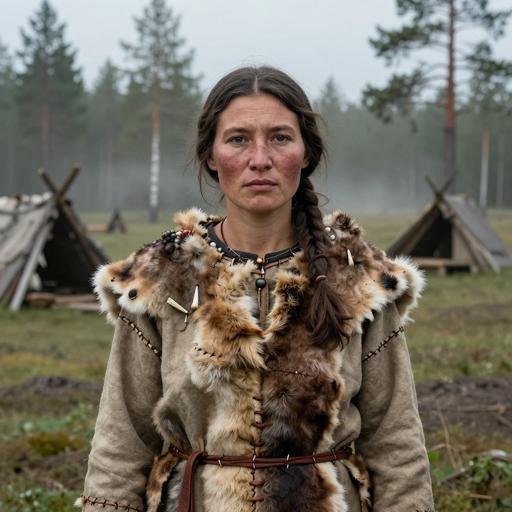
Portrait reconstruction of UzOO77_new
Ancient Individual

A woman buried in Russia in the Mesolithic era

UzOO77_new
5500 BCE - 5000 BCE
Female
Eastern Hunter-Gatherer, Russia
Russia
Scroll to begin
Chapter I

Identity

The biological and cultural markers that define this ancient individual

Sample ID

UzOO77_new

Date Range

5500 BCE - 5000 BCE

Biological Sex

Female

mtDNA Haplogroup

R1b

Cultural Period

Eastern Hunter-Gatherer, Russia

Chapter II

Place

Where this individual was discovered

Country Russia
Locality Yuzhnyy Oleni Ostrov. Karelia
Coordinates 62.0460, 35.3640
Chapter III

Time

When this individual lived in the broader context of human history

UzOO77_new 5500 BCE - 5000 BCE
Chapter IV

Story

The narrative of this ancient life

The Eastern Hunter-Gatherers (EHG) represent a fascinating period in prehistoric human history, specifically within the context of the Mesolithic and Neolithic periods of Eastern Europe, with a significant focus on what is now modern-day Russia. This group forms an integral part of the broader Circumpolar Culture, which encompasses the various hunter-gatherer societies that inhabited the northern latitudes around the Arctic Circle.

Geographic Distribution

The EHG communities primarily occupied the expanses of Eastern Europe, stretching into parts of Russia, particularly around the Volga River Basin, the Ural Mountains, and extending towards western Siberia. These areas are characterized by vast forests, steppe zones, and numerous rivers and waterways, which played a crucial role in the sustenance of these communities.

Chronological Framework

The EHG are predominantly associated with the Mesolithic period, transitioning into the early Neolithic, approximately between 10,000 BCE and 3,000 BCE. This era is marked by significant climatic changes following the last Ice Age, leading to the development of more temperate environments that supported diverse ecosystems.

Lifestyle and Economy

  • Subsistence Strategy: EHG societies were primarily hunter-gatherers, relying on hunting, fishing, and foraging. Large game such as elk, moose, and reindeer were common targets, while the numerous rivers and lakes offered rich fishing opportunities. Seasonally available plant resources were also an important part of their diet.

  • Tools and Technology: The EHG developed a variety of tools made from stone, bone, and antler. These tools include spearheads, arrowheads, scrapers, and awls, which exhibit sophisticated knapping techniques. The Mesolithic also saw the advent of microliths, small stone blades that could be hafted onto wooden shafts to create composite tools.

  • Housing and Settlements: Settlements were typically temporary and mobile, reflecting their subsistence strategies. These consisted of simple structures made from available natural materials such as wood, hide, and bone. In regions closer to water sources, semi-permanent camps were established.

Social and Cultural Aspects

  • Community Structure: EHG societies were likely organized in small, kin-based groups or bands. Social structures would have been relatively egalitarian, typical of hunter-gatherer groups, with shared responsibilities in hunting and gathering.

  • Spiritual and Ritualistic Practices: While concrete evidence is sparse, the EHG likely had complex spiritual beliefs tied to nature and animals, similar to other circumpolar and shamanistic traditions. Burial sites from this period suggest ritualistic practices, with some graves containing grave goods that indicate beliefs in an afterlife or spiritual journey.

  • Art and Symbolism: There is evidence of artistic expression in EHG communities, including petroglyphs and carved figurines. These artworks often depict animals, human figures, and abstract symbols, hinting at a rich cultural and symbolic life.

Genetic Legacy

Recent genetic studies have provided more insight into the EHG and their role in prehistoric migrations. The EHG exhibit a genetic profile that contributed significantly to the ancestry of later European populations, particularly through interactions with other hunter-gatherer groups and early agrarian societies.

Interaction with Other Cultures

The EHG were part of a broader network of hunter-gatherer communities across Eurasia. They interacted with Western Hunter-Gatherers (WHG) and later with incoming Early European Farmers (EEF), contributing to the genetic and cultural mosaic of prehistoric Europe. This era of interaction likely involved trade, cultural exchange, and occasional conflict.

Climate and Environment

The transition from the Pleistocene to the Holocene era brought about climatic shifts that influenced EHG life. A warming climate led to the retreat of glaciers and the establishment of boreal forests, creating new opportunities and challenges for these societies. The adaptation to these changing conditions was a hallmark of EHG resilience and innovation.

In summary, the Eastern Hunter-Gatherers of Russia represent a key cultural and historical phase in the broader narrative of human prehistory, exemplifying the adaptability and resourcefulness of early human societies in the face of dynamic environmental changes. Their legacy persists in the genetic and cultural heritage of contemporary populations across Europe and Asia.

Chapter V

Genetics

The genetic ancestry of this ancient individual

Ancient Genetic Admixture

This analysis compares the DNA profile of UzOO77_new with ancient reference populations, showing the genetic composition in terms of prehistoric ancestral groups.

Western Steppe Pastoralists 69.1%
European Hunter-Gatherers 14.1%
Ancient Asians 9.0%
Ancient Native Americans 7.8%

Modern Genetic Admixture

This analysis compares the DNA profile with present-day reference populations, showing what percentage of genetic makeup resembles modern populations from different regions.

Europe 87.9%
Eastern European 63.0%
Northwestern European 24.9%
Finnish 20.6%
Scandinavian 4.4%
America 12.1%
America 12.1%
Native American 12.1%

Closest Modern Populations

These are the modern populations showing the closest statistical alignment to A woman buried in Russia in the Mesolithic era, ranked by genetic distance. Lower distance values indicate closer statistical similarity.

1
Komi A
4.4437
2
Tatar Mishar
4.9330
3
Russian Leshukonsky
5.0511
4
Tatar Kazan
5.7006
5
Saami Kola
6.1119
6
Russian Pinega
6.2795
7
Russian Pinezhsky
6.3012
8
Besermyan
6.8849
9
Russian Krasnoborsky
7.0346
10
Vepsian
7.0504
Chapter VI

Context

Other ancient individuals connected to this sample

Sources

References

Scientific publications and genetic data

Scientific Publication

The genetic prehistory of the Baltic Sea region

Authors Mittnik A, Wang CC, Pfrengle S
Abstract

While the series of events that shaped the transition between foraging societies and food producers are well described for Central and Southern Europe, genetic evidence from Northern Europe surrounding the Baltic Sea is still sparse. Here, we report genome-wide DNA data from 38 ancient North Europeans ranging from ~9500 to 2200 years before present. Our analysis provides genetic evidence that hunter-gatherers settled Scandinavia via two routes. We reveal that the first Scandinavian farmers derive their ancestry from Anatolia 1000 years earlier than previously demonstrated. The range of Mesolithic Western hunter-gatherers extended to the east of the Baltic Sea, where these populations persisted without gene-flow from Central European farmers during the Early and Middle Neolithic. The arrival of steppe pastoralists in the Late Neolithic introduced a major shift in economy and mediated the spread of a new ancestry associated with the Corded Ware Complex in Northern Europe.

G25 Coordinates

The G25 coordinates for sample UzOO77_new can be used for detailed admixture analysis in our G25 Studio tool.

UzOO77_new,0.1191627,0.03014186,0.08021852,0.06767412,0.00439664,0.013407,-0.00896092,-0.01372656,-0.00856624,-0.03159624,0.00770102,-0.0096577,0.015681,0.0074237,-0.01431684,-0.01822836,-0.01188166,-0.00125376,-0.00939496,-0.00745522,-0.00398642,0.0044497,-0.00807142,0.00107574,-0.00471845
Analyze in G25 Studio
Use code for 40% off Expires Feb 27