Menu
Store
Blog
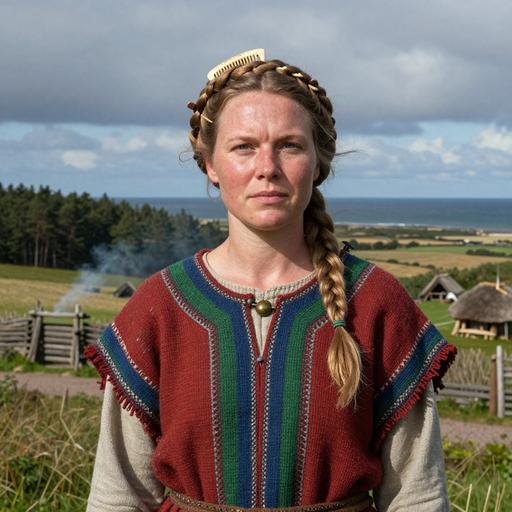
Portrait reconstruction of VK214
Ancient Individual

A woman buried in Denmark in the Late Neolithic to Bronze Age era

VK214
2011 BCE - 1774 BCE
Female
Late Neolithic to Bronze Age Denmark
Denmark
Scroll to begin
Chapter I

Identity

The biological and cultural markers that define this ancient individual

Sample ID

VK214

Date Range

2011 BCE - 1774 BCE

Biological Sex

Female

mtDNA Haplogroup

X2c1

Cultural Period

Late Neolithic to Bronze Age Denmark

Chapter II

Place

Where this individual was discovered

Country Denmark
Locality Sealand. Gerdrup
Coordinates 55.7300, 12.1200
Chapter III

Time

When this individual lived in the broader context of human history

VK214 2011 BCE - 1774 BCE
Chapter IV

Story

The narrative of this ancient life

The period spanning the Late Neolithic to the Bronze Age in Denmark, often referred to as the Nordic Bronze Age (approximately 1700–500 BCE), represents a significant cultural and technological evolution in the region. This era marks a transition from predominantly stone-based societies to more sophisticated communities with advances in metallurgy, trade, social structures, and artistic expression.

Geography and Environment

During the Late Neolithic and into the Bronze Age, Denmark's landscape was characterized by varied terrain, including fertile plains, dense forests, and an intricate coastline with fjords and islands. This environment supported diverse ecosystems that provided ample resources for human habitation, such as game for hunting, fish from abundant waterways, and rich soils for agriculture.

Societal Organization

Social Hierarchies and Settlements: The emergence of the Bronze Age saw the development of more complex social hierarchies in Denmark. Communities began to organize into tribes with distinct social stratification. This period witnessed the establishment of larger and increasingly permanent settlements, often strategically located for trade and defense. Longhouses became common as the principal form of dwelling, accommodating extended families and reflecting the social status of occupants.

Trade Networks: Denmark became an integral part of extensive trade networks that spanned much of Northern and Central Europe. The introduction of bronze, a metal alloy of copper and tin, revolutionized toolmaking and weaponry. As copper and tin were not locally available, the necessity for trade drove connections with distant regions, such as the British Isles, Central Europe, and possibly even the Mediterranean.

Technology and Economy

Metalworking Advances: The era marked a transition from stone to metal tools and weapons, as bronze became the material of choice. This advancement significantly impacted both practical and ceremonial aspects of life. Metalworkers of the Nordic Bronze Age were skilled artisans, crafting intricate weapons, tools, and jewelry, contributing to the prestige and power of individuals and groups who could control or afford these items.

Agriculture and Economy: Agriculture remained a cornerstone of Danish society, with a focus on cereal crops like barley and wheat, complemented by the rearing of livestock including cattle, sheep, and pigs. The agricultural abundance supported larger communities and allowed for specialized labor, which in turn supported craft production and trade.

Cultural Practices and Beliefs

Art and Symbolism: The Nordic Bronze Age is renowned for its exceptional artistry, particularly in metalwork. Artifacts from this period often exhibit intricate designs, such as spirals and geometric patterns, and show influences from broader European motifs. Rock carvings, often depicting ships, sun symbols, and anthropomorphic figures, suggest complex cosmological beliefs and a society attuned to both land and sea.

Burial Customs: Burial practices evolved during this period, with a move towards single burials in barrows or cairns. Burials were often accompanied by grave goods, including weapons, tools, and ornaments, indicating beliefs in an afterlife and the social importance of the deceased. The presence of richly furnished graves for certain individuals points to emerging social stratification and the significance of elite status.

Religious and Ritualistic Activities: The religious life of Late Neolithic and Bronze Age Denmark likely involved a pantheon of deities, nature worship, and veneration of ancestors. The sun, a central symbol evident in rock carvings and artifacts, suggests a solar cult or at least a deep reverence for the life-giving power of the sun. Ritual sites, possibly used for communal gatherings or ceremonial purposes, highlight the spiritual dimensions of the landscape.

Conclusion

The Late Neolithic to Bronze Age in Denmark was a transformative period marked by technological innovations, expanding trade networks, and the evolution of complex societal structures. The cultural and material richness of this era set the foundation for subsequent developments in the Nordic regions, reflecting a dynamic interplay between environment, technology, and human ingenuity. As inhabitants of a pivotal region in prehistoric Europe, the communities of Denmark played an essential role in the broader narrative of Europe's Bronze Age civilizations.

Chapter V

Genetics

The genetic ancestry of this ancient individual

Ancient Genetic Admixture

This analysis compares the DNA profile of VK214 with ancient reference populations, showing the genetic composition in terms of prehistoric ancestral groups.

Western Steppe Pastoralists 41.9%
European Hunter-Gatherers 39.0%
Neolithic Farmers 16.0%
Ancient Asians 3.2%

Modern Genetic Admixture

This analysis compares the DNA profile with present-day reference populations, showing what percentage of genetic makeup resembles modern populations from different regions.

Europe 97.9%
Northwestern European 96.7%
English 38.9%
Scandinavian 21.4%
Finnish 20.2%
Northwestern European 16.3%
Eastern European 1.3%
Asia 1.5%
Chinese & Southeast Asian 1.5%
Vietnamese 1.5%
Africa 0.5%
West African 0.5%
Ghanaian, Liberian, Sierra Leonean 0.5%

Closest Modern Populations

These are the modern populations showing the closest statistical alignment to A woman buried in Denmark in the Late Neolithic to Bronze Age era, ranked by genetic distance. Lower distance values indicate closer statistical similarity.

1
Orcadian
2.1182
2
Scottish
2.2932
3
Irish
2.5474
4
English
2.5655
5
English Cornwall
2.6284
6
Shetlandic
2.7896
7
Dutch
2.8224
8
Welsh
2.8433
9
Icelandic
2.9428
10
Norwegian
2.9998
Chapter VI

Context

Other ancient individuals connected to this sample

Sources

References

Scientific publications and genetic data

Scientific Publication

Population genomics of the Viking world

Authors Margaryan A, Lawson DJ, Sikora M
Abstract

The maritime expansion of Scandinavian populations during the Viking Age (about AD 750-1050) was a far-flung transformation in world history1,2. Here we sequenced the genomes of 442 humans from archaeological sites across Europe and Greenland (to a median depth of about 1×) to understand the global influence of this expansion. We find the Viking period involved gene flow into Scandinavia from the south and east. We observe genetic structure within Scandinavia, with diversity hotspots in the south and restricted gene flow within Scandinavia. We find evidence for a major influx of Danish ancestry into England; a Swedish influx into the Baltic; and Norwegian influx into Ireland, Iceland and Greenland. Additionally, we see substantial ancestry from elsewhere in Europe entering Scandinavia during the Viking Age. Our ancient DNA analysis also revealed that a Viking expedition included close family members. By comparing with modern populations, we find that pigmentation-associated loci have undergone strong population differentiation during the past millennium, and trace positively selected loci-including the lactase-persistence allele of LCT and alleles of ANKA that are associated with the immune response-in detail. We conclude that the Viking diaspora was characterized by substantial transregional engagement: distinct populations influenced the genomic makeup of different regions of Europe, and Scandinavia experienced increased contact with the rest of the continent.

G25 Coordinates

The G25 coordinates for sample VK214 can be used for detailed admixture analysis in our G25 Studio tool.

VK214,0.12557226,0.1291364,0.06257486,0.04627928,0.04034498,0.01756102,0.00093286,-0.00118324,0.00483544,-0.00163076,-0.00792538,0.00708134,-0.01365816,-0.00972686,0.02308078,-0.01071096,-0.02148904,0.00077646,0.00086598,-0.00296402,0.00629172,0.00115808,-0.00671856,0.01378112,-0.00351075
Analyze in G25 Studio
Use code for 40% off Expires Feb 27