Menu
Store
Blog
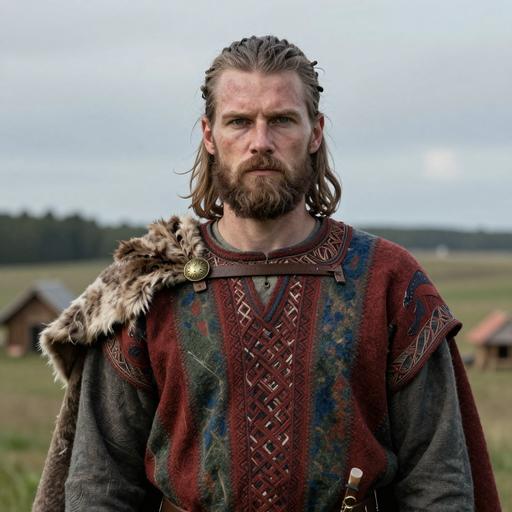
Portrait reconstruction of VK359
Ancient Individual

A man buried in Sweden in the Middle Ages era

VK359
700 CE - 800 CE
Male
Early Viking Age Sweden
Sweden
Scroll to begin
Chapter I

Identity

The biological and cultural markers that define this ancient individual

Sample ID

VK359

Date Range

700 CE - 800 CE

Biological Sex

Male

mtDNA Haplogroup

H1f-a

Y-DNA Haplogroup

CT

Cultural Period

Early Viking Age Sweden

Chapter II

Place

Where this individual was discovered

Country Sweden
Locality Oland
Coordinates 57.3501, 17.0758
Chapter III

Time

When this individual lived in the broader context of human history

VK359 700 CE - 800 CE
Chapter IV

Story

The narrative of this ancient life

The Early Viking Age in Sweden, part of the broader Norse cultural panorama, is a fascinating period marked by significant societal, economic, and cultural transformations. The Viking Age is generally dated from the late 8th century to the early 11th century. In Sweden, the early part of this era is characterized by the formation of distinct Norse socio-political structures, maritime advancements, and a rich tapestry of mythology and religion.

Society and Social Structure: Swedish society during the Early Viking Age was primarily organized into small, kin-based communities led by local chieftains. These chieftains were powerful figures who wielded both military and religious authority within their regions. Society was broadly divided into three main classes: Jarls, Karls, and Thralls. Jarls were the noble class, possessing wealth and land, and were often the leaders of raids and expeditions. Karls were free men, typically farmers, skilled craftsmen, and traders. Thralls were slaves, who had limited rights and primarily worked the land or served in households, often captured during raids.

Economy: The economy of Early Viking Age Sweden was predominantly agricultural, with communities engaged in farming, animal husbandry, and fishing. However, trade also played a crucial role. Swedes were known for their extensive trade networks, stretching across the Baltic Sea and into Eastern Europe, notably establishing trade routes along the rivers leading to the Byzantine Empire and the Middle East. They traded furs, iron, and timber, for silver, silk, spices, and other luxury goods. Significant archaeological finds, such as those at Birka, an important trading center near modern-day Stockholm, illustrate the extensive reach and influence of Swedish Viking traders.

Maritime Culture and Raiding: The Vikings are perhaps best known for their seafaring skills. Early Viking Age Swedes were expert shipbuilders and navigators, creating the iconic longships that enabled them to traverse vast distances. These vessels were not only used for trade but also for raiding and exploration. Swedish Vikings, often referred to as the \Rus," traveled eastwards and are credited with founding early Russian principalities. Their forays into the rivers and lakes of Eastern Europe led to the establishment of strategic trade posts and settlements.

Religion and Mythology: Religion during this period was strongly tied to Norse mythology, a polytheistic belief system centered around a pantheon of gods and goddesses like Odin, Thor, and Freyja. These deities were believed to influence all aspects of life, from harvests to warfare. Religious practices involved rituals, sacrifices, and assemblies at places of worship such as groves, springs, and specially constructed temples. The Vikings also held festivals to honor their gods and believed in a complex afterlife, with realms such as Valhalla and Helheim playing key roles in their cosmology.

Material Culture and Artistry: Swedish Vikings are renowned for their artistic achievements, which included intricate metalwork, detailed wood carvings, and rune stones—large memorial stones etched with runic inscriptions. The art often depicted scenes from Norse myths, daily life, and the natural environment, frequently incorporating intricate animal motifs and interlaced patterns.

Political Organization: The early Viking Age saw the emergence of organized political entities known as "things," assemblies that served as judicial and legislative bodies. Community leaders or chieftains would convene these gatherings to settle disputes and make collective decisions. Over time, these assemblies played a formative role in the development of more centralized political structures.

In conclusion, Early Viking Age Sweden was a vibrant society characterized by its maritime prowess, expansive trade networks, and rich cultural heritage. The era laid the foundations for the later unification of Sweden and integration into the Christianized Europe, marking a pivotal chapter in the history of Scandinavia."

Chapter V

Genetics

The genetic ancestry of this ancient individual

Ancient Genetic Admixture

This analysis compares the DNA profile of VK359 with ancient reference populations, showing the genetic composition in terms of prehistoric ancestral groups.

European Hunter-Gatherers 39.2%
Western Steppe Pastoralists 26.9%
Ancient Oceanians 23.8%
Neolithic Farmers 10.1%

Modern Genetic Admixture

This analysis compares the DNA profile with present-day reference populations, showing what percentage of genetic makeup resembles modern populations from different regions.

Europe 93.5%
Northwestern European 67.5%
Finnish 67.5%
Eastern European 25.9%
America 5.0%
America 5.0%
Native American 5.0%
Asia 1.6%
Northern Asian 1.6%
Mongolian 1.6%

Closest Modern Populations

These are the modern populations showing the closest statistical alignment to A man buried in Sweden in the Middle Ages era, ranked by genetic distance. Lower distance values indicate closer statistical similarity.

1
Ukrainian Zakarpattia
3.1437
2
Moldovan O
3.3872
3
Hungarian
3.3904
4
Ukrainian Lviv
3.5530
5
Czech
3.6782
6
Croatian
3.6814
7
Slovenian
3.7757
8
Moldovan
3.9050
9
Austrian
4.1284
10
Ukrainian Dnipro
4.1727
Chapter VI

Context

Other ancient individuals connected to this sample

Sources

References

Scientific publications and genetic data

Scientific Publication

Population genomics of the Viking world

Authors Margaryan A, Lawson DJ, Sikora M
Abstract

The maritime expansion of Scandinavian populations during the Viking Age (about AD 750-1050) was a far-flung transformation in world history1,2. Here we sequenced the genomes of 442 humans from archaeological sites across Europe and Greenland (to a median depth of about 1×) to understand the global influence of this expansion. We find the Viking period involved gene flow into Scandinavia from the south and east. We observe genetic structure within Scandinavia, with diversity hotspots in the south and restricted gene flow within Scandinavia. We find evidence for a major influx of Danish ancestry into England; a Swedish influx into the Baltic; and Norwegian influx into Ireland, Iceland and Greenland. Additionally, we see substantial ancestry from elsewhere in Europe entering Scandinavia during the Viking Age. Our ancient DNA analysis also revealed that a Viking expedition included close family members. By comparing with modern populations, we find that pigmentation-associated loci have undergone strong population differentiation during the past millennium, and trace positively selected loci-including the lactase-persistence allele of LCT and alleles of ANKA that are associated with the immune response-in detail. We conclude that the Viking diaspora was characterized by substantial transregional engagement: distinct populations influenced the genomic makeup of different regions of Europe, and Scandinavia experienced increased contact with the rest of the continent.

G25 Coordinates

The G25 coordinates for sample VK359 can be used for detailed admixture analysis in our G25 Studio tool.

VK359,0.1253975,0.10677194,0.05291648,0.03867772,0.02346656,0.0174712,0.00910222,0.0113839,-0.00479198,-0.01189264,-0.00551416,-5.726E-05,0.00216754,0.01756034,-0.00038938,-0.00151954,-0.00315498,-0.00165496,0.00367328,0.0061635,0.0034815,-0.00019302,0.0049917,-0.00457532,-0.00113067
Analyze in G25 Studio
Use code for 40% off Expires Feb 26