Menu
Store
Blog
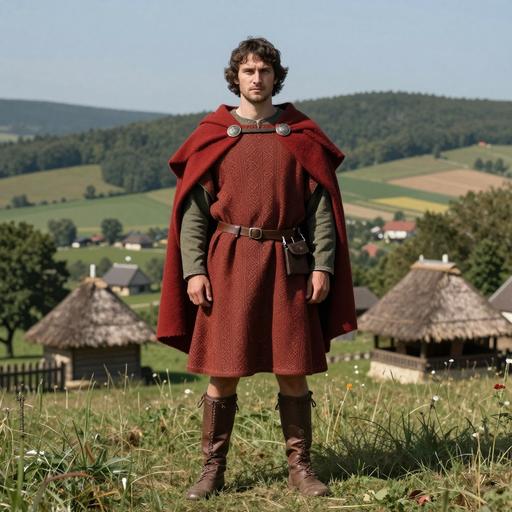
Portrait reconstruction of VPB-279
Ancient Individual

A man buried in Hungary in the Middle Ages era

VPB-279
800 CE - 900 CE
Male
Carolingian Hungary
Hungary
Scroll to begin
Chapter I

Identity

The biological and cultural markers that define this ancient individual

Sample ID

VPB-279

Date Range

800 CE - 900 CE

Biological Sex

Male

mtDNA Haplogroup

U2e1a1

Y-DNA Haplogroup

Not available

Cultural Period

Carolingian Hungary

Chapter II

Place

Where this individual was discovered

Country Hungary
Locality Somogy County. Vörs-Papkert-B
Coordinates 46.8003, 17.3095
Chapter III

Time

When this individual lived in the broader context of human history

VPB-279 800 CE - 900 CE
Chapter IV

Story

The narrative of this ancient life

The period from 800 to 900 CE, often referred to as the \Carolingian Hungary" era, represents a fascinating intersection of political transformations, cultural exchanges, and military endeavors in Central Europe within the broader context of the Carolingian Empire. While Hungary as a distinct entity did not exist during this era, the lands that would eventually comprise Hungary were influenced by the expansion and policies of the Carolingian Empire. The period is nested within the larger Carolingian Renaissance—a revival of art, culture, and scholarship supported by the rulers of the Carolingian dynasty.

Historical Context

The Carolingian Dynasty, founded by Charles Martel and reaching its zenith under Charlemagne, sought to consolidate power over large parts of Western and Central Europe. This included regions inhabited by Avars, Slavs, and other groups. By 800 CE, under Charlemagne's reign, the influence of the Carolingian Empire expanded into Central European territories through military conquests, alliances, and religious missions.

Political Influence in Central Europe

The Frontier of Carolingian Power

Carolingian Hungary is a term that reflects the empire's influence on the region, rather than governance over a defined Hungarian state. The territories were part of the eastern frontier of the empire, and their political landscape was marked by a complex network of alliances and hostilities among various tribes and the Carolingians.

Campaigns Against the Avars

Charlemagne's campaigns against the Avars, a nomadic group that had established a significant presence in the Carpathian Basin, were crucial in this era. Going as far back as the late 8th century, these military efforts culminated in the collapse of the Avar Khaganate, allowing the Carolingians to extend their influence over the region and facilitating the introduction of Christianity.

The Role of Christianity

One of the major tools of Carolingian policy was the spread of Christianity, which served both spiritual and political purposes. By converting the local populace and establishing bishoprics and monastic communities, the Carolingians facilitated the integration of these lands into the broader Christian and Carolingian cultural sphere.

Carolingian Culture

The Carolingian Renaissance

This period is noted for the Carolingian Renaissance, a revival of learning, art, and architecture. The Carolingian leaders implemented educational reforms and promoted the liberal arts, leading to the establishment of schools, scriptoria, and an emphasis on manuscript production. Important figures like Alcuin of York were part of Charlemagne's court, advancing theological studies and classical learning.

Art and Architecture

Carolingian art was heavily influenced by Roman and Byzantine traditions but exhibited unique characteristics such as intricate metalwork, manuscript illumination, and the Carolingian minuscule script, which would have a long-lasting impact on European literacy and book production. Architecture during this period saw a revival of Roman architectural forms with innovations that would influence Romanesque styles, visible in monasteries and churches in the empire.

Linguistic Impact

Latin remained the lingua franca, but the Empire's expansion facilitated interaction among diverse linguistic and cultural groups, laying the groundwork for the development of regional languages and dialects.

Society and Economy

Feudal Structures

The era was characterized by the early developments of feudalism, with the complex hierarchy of lords and vassals emerging as a central feature of social organization. Land was granted by the Carolingian rulers to loyal followers, fostering military allegiance and local governance.

Agricultural Advancements

Agriculture saw incremental innovations, such as the three-field system, and improved plowing techniques which helped sustain the growing population and the empire's economic base.

Trade and Commerce

Though the Carolingian economy was predominantly agrarian, trade networks extended across Europe, facilitated by Carolingian coinage and infrastructure improvements such as roads and bridges.

Conclusion

The period of 800-900 CE under Carolingian influence in lands that would later be known as Hungary illustrates the complexity of early medieval European history, marked by military conquests, the spread of Christianity, and the vibrant cultural renaissance. While Hungary as a nation-state did not yet exist, the groundwork laid during this era—politically, culturally, and religiously—would influence the development of Central Europe in the centuries that followed."

Chapter V

Genetics

The genetic ancestry of this ancient individual

Ancient Genetic Admixture

This analysis compares the DNA profile of VPB-279 with ancient reference populations, showing the genetic composition in terms of prehistoric ancestral groups.

Neolithic Farmers 52.9%
European Hunter-Gatherers 38.5%
Western Steppe Pastoralists 3.0%
Ancient Asians 2.9%
Ancient Native Americans 2.8%

Modern Genetic Admixture

This analysis compares the DNA profile with present-day reference populations, showing what percentage of genetic makeup resembles modern populations from different regions.

Europe 75.2%
Southern European 55.6%
Balkan 35.5%
Iberian 14.8%
Sardinian 5.3%
Northwestern European 19.6%
English 17.7%
Northwestern European 1.9%
Asia 24.8%
Northern West Asian 17.6%
Mesopotamian 12.2%
Anatolian 5.4%
Central Asian, Northern Indian & Pakistani 6.8%
Indian 6.8%

Closest Modern Populations

These are the modern populations showing the closest statistical alignment to A man buried in Hungary in the Middle Ages era, ranked by genetic distance. Lower distance values indicate closer statistical similarity.

1
Gagauz
2.3643
2
Rumelia East
2.9005
3
Bulgarian
3.2062
4
Greek Macedonia
3.3472
5
Greek Central Macedonia
3.3704
6
Turkish Deliorman
3.4201
7
Greek West Taygetos
3.4752
8
Greek Thessaly
3.5087
9
Greek East Macedonia And Thrace
3.6153
10
Greek Messenia
3.8487
Chapter VI

Context

Other ancient individuals connected to this sample

Sources

References

Scientific publications and genetic data

Scientific Publication

The genetic origin of Huns, Avars, and conquering Hungarians

Authors Maróti Z, Neparáczki E, Schütz O
Abstract

Huns, Avars, and conquering Hungarians were migration-period nomadic tribal confederations that arrived in three successive waves in the Carpathian Basin between the 5th and 9th centuries. Based on the historical data, each of these groups are thought to have arrived from Asia, although their exact origin and relation to other ancient and modern populations have been debated. Recently, hundreds of ancient genomes were analyzed from Central Asia, Mongolia, and China, from which we aimed to identify putative source populations for the above-mentioned groups. In this study, we have sequenced 9 Hun, 143 Avar, and 113 Hungarian conquest period samples and identified three core populations, representing immigrants from each period with no recent European ancestry. Our results reveal that this "immigrant core" of both Huns and Avars likely originated in present day Mongolia, and their origin can be traced back to Xiongnus (Asian Huns), as suggested by several historians. On the other hand, the "immigrant core" of the conquering Hungarians derived from an earlier admixture of Mansis, early Sarmatians, and descendants of late Xiongnus. We have also shown that a common "proto-Ugric" gene pool appeared in the Bronze Age from the admixture of Mezhovskaya and Nganasan people, supporting genetic and linguistic data. In addition, we detected shared Hun-related ancestry in numerous Avar and Hungarian conquest period genetic outliers, indicating a genetic link between these successive nomadic groups. Aside from the immigrant core groups, we identified that the majority of the individuals from each period were local residents harboring "native European" ancestry.

G25 Coordinates

The G25 coordinates for sample VPB-279 can be used for detailed admixture analysis in our G25 Studio tool.

VPB-279,0.11660694,0.12872268,0.0140756,-0.00445226,0.01061866,-0.00054936,0.0049604,0.00146048,-0.01070144,0.00386342,-0.0024729,0.00470088,-0.00944998,0.00382766,-0.00311352,-0.00228128,0.0066779,-0.00066458,-0.00031542,0.00117256,0.00083004,4.522E-05,0.00091974,-0.00407736,-0.00066474
Analyze in G25 Studio
Use code for 40% off Expires Feb 27