Menu
Store
Blog
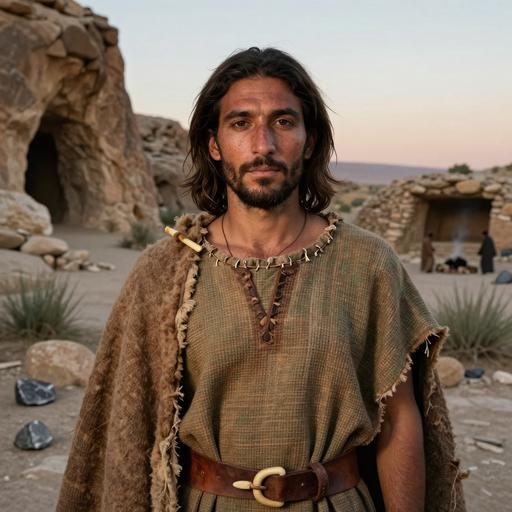
Portrait reconstruction of WC1
Ancient Individual

A man buried in Iran in the Neolithic era

WC1
7461 BCE - 7076 BCE
Male
Neolithic Wezmeh Cave, Iran
Iran
Scroll to begin
Chapter I

Identity

The biological and cultural markers that define this ancient individual

Sample ID

WC1

Date Range

7461 BCE - 7076 BCE

Biological Sex

Male

mtDNA Haplogroup

J1d6*

Y-DNA Haplogroup

G-Z8022

Cultural Period

Neolithic Wezmeh Cave, Iran

Chapter II

Place

Where this individual was discovered

Country Iran
Locality Wezmeh Cave. Central Zagros
Coordinates 34.6129, 47.1057
Chapter III

Time

When this individual lived in the broader context of human history

WC1 7461 BCE - 7076 BCE
Chapter IV

Story

The narrative of this ancient life

The Neolithic era, particularly in regions like the Zagros Mountains of Iran, marks a significant period in human prehistory known for the transition from nomadic hunter-gatherer communities to settled agricultural societies. Wezmeh Cave, located in this mountainous region, provides significant insights into this transformative period during the Zagros Neolithic era.

Geographic and Environmental Context

Wezmeh Cave is situated in the rugged Zagros Mountains, a prominent range in western Iran. This region is characterized by its diverse topography, including high peaks, deep valleys, and fertile plains. The climate during the early Neolithic period would have been relatively mild compared to today, supporting a variety of flora and fauna that were crucial to the subsistence strategies of early human inhabitants.

Archaeological Significance

Wezmeh Cave is an important archaeological site that has yielded numerous artifacts and remains from the Neolithic era. The findings from the cave contribute to understanding the broader Zagros Neolithic culture, highlighting the ways in which early humans adapted to their environment and transitioned toward sedentism.

Cultural and Societal Developments

  1. Subsistence Strategies:

    • Domestication of Plants and Animals: Evidence from Wezmeh Cave suggests early forms of agriculture. Cereals like wheat and barley, alongside legumes, were among the first domesticated plants. The domestication of animals, including goats and sheep, marked a crucial development in food production.
    • Hunting and Gathering: Despite the advancing agricultural practices, hunting of wild animals and gathering of plant resources continued to play a significant role. This dual strategy allowed for a more reliable food source as communities adjusted to new modes of subsistence.
  2. Tools and Technology:

    • The inhabitants of the Wezmeh Cave used a variety of lithic tools. These tools were essential for both agricultural activities and hunting.
    • Pottery shards found in the cave indicate the early development of ceramic technology, which was important for food storage and cooking.
  3. Societal Structures:

    • Settlements: While the cave itself would have primarily served as a seasonal shelter or for specific activities, evidence points towards more permanent settlements developing in the surrounding areas.
    • Social Organization: The gradual rise in sedentism likely led to changes in societal organization, with indications of more complex social structures emerging, including division of labor and possibly the beginnings of social hierarchies.
  4. Symbolic and Ritual Practices:

    • Findings such as figurines and burial artifacts suggest that the Zagros Neolithic communities, including those at Wezmeh Cave, engaged in ritualistic and symbolic practices. These artifacts provide insights into the spiritual and cultural lives of the inhabitants.

Interactions and Influence

The Zagros Neolithic culture, as evidenced by sites like Wezmeh Cave, was not isolated. It played a part in a broader network of interactions across the Neolithic world. There is evidence of trade and cultural exchange, which facilitated the dissemination of technological innovations and agricultural practices.

Conclusion

The study of Wezmeh Cave offers valuable insights into the Neolithic period in the Zagros region. It highlights significant cultural and technological transformations that defined early human societies' shift towards agriculture and sedentism. The archaeological record from the cave underscores the complexity and adaptability of human populations in ancient Iran, illustrating a pivotal era that laid the foundations for future civilizations in the region.

Chapter V

Genetics

The genetic ancestry of this ancient individual

Ancient Genetic Admixture

This analysis compares the DNA profile of WC1 with ancient reference populations, showing the genetic composition in terms of prehistoric ancestral groups.

Neolithic Farmers 75.8%
Ancient Asians 18.7%
Ancient Africans 3.0%
European Hunter-Gatherers 2.5%

Modern Genetic Admixture

This analysis compares the DNA profile with present-day reference populations, showing what percentage of genetic makeup resembles modern populations from different regions.

Asia 98.8%
Central Asian, Northern Indian & Pakistani 64.5%
Pakistan 42.9%
Indian 21.7%
Northern West Asian 33.1%
Mesopotamian 33.0%
Arab, Egyptian & Levantine 1.2%
Arabian 1.2%
Africa 1.2%
West African 0.7%
Nigerian 0.7%
Congolese & Southern East African 0.6%
South East African 0.6%

Closest Modern Populations

These are the modern populations showing the closest statistical alignment to A man buried in Iran in the Neolithic era, ranked by genetic distance. Lower distance values indicate closer statistical similarity.

1
Iranian Persian Khorasan
3.4955
2
Parsi Pakistan
3.9651
3
Iranian Mazandarani O
4.0050
4
Parsi India
4.1065
5
Iranian Persian Shiraz
4.3337
6
Iranian Mazandarani
4.3763
7
Irani Zoroastrian India
4.4484
8
Iranian Central
4.5887
9
Iranian Persian Yazd
4.6144
10
Turkmen O
4.6847
Chapter VI

Context

Other ancient individuals connected to this sample

Sources

References

Scientific publications and genetic data

Scientific Publication

Early Neolithic genomes from the eastern Fertile Crescent

Authors Broushaki F, Thomas MG, Link V
Abstract

We sequenced Early Neolithic genomes from the Zagros region of Iran (eastern Fertile Crescent), where some of the earliest evidence for farming is found, and identify a previously uncharacterized population that is neither ancestral to the first European farmers nor has contributed substantially to the ancestry of modern Europeans. These people are estimated to have separated from Early Neolithic farmers in Anatolia some 46,000 to 77,000 years ago and show affinities to modern-day Pakistani and Afghan populations, but particularly to Iranian Zoroastrians. We conclude that multiple, genetically differentiated hunter-gatherer populations adopted farming in southwestern Asia, that components of pre-Neolithic population structure were preserved as farming spread into neighboring regions, and that the Zagros region was the cradle of eastward expansion.

G25 Coordinates

The G25 coordinates for sample WC1 can be used for detailed admixture analysis in our G25 Studio tool.

WC1,0.0858307,0.07660176,-0.08155744,-0.00636534,-0.05471086,0.00643844,0.00684274,-0.00184086,-0.0328244,-0.013833,-0.0012041,0.0023045,-0.00703222,0.00107766,0.00681916,0.00012212,0.00961058,-0.00177626,-0.00295236,-0.00013096,0.00734542,-0.00348734,0.00353618,-0.0099494,-0.00092938
Analyze in G25 Studio
Use code for 40% off Expires Feb 27