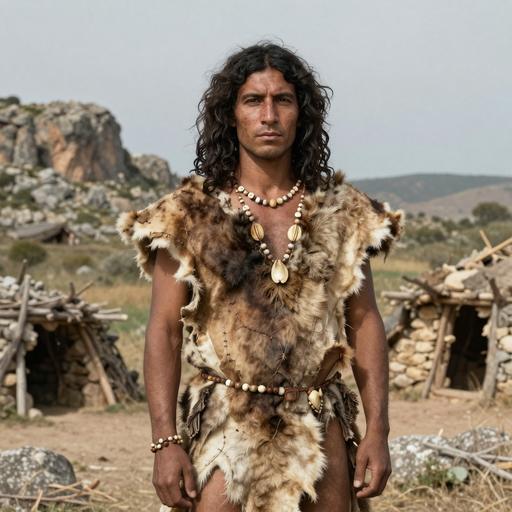
The Upper Paleolithic Azilian culture, named after the site of Mas d’Azil in the French Pyrenees but extending into parts of Spain, represents a fascinating and complex era of European prehistory associated with the later stages of the Paleolithic period, approximately 12,000 to 9,500 years ago. This culture is situated in a transitional phase that links the Paleolithic hunter-gatherer societies to the more settled, agrarian Neolithic communities.
Environmental Context
During the Azilian period, Europe was undergoing significant climatic changes. This era followed the Last Glacial Maximum and coincided with a warming climate and the retreat of ice sheets. As the environment became more temperate, the landscapes of Spain transformed significantly. Forests of pine and birch started to dominate areas previously covered by tundra, creating rich ecosystems potentially brimming with wildlife, such as deer, wild boars, and smaller mammals, as well as a variety of plant resources.
Cultural Characteristics
The Azilian culture marks the tail end of the Upper Paleolithic and the beginning of the Mesolithic in some regions, characterized by adaptation to post-glacial environments. It is distinguished by its simplified tool technology compared to the preceding Magdalenian culture. Typical Azilian artifacts include:
- Microliths: Small, often geometric microliths are a hallmark of this culture. These were used as barbs and points for arrows or spears, reflecting advancements in hunting tools.
- Bone and Antler Tools: Though these became less elaborate than those of the Magdalenian era, bone implements, including awls and spatulas, continued in use.
- Painted Pebbles: Perhaps one of the most iconic aspects of Azilian culture is the presence of painted pebbles. These small stones, usually with simple geometric or linear patterns drawn in red pigment, suggest symbolic or artistic expression, though their exact purpose remains a subject of debate.
Social Organization and Lifestyle
As hunter-gatherers, the Azilians were presumably organized in small, mobile bands. With the changing climate, they likely followed seasonal migrations of game and adjusted their subsistence strategies to incorporate a broader spectrum of resources, including fishing and foraging for plant foods.
The Azilian sites in Spain, including areas like northern Iberia and the Cantabrian region, often reveal evidence of open-air camps and rock shelters rather than the deep cave habitation seen in earlier periods. These settlements could indicate a degree of sedentism, as the stable climates and resource-rich environments permitted longer stays in favorable locations.
Artistic and Symbolic Expression
While the iconic cave paintings of earlier periods, such as those at Altamira, became less frequent during the Azilian era, art did not vanish. The painted pebbles indicate a continuity of symbolic thought and possibly communication or social cohesion expressions. Additionally, these artifacts could have been included in ritualistic or communal activities.
Burial Practices
Evidence for Azilian burial customs is scant, but it suggests less elaborate burials than in some earlier cultures, with few grave goods. However, this might indicate a change in belief systems or social structures.
Technological and Cultural Legacy
The Azilian culture represents a bridge between the Paleolithic and Mesolithic ways of life. As an adaptation to post-glacial environments, it laid down patterns that would inform subsequent European cultures' social and technological developments. This era encompasses the last expressions of a society reliant on hunting, gathering, and fishing before the dawn of agriculture that characterized the Neolithic Revolution.
In summary, the Azilian culture in Spain characterizes a people adept at adapting to a rapidly changing world, carrying forward the legacy of artistic expression, yet simplifying their technological toolkit in response to a new climate and ecological context. Their mark on the archaeological record, though less grandiose than some predecessors, provides critical insight into the resilience and creativity of human societies transitioning through dramatic environmental transformations.