Bot17 - A man buried in Brazil in the Colonial Era North America era

Download PDF creates a visual, rasterized copy. Use Print for selectable text and better assistive-technology support.

Menu
Currency
Main
Store
Blog

Loading Report

Preparing your ancestry journey

Connecting to ancient matches...

Preparing your report

Skip to main content
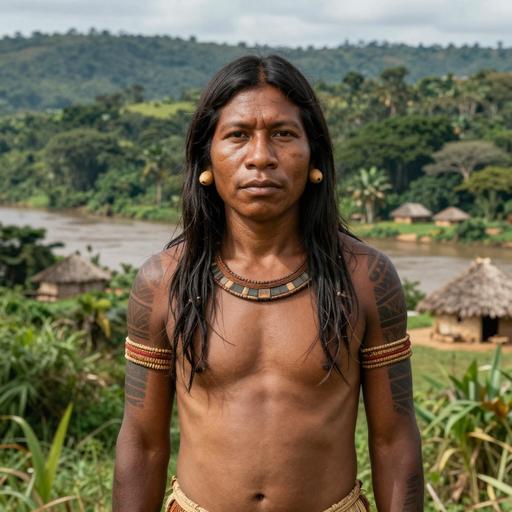
Portrait reconstruction of A man buried in Brazil in the Colonial Era North America era
Ancient Individual

A man buried in Brazil in the Colonial Era North America era

A man buried in Brazil during the Botocudo People, Brazil

A fragment of the ancient world, preserved across millennia in strands of DNA.

Bot17
1496 CE - 1842 CE
Male
Brazil
Scroll to begin
Chapter I

Identity

The biological and cultural markers that define this ancient individual

Sample ID

Bot17

Date Range

1496 CE - 1842 CE

Cultural Period

Botocudo People, Brazil

Biological Sex

Male

mtDNA Haplogroup

Not available

Y-DNA Haplogroup

C-M208

Social Role

Hunter (AI estimate, era-typical)

Chapter II

Place

Where this individual was discovered

Country Brazil
Locality Rio Doce Valley
Chapter III

Time

When this individual lived in the broader context of human history

Bot17 1496 CE - 1842 CE
Chapter IV

Story

The narrative of this ancient life

“Botocudo” is an ethnographic label used for Indigenous groups in parts of Brazil, often described in relation to their distinct material practices and experiences during periods of colonial contact. Archaeologically, this era is approached cautiously through broad regional patterns rather than as a single, directly dated culture.

Region & Environment

The region associated with Botocudo accounts spans areas of southern and southeastern Brazil, including forested landscapes, river valleys, and environments that supported diverse hunting, fishing, and foraging. Ecological variability shaped settlement choices and seasonal movement strategies.

Historical Context

From the early modern period onward, colonial expansion in Brazil intensified contact, conflict, and exchange. Indigenous groups across the interior confronted pressures that affected mobility, subsistence, and long-term cultural continuity—factors that can complicate archaeological interpretation.

Populations & Lifeways

Botocudo lifeways are typically described (ethnographically) as involving hunting, gathering, and shifting patterns of settlement tied to local resources. The production and use of durable everyday items, and the management of tools for daily work, were central to maintaining subsistence in forest environments.

Archaeology & Material Culture

Archaeological correlates are generally inferred through regional assemblages: stone and bone tools, woodworking implements where detectable, and patterns of site use consistent with mobile or semi-mobile foraging. Distinctive personal adornments and technologies mentioned in ethnographic sources cannot always be securely tracked archaeologically, so interpretations often remain at the level of broad subsistence and craft practice.

Culture & Society

Social life among Indigenous Brazilian groups was organized around kinship ties, cooperation in subsistence, and knowledge transmission. Material culture—especially tools used for hunting and processing resources—was integral to daily roles and group identity.

Legacy & Transition

The late 19th century represents a major turning point in many Indigenous communities in Brazil due to sustained colonial and post-colonial pressures. While archaeology preserves evidence for long-standing lifeways, connecting specific modern-labeled groups to precise archaeological phases requires careful, conservative interpretation.

Chapter V

Genetics

These comparisons show genetic similarity, not identity or origin. The populations listed are those whose genomes show statistical alignment to this ancient individual.

Similarity reflects shared history, not shared identity. These are analytical comparisons, not claims about who this person was.

Modern Genetic Admixture

This analysis compares the DNA profile with present-day reference populations, showing statistical similarity to modern reference populations from different regions. The excavation site records where this individual was found, not a fixed modern genetic identity.

Asia 70.1%
Chinese & Southeast Asian 66.7%
Chinese 46.6%
Vietnamese 20.1%
Japanese & Korean 3.2%
Japanese 3.2%
Oceania 26.9%
Melanesian 26.9%
Papuan 26.9%
Africa 1.4%
North African 1.1%
North African 1.1%
America 0.9%
America 0.9%
Native American 0.9%
Europe 0.6%
Northwestern European 0.6%
Finnish 0.6%

Closest Modern Populations

These are the modern populations showing the closest statistical alignment to A man buried in Brazil in the Colonial Era North America era, ranked by genetic distance. Lower distance values indicate closer statistical similarity. Cross-region similarity can reflect shared ancestry, population movement, continuity, or later admixture.

1
Bajo
7.3782
2
Batak
11.3629
3
Aeta
12.0252
4
Agta
12.5558
5
Thai
14.7609
6
Mon
14.8818
7
Malay
14.9751
8
Vizayan
15.2290
9
Maniq
15.3039
10
Cambodian
15.6262
Context

Related Samples

This individual exists within a broader network of ancient samples. No ancient genome stands alone.

Sample ID Culture/Period Date Location Action
Botocudo15 Botocudo People, Brazil 1479 CE Rio Doce Valley, Brazil View
Botocudo15.SG Botocudo People, Brazil 1479 CE Rio Doce Valley, Brazil View
Bot17 Botocudo People, Brazil 1496 CE Rio Doce Valley, Brazil View
Bot17 1496 CE Rio Doce Valley, Brazil View
Botocudo15.SG 1479 CE Rio Doce Valley, Brazil View
Sample ID Culture/Period Date Location Action
Botocudo15 Botocudo People, Brazil 1479 CE Rio Doce Valley, Brazil View
Botocudo15.SG Botocudo People, Brazil 1479 CE Rio Doce Valley, Brazil View
Bot17 Botocudo People, Brazil 1496 CE Rio Doce Valley, Brazil View
Sources

References

Scientific publications and genetic data that inform this profile.

Scientific Publication

Two ancient human genomes reveal Polynesian ancestry among the indigenous Botocudos of Brazil

Authors Malaspinas AS, Lao O, Schroeder H, Rasmussen M, Raghavan M et al.
Abstract

Understanding the peopling of the Americas remains an important and challenging question. Here, we present (14)C dates, and morphological, isotopic and genomic sequence data from two human skulls from the state of Minas Gerais, Brazil, part of one of the indigenous groups known as 'Botocudos'. We find that their genomic ancestry is Polynesian, with no detectable Native American component. Radiocarbon analysis of the skulls shows that the individuals had died prior to the beginning of the 19th century. Our findings could either represent genomic evidence of Polynesians reaching South America during their Pacific expansion, or European-mediated transport.

G25 Coordinates

These coordinates represent a position in genetic space, a tool for comparison, not a conclusion. You can use these to perform custom admixture analysis in G25 Studio.

Bot17,-0.00017118,-0.38362056,-0.09675248,0.027268,0.13314946,-0.06648512,-0.00511904,-0.00677988,-0.0221671,-0.0115266,0.0093383,0.00250002,0.001847,-0.00654148,0.00239,0.00196896,0.00589532,-0.00337368,-0.00143648,-0.00846584,0.00852674,0.0068965,0.01037218,0.00356218,0.00566359
Continue in G25 Studio
Use code for 35% off Expires Aug 11